Photography Pricing Guide: How to Price Your Work Profitably
How photographers should price their services — covering cost-plus foundations, time multipliers, pricing models, rate benchmarks by specialty, and licensing fees.
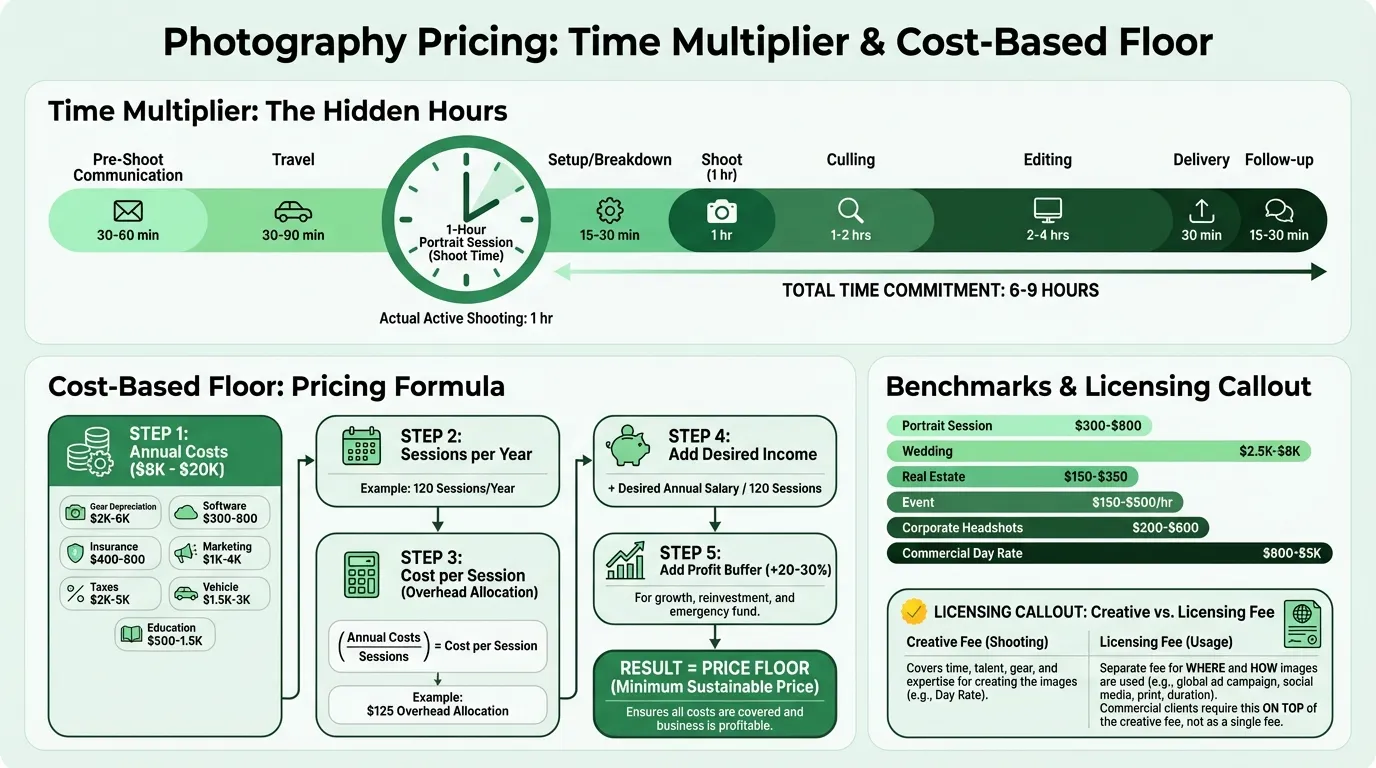
Most photographers price based on what feels comfortable — what a client will say yes to, what a competitor charges, or what they'd personally be willing to pay. The math almost never enters the picture.
The result: photographers who are busy but not profitable, working more sessions each year to stay in place while undercharging on every one of them.
Pricing photography correctly starts with a single reframe: you're not selling an hour of your time. You're running a business that happens to involve a camera.
The Time Multiplier Problem
Before building any pricing structure, you need to know how long a job actually takes.
Most photographers count the shoot. A one-hour portrait session is one hour of work — so $200 per hour means $200 for that session. But count every hour the client's job actually consumes:
- Pre-shoot communication and scheduling: 30–60 minutes
- Travel to and from location: 30–90 minutes
- Setup and breakdown: 15–30 minutes
- The shoot itself: 1 hour
- Culling and selecting images: 1–2 hours
- Editing and retouching: 2–4 hours
- Exporting, uploading, and delivery: 30 minutes
- Follow-up and gallery management: 15–30 minutes
A one-hour portrait session commonly consumes 6–9 hours of total time. A two-hour wedding ceremony turns into a 12–14 hour workday when travel, a full reception, culling hundreds of frames, and hours of editing are included.
Photographers who price only for shooting time are quoting 20–30% of the job. The rest is free labor. This is the single most common reason otherwise talented photographers fail to build financially sustainable businesses.
Before you quote anything, calculate total hours per session type in your actual workflow. That number — not the shooting time — is what your pricing needs to cover.
Building a Cost-Based Price Floor
The goal of cost-plus pricing is to find the floor: the minimum you can charge without losing money. You layer market positioning on top. But without the floor, you're guessing.
Step 1: Calculate annual business costs
Add up every cost of running your photography business for a year:
| Cost Category | Examples |
|---|---|
| Gear depreciation | Camera bodies, lenses, lighting (cost ÷ years of expected use) |
| Software subscriptions | Adobe CC, Lightroom presets, delivery platforms, CRM, backup storage |
| Insurance | Equipment floater, general liability |
| Marketing | Website hosting, paid ads, styled shoots, professional memberships |
| Taxes | Self-employment tax (15.3% of net profit), estimated quarterly payments |
| Vehicle | Mileage (IRS standard rate: $0.70/mile in 2025), parking, tolls |
| Education | Workshops, conferences, courses |
| Admin time | Bookkeeping, contracts, client communication |
For a working freelance photographer, annual business costs commonly run $8,000–$20,000 before paying yourself anything.
Step 2: Calculate total sessions per year
Be honest about capacity. If you want to shoot 80 portrait sessions and 10 weddings per year, count actual available weekends, your editing turnaround time, and how many shoots you can sustain without burning out.
Step 3: Allocate costs per session
Divide annual overhead by total shoot count to find overhead per session. If you have $15,000 in annual costs and shoot 120 total sessions, each session needs to recover $125 in overhead before profit.
Step 4: Add your income
Decide what annual income you need. After subtracting costs and accounting for self-employment taxes, what does your hourly rate need to be to hit that income? Multiply by total hours per session type (from the time multiplier calculation above).
Step 5: Add profit
Pricing educators consistently recommend building in 20–30% above break-even. This covers equipment replacement cycles, slow seasons, unexpected costs, and growth.
The total — costs + income + profit — is your price floor. Anything below that rate means you're subsidizing your clients' photography budget. The photography break-even calculator runs this calculation for you with your actual cost inputs.
Pricing Models and When to Use Each
Session/flat rate is the most common structure for portrait and family photography. You charge a single fee for the shoot; digital images may be included or priced separately. It works because scope is predictable and clients know exactly what they'll spend.
Package pricing bundles coverage time, image count, and add-ons (albums, prints, second shooters) into tiered options. Wedding photography almost universally uses packages. Packages create upsell opportunities and allow clients to self-select by budget — but every package tier needs the same rigorous cost analysis. A $2,500 package that requires 20 hours of your time is not necessarily more profitable than a $1,500 package that requires 8.
Hourly billing works for event and corporate photography where the scope isn't fixed upfront. Charge a minimum (typically 2–3 hours) to cover travel and setup costs even on short bookings.
Day rates are standard for commercial photography. A day rate (typically $800–$5,000+ depending on specialty and market) covers the shooting day. Usage licensing is charged separately.
Retainers — recurring monthly fees for ongoing clients like real estate agencies, restaurants, or brands — trade top-end income for predictable revenue. Useful once you've established a reliable client relationship and know exactly what a given client's volume requires.
Rate Benchmarks by Photography Specialty
These are US national ranges from aggregated market data. Actual rates vary significantly by market — photographers in major metro areas typically charge 20–50% above these benchmarks.
| Specialty | Typical Rate Range |
|---|---|
| Portrait session (1 hr, ~15 images) | $300–$800 |
| Mini session (30 min, 5 images) | $150–$350 |
| Wedding photography (full day) | $2,500–$8,000 |
| Real estate (standard MLS package) | $150–$350 per property |
| Event photography | $150–$500/hour |
| Corporate headshots | $200–$600 per session |
| Commercial/product (day rate) | $800–$5,000 |
Real estate photography has the most granular public data. The national average for a standard residential shoot (10–25 MLS photos) is approximately $230. City-level benchmarks: Los Angeles ~$318, New York/Seattle ~$285, Phoenix ~$208. Properties marketed with aerial photography reportedly sell faster on average than those without — which is why twilight sessions and drone add-ons command a premium in competitive markets.
Wedding photography ranges more widely than any other specialty. Entry-level coverage starts around $1,500–$2,000. Mid-range full-day coverage with an album runs $3,000–$4,500. Premium wedding photographers in major markets charge $5,000–$15,000, with a second shooter, engagement session, and premium album included.
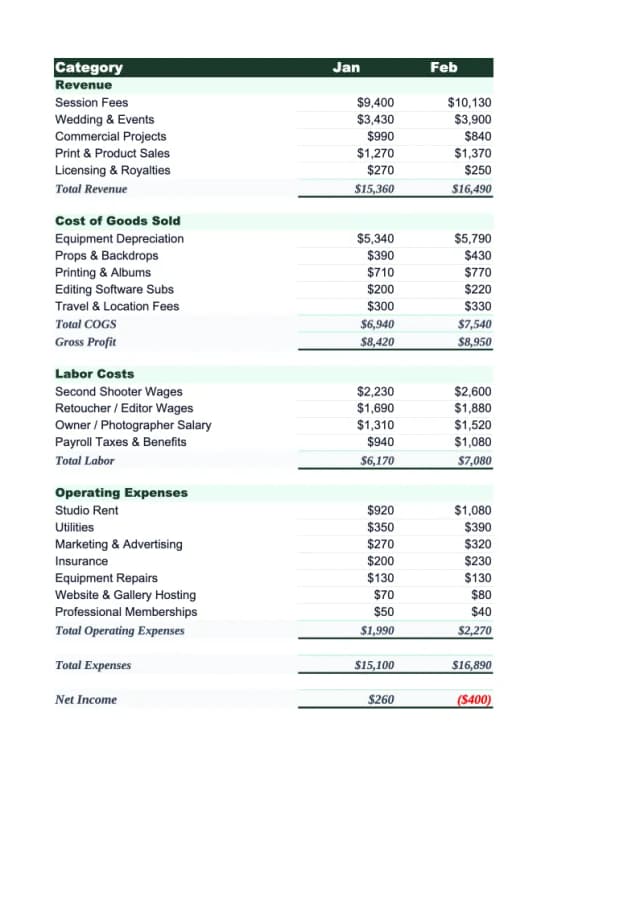
Need a ready-made budget template for your photography?
Download a pre-built spreadsheet with industry-specific categories, formulas, and formatting.
Commercial Photography: Don't Forget Licensing
Portrait and event photographers typically include personal-use rights in their session fee — the client can print the photos and share them socially. That's fine for personal work.
Commercial clients are different. When a business pays for photos to use in advertising, on product packaging, in national print campaigns, or on a website that drives sales, they're not buying personal-use rights. They're licensing your images for a specific use, in a specific medium, for a specific duration.
Licensing is charged separately from the creative fee (your shooting day rate). Creative fee covers your time. Licensing covers what the client can do with the resulting images.
Common licensing variables that affect pricing:
- Usage type: editorial vs. advertising vs. packaging
- Distribution: local, regional, national, worldwide
- Duration: six months, one year, perpetual
- Exclusivity: can other companies in the same industry use similar images?
Photographers new to commercial work frequently quote only a creative fee and give away licensing — effectively donating the commercial value of the images. A company running a national ad campaign will typically pay $2,000–$10,000+ in licensing fees on top of a $1,500–$4,000 creative fee. Not knowing to charge for it means that revenue goes to zero.
How to Raise Your Prices Without Losing Clients
The best time to raise prices is when you're turning away work — when you have leverage to absorb the clients you lose. The worst time is when you're desperate.
The practical mechanics:
Add before you raise. Bundle a previously-separate deliverable into the new base package before announcing an increase. A $2,500 wedding package that becomes $3,200 with an engagement session included (previously $400 extra) and a second shooter for the ceremony (previously $300 extra) is an easier conversation than a bare rate increase.
Announce calmly, not apologetically. "Starting [date], my wedding packages begin at $3,200" is a complete sentence. Explaining your gear costs, your editing hours, and how hard you've worked trains clients to negotiate. A business announcing updated pricing doesn't need to justify itself.
Stagger gradually. A 15–20% increase over 18–24 months is easier for existing clients to absorb than a single large jump. Test new rates with new inquiries before rolling them out to your existing client base.
Give advance notice proportional to your booking window. Wedding photographers should notify 6–12 months ahead. Portrait photographers need 4–8 weeks. Never announce mid-booking or during active event planning.
Honor existing deposits at the old rate. Existing contracts hold. Future bookings get the new rate. That's the standard and reasonable approach.
If raising rates 40% causes 25% of your clients to leave, your revenue increases by 5% with meaningfully less work — and you've created capacity for better-fit clients who value what you deliver.
Common Pricing Mistakes
Only counting shoot time. The most costly mistake. Editing, travel, communication, and delivery are all part of the job. Price the total hours.
Checking competitors before checking costs. Competitor rates tell you what other photographers charge, not whether those rates are profitable. Many photographers in your market are also undercharging. Starting with your own cost structure gives you a floor that's actually yours.
Omitting self-employment taxes. Employed workers have taxes withheld automatically. Freelance photographers owe self-employment tax (15.3% on net income up to $176,100 in 2025) plus regular income tax on top. If taxes aren't built into pricing, they come as a surprise at filing time — and that surprise is often large enough to create real financial strain. The photography profit margin calculator factors in tax burden so you can see true take-home per session.
Over-delivering out of guilt. Charging low rates and then adding extra edits, extra images, and extra turnaround speed to justify the low price amplifies the loss on every session. The fix is correct pricing, not more work.
Skipping licensing on commercial work. If a business is paying you for photos they'll use commercially, the licensing fee is part of the deal. Not knowing to charge it is expensive; leaving it unclaimed repeatedly compounds over a career.
Tracking Whether Your Pricing Is Working
Three numbers to watch:
Net income per session hour. After subtracting every hour spent on a session (shoot + edit + travel + communication) and every cost allocated to it, how much are you actually earning per hour? Track this across session types. It tells you which work is worth taking and which isn't.
Annual income vs. target. Are you hitting the income number from your cost-plus calculation? If you're consistently short, the gap is usually either rate or volume — and usually rate.
Time per session type. Track actual hours for a few sessions of each type against your estimates. Systematic over-runs mean estimates are wrong, which means pricing is wrong.
A simple spreadsheet — tracking sessions, total hours, costs, and revenue by type — is enough to see where you're profitable and where you're not. For photographers who want a structured approach to annual business finances, the Photography Income Statement Template covers revenue, cost of services, and overhead tracking built for how photography businesses work. The Photography Budget Template structures annual cost planning by category — gear depreciation, software, marketing, and insurance — so expenses don't become surprises.
Profitable photography pricing isn't about charging what clients will pay or what competitors charge. It's about knowing your actual costs, building a rate that covers them, and having the business confidence to hold it. That starts with running the numbers — once, thoroughly — and letting them tell you what you need to charge.
Last updated: March 25, 2026
Frequently Asked Questions
Related Articles
Auto Repair Pricing Guide: How to Price Your Shop Profitably
How auto repair shop owners should price labor and parts — covering labor rate calculation, flat-rate hours, parts markup matrices, diagnostic fees, and the metrics that matter.
Cleaning Service Pricing Guide: How to Price Your Business Profitably
A practical guide to cleaning service pricing — covering hourly vs. flat rate vs. per square foot models, price benchmarks by service type, labor cost math, and the common mistakes that keep cleaning businesses from hitting their margin targets.
Construction Pricing Guide: How to Price Your Work Profitably
How contractors should price construction work — covering labor burden, overhead recovery, material markup, pricing methods, and the mistakes that quietly erode margin.
Electrical Pricing Guide: How to Price Your Work Profitably
How electricians and electrical contractors should price their work — covering hourly rates, flat-rate pricing, overhead recovery, material markup, and common mistakes that erode margin.
Hotel Sales Forecast: A Practical Example and Guide
How to build a hotel sales forecast — covering rooms, F&B, events revenue, key metrics like RevPAR and ADR, booking pace, and the rolling forecast structure that keeps you ahead.
Landscaping Pricing Guide: How to Price Your Work Profitably
A practical guide to landscaping pricing — covering hourly rates, per-square-foot benchmarks, overhead recovery, and the markup math that determines whether you're making money.