Event Planning Budget Example: Real Numbers for Your Business
A practical event planning budget example covering agency overhead, per-event costs, revenue models, and the benchmarks every planner needs to protect margins.
Event planning businesses run two budgets at once: the agency's own operating budget and the per-event budget managed for each client. Conflating the two is the most common financial mistake in this industry — and the one that most often erodes margins.
This post covers both layers with real numbers: what it costs to run an event planning business, what per-event budgets look like, and the benchmarks that separate profitable agencies from those constantly chasing their next booking.
The Two Budgets Every Event Planner Needs
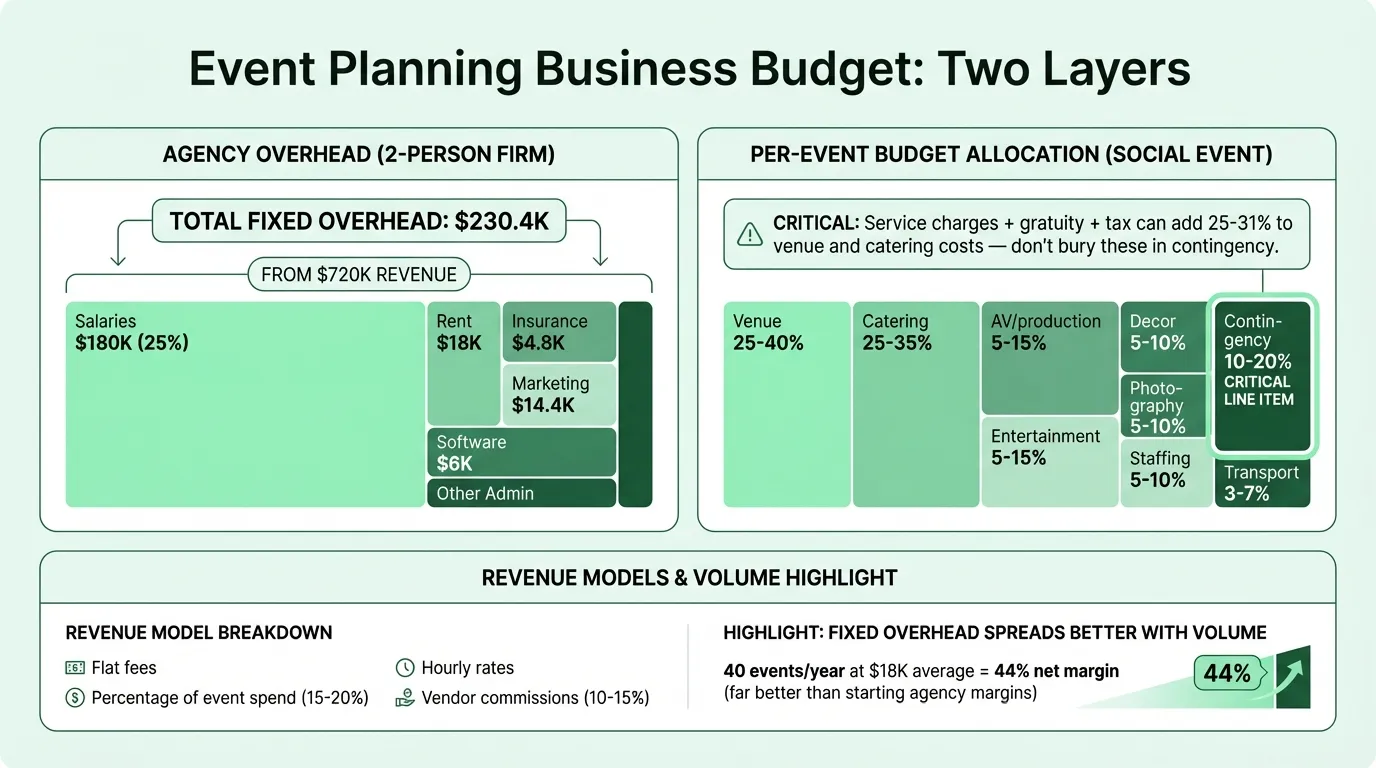
Agency budget: What it costs to keep your business running regardless of how many events you execute. Salaries, rent, software, insurance, marketing. These costs exist whether you close one client this month or five.
Per-event budget: The financial plan for each specific engagement — venue, catering, AV, staffing, decor, and everything else scoped for the client. This is what you present to clients and what you manage against as execution unfolds.
Most event planners are detailed about per-event budgets and sloppy about their agency budget. That's backwards. If you don't know your agency's fixed cost structure, you can't price work accurately, and you'll consistently undercharge for the overhead you're absorbing.
Agency Revenue: How Event Planners Get Paid
Before building a budget, know which revenue model you're using — because they produce different margin structures:
Flat project fee: You quote a fixed price for the engagement. Your margin is the difference between the fee and your total costs (time + overhead + any pass-through expenses). Most predictable for cash flow planning.
Percentage of event spend: Typically 15–20% of the client's total event budget. On a $150,000 event, that's $22,500–$30,000 in revenue. Scales naturally with event size, but harder to forecast month-to-month.
Hourly rate: Ranges from $25/hour for new planners to $100+ for experienced corporate specialists. Requires disciplined time tracking to bill accurately. Corporate events command roughly a 30% premium over social events at comparable hourly rates.
Vendor commissions: Standard practice is 10–15% commission on vendors you refer and manage (caterers, florists, AV companies, photographers). A client spending $50,000 with referred vendors generates $5,000–$7,500 in additional revenue. Document and disclose this in your contracts.
Most established agencies combine models — a flat planning fee plus vendor commissions, or a retainer for corporate clients plus per-event project fees.
Agency Operating Budget
For a small event planning firm — one to three planners, primarily local and regional events — here's what the overhead structure typically looks like:
Fixed Monthly Costs
| Category | Monthly Amount |
|---|---|
| Lead planner salary | $6,500–$8,500 |
| Coordinator/associate salary | $3,500–$4,500 |
| Office rent (or home office allocation) | $0–$2,500 |
| Software subscriptions (CRM, event mgmt, accounting) | $300–$600 |
| General liability + errors & omissions insurance | $200–$400 |
| Marketing (website, ads, directory listings) | $500–$1,500 |
| Accounting and legal | $300–$600 |
| Estimated total fixed costs | $11,300–$18,600/mo |
For a solo operator working from home, the lower end of this range applies. An established two-person firm renting office space lands closer to the top.
Variable Costs
Variable costs scale with event volume. For a firm doing 30–50 events per year at the $20,000–$50,000 fee range:
- Subcontracted labor (event-day staff, specialized coordinators): 15–25% of event fee
- Client-related travel (site visits, vendor meetings, event execution): 5–10% of revenue
- Event supplies and materials owned by the agency: 2–4% of revenue
Per-Event Budget: Where the Money Goes
For each client engagement, you'll build a line-item budget. The proportions below apply to most social events (weddings, galas, private parties) and mid-market corporate events. Large conferences and trade shows will vary significantly on AV and technology spend.
Typical Event Budget Allocation
| Category | % of Total Event Budget |
|---|---|
| Venue rental and related fees | 25–40% |
| Catering (food, beverage, service staff, gratuity) | 25–35% |
| Audio/visual and production | 5–15% |
| Entertainment and speakers | 5–15% |
| Decor and florals | 5–10% |
| Photography and videography | 5–10% |
| Staffing (event-day labor) | 5–10% |
| Transportation and logistics | 3–7% |
| Marketing and printed materials | 2–5% |
| Permits and licenses | 1–3% |
| Contingency | 10–20% |
The two largest line items — venue and catering — together consume 50–75% of a typical event budget. If either runs over, the entire budget is compromised. The contingency should be sized at 10% for familiar venues and vendors, 15–20% for new venues or complex outdoor logistics.
The line item most event planners forget: taxes, service charges, and gratuities. In many markets, venue service charges (18–22%), catering gratuities (18–20%), and sales tax can add 25–31% to the apparent cost of venue and catering contracts. A venue that quotes $20,000 for rental and food minimum often costs $25,000–$26,200 once you read the contract closely. Budget these explicitly rather than absorbing them into contingency.
Example: Small Agency Annual Budget
Here's a realistic operating budget for a two-person event planning business doing 40 events per year at an average fee of $18,000:
Revenue
| Source | Amount | % of Revenue |
|---|---|---|
| Planning fees (flat fee + percentage) | $560,000 | 78% |
| Vendor commissions (avg. 12% on $3M vendor spend) | $120,000 | 17% |
| Consultation and day-of packages | $40,000 | 5% |
| Total Revenue | $720,000 |
Agency Overhead
| Category | Amount | % of Revenue |
|---|---|---|
| Salaries (2 planners + benefits) | $180,000 | 25.0% |
| Office rent and utilities | $18,000 | 2.5% |
| Software and tech subscriptions | $6,000 | 0.8% |
| Insurance (GL + E&O) | $4,800 | 0.7% |
| Marketing and business development | $14,400 | 2.0% |
| Accounting, legal, and admin | $7,200 | 1.0% |
| Total Agency Overhead | $230,400 | 32.0% |
Variable Costs
| Category | Amount | % of Revenue |
|---|---|---|
| Subcontracted event-day staffing | $108,000 | 15.0% |
| Client travel and site visits | $43,200 | 6.0% |
| Supplies and event materials | $21,600 | 3.0% |
| Total Variable Costs | $172,800 | 24.0% |
Net Pre-Tax Profit: $316,800 (44.0% of revenue)
This reflects a well-established two-person agency with a solid vendor commission income stream and manageable overhead. Early-stage agencies and those with higher rent or lower vendor volume will land lower — 10–15% net margin is the realistic target for the first few years.
The Event Planning Budget Template has both the agency overhead structure and per-event budget already built out — enter your specific figures and the margin calculations update automatically.
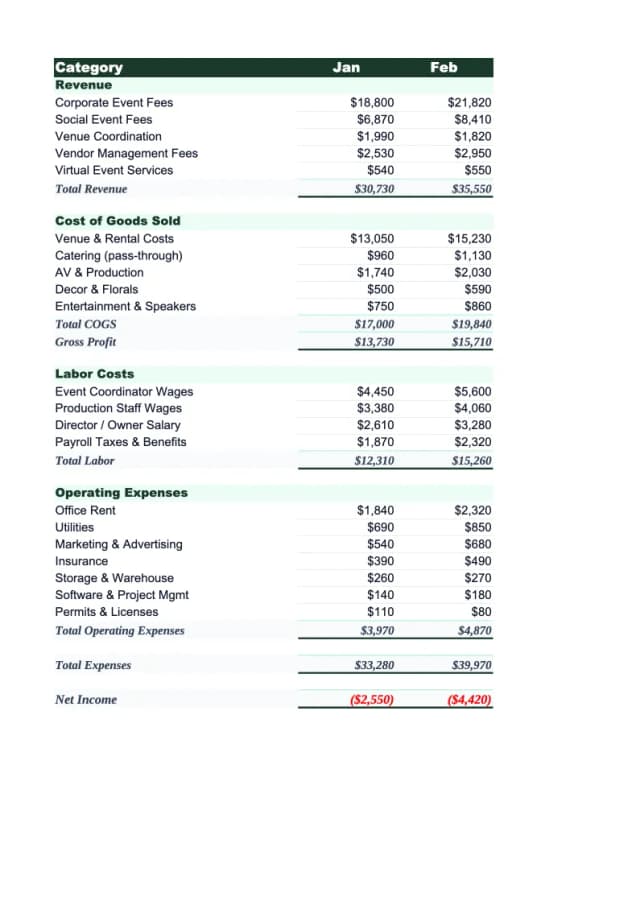
Need a ready-made budget template for your event planning?
Download a pre-built spreadsheet with industry-specific categories, formulas, and formatting.
How Margins Actually Work in Event Planning
The industry average for small event agencies is 10–15% net margin. Established companies with recurring corporate clients and volume above 50 events per year often reach 15–25%. The difference comes from a few specific dynamics:
Vendor commissions are high-margin revenue. Once you have established relationships with preferred vendors, commissions arrive without significant additional labor. An agency managing $3M in annual vendor spend at a 12% commission earns $360,000 — often more than their planning fees alone. Newer agencies haven't built these relationships yet, so their early revenue skews toward planning fees and their margins suffer accordingly.
Fixed overhead amortizes with volume. Two planners generating $720,000 in revenue have a very different overhead ratio than two planners generating $300,000. The $230,000 in fixed overhead is the same either way — volume drives margin expansion.
Cash flow is the real operational challenge. Forty-five percent of event planners report payment delays as a regular problem. Client deposits cover initial vendor commitments, but if a client pays the final invoice 60 days after the event, you've fronted those costs. Require deposits of 25–50% at contract signing, 25% at the 60-day milestone, and the balance 30 days before the event. Never pay vendors more than you've collected from the client. The Event Planning Cash Flow Template maps deposit timing against vendor payment schedules so you can spot gaps before they hit your bank account.
Staffing Costs by Event Scale
Event-day staffing is often the most variable cost in an event budget. The standard ratio is one staff member per 12 guests for a moderate-complexity event (corporate dinner, gala, conference reception). More complex production or service-intensive events scale down to one per 8–10 guests.
| Event Size | Staff Needed | Staffing Cost (est. $25/hr, 8 hrs) |
|---|---|---|
| 50 guests | 4–5 staff | $800–$1,000 |
| 150 guests | 12–15 staff | $2,400–$3,000 |
| 300 guests | 25–30 staff | $5,000–$6,000 |
| 500 guests | 40–45 staff | $8,000–$9,000 |
Budget at the top of the range for full-service or outdoor events. If you're using a staffing agency rather than direct-hire labor, add 20–30% for their margin.
Common Event Planning Budget Mistakes
Booking the venue before setting the agenda. The venue drives transportation requirements, catering constraints, AV infrastructure, and sometimes entertainment options. Lock the agenda framework first, then find a venue that fits — not the reverse.
Treating contingency as a negotiating tool. Some planners cut the contingency when clients push back on total cost. Don't. The contingency is insurance against the things you can't control: a vendor who misquotes a service charge, a last-minute A/V equipment upgrade, a weather contingency for outdoor events. If you need to reduce the budget, cut scope — not the reserve.
Not tracking time by client. If you charge flat fees or percentage-based pricing, you need to know whether your actual hours match your pricing assumptions. A $20,000 planning fee sounds profitable until you track 180 hours against it. Time tracking isn't optional — it's how you learn to price accurately. The event planning profit margin calculator helps you check whether a given fee covers your actual hours and overhead.
Mixing agency funds with client deposits. Keep client deposits in a separate account. They're not your revenue until the event executes. Commingling these funds creates cash flow distortions and legal exposure if an event cancels.
Keep the client’s agreed deliverables aligned with the event budget. Use DocStaple’s event planning proposal to document the offer and approval step, then update the financial plan when the client approves a scope change.
Building the Budget-vs-Actual Habit
A budget only creates value when you compare it against actual results. After each event:
- Pull the final vendor invoices and receipts
- Compare actual spend to budgeted amounts by category
- Calculate the variance — both in dollars and as a percentage of budget
- Record which line items consistently run over and why
Over 10–15 events, patterns emerge. If AV consistently runs 20% over budget, your AV estimates need adjustment. If catering gratuities surprise you every time, they need their own line item. The budget gets more accurate with each event cycle — but only if you close the loop.
The Event Planning Budget Template includes a per-event tracking section alongside the agency annual view, so both layers stay in one place. For the revenue side, if you're forecasting client volume and project pipeline, that connects naturally to the Financial Planning templates built for service businesses.
Setting Realistic Expectations
The U.S. party and event planning industry employs an average of 1.2 people per business — the vast majority of operators are solo or micro-agency. At that scale, there's no meaningful separation between the owner's labor and the business's profitability. The budget has to account for what the owner is actually worth, not just what they're currently paying themselves.
Price your time as if you'd need to hire someone to replace it. If you're doing $500,000 in revenue as a solo operator but would need a $90,000 coordinator to handle that volume without you, your true labor cost is $90,000 — not whatever you've been drawing. Build the budget that way, and the margins you see will reflect what the business actually earns, not just what it passes through to you. The Event Planning Income Statement Template structures this view with owner compensation as an explicit line item alongside agency overhead.
Last updated: March 23, 2026
Frequently Asked Questions
Related Articles
Coffee Shop Budget Example: Real Numbers and Benchmarks
A practical coffee shop budget example with real cost benchmarks — covering beverage COGS, labor, rent, equipment maintenance, and the line items most operators underestimate.
Church Budget Example: Categories, Percentages, and What to Include
A practical church budget example with real percentages for staff, facilities, missions, and programs — plus the line items most churches overlook.
Construction Budget Example: Line Items, Percentages, and What to Include
A practical construction budget example covering hard costs, soft costs, overhead allocation, and the line items most contractors underestimate.
Daycare Budget Example: Categories, Benchmarks, and What to Watch
A practical daycare budget example covering revenue sources, expense ratios, occupancy thresholds, and the line items that determine whether a center stays financially viable.
Hotel Budget Example: Departments, Benchmarks, and Real Numbers
A practical hotel budget example covering the USALI department structure, labor benchmarks, GOP targets, and the line items independent hoteliers most often miss.
What Is a Good Landscaping Budget? Benchmarks and Examples
A landscaping business budget breakdown covering labor, materials, equipment, overhead benchmarks, and the margin targets that separate profitable companies from struggling ones.