Event Planning Budget Template
Budget your event planning business and individual events with a template built for how coordinators actually work — per-event cost tracking, vendor pass-throughs, and business overhead in one file.
What's Inside This Event Planning Budget Template
This template includes 5 worksheets, each designed for a specific part of your event planning financial workflow:
Per-Event Budget
The core worksheet for planning and tracking costs on individual events.
Business Operating Budget
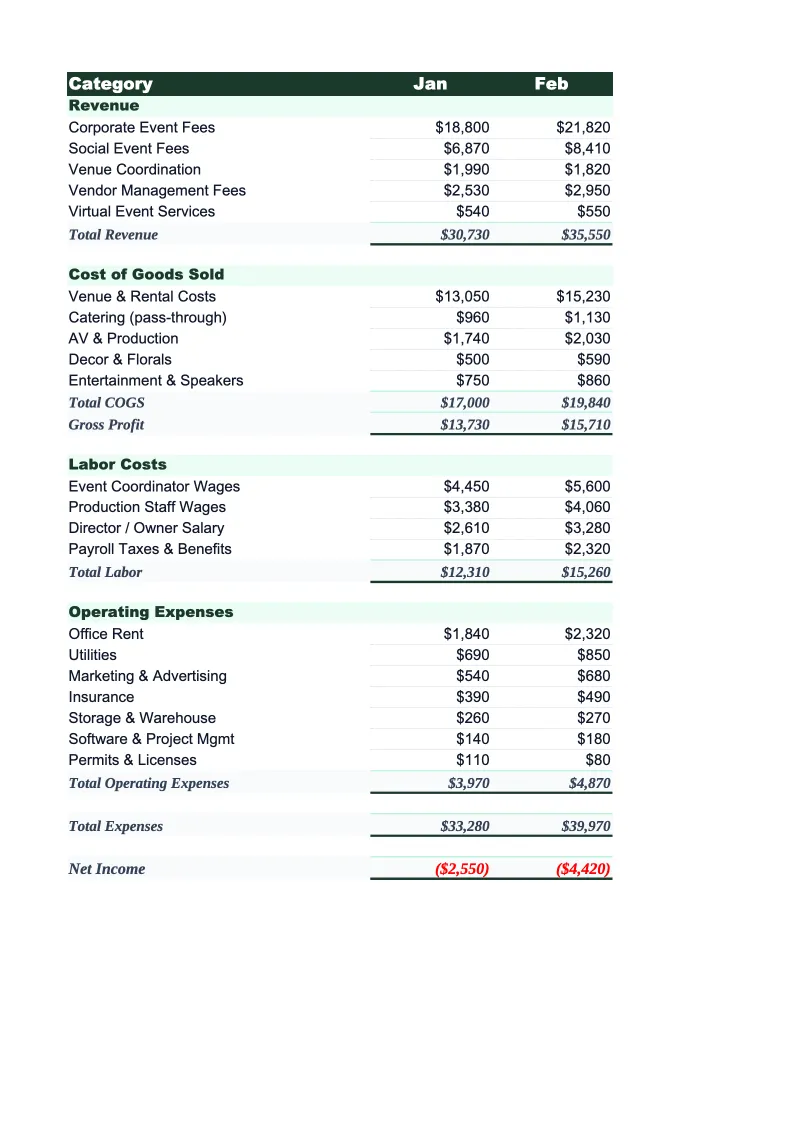
Tracks the fixed and semi-fixed overhead costs of running your event planning business — independent of any single event.
Annual Summary
A 12-month rollup that pulls event revenue and business overhead together into a single view.
Budget vs Actual
Side-by-side comparison of planned versus actual figures at both the business level and the per-event level.
Dashboard
A visual overview with pre-built charts and key metrics that update automatically as you enter data in the other sheets.
Event Planning Budget Template Features
- Per-event budget with vendor pass-through markup tracking
- Business overhead budget with overhead rate auto-calculation
- 12-month annual summary showing seasonal revenue patterns
- Budget vs actual variance with color-coded overage flags
- Visual dashboard with revenue, margin, and event KPIs
- Pre-loaded categories for venue, catering, AV, decor, staffing, and permits
How to Use This Event Planning Budget Spreadsheet
Start by setting up the Business Operating Budget sheet. Enter your monthly overhead costs — insurance, software subscriptions, marketing, and any staff compensation. This takes about 10 minutes and gives you your overhead rate: the percentage of revenue you need to cover fixed costs before you see a dollar of profit. If you don't know some figures exactly, use annual amounts divided by 12. Once overhead is entered, you have the baseline every event quote needs to beat.
For each event you book, open the Per-Event Budget sheet and enter the client name, event date, contract value, and expected direct costs by category. The vendor markup section lets you record what vendors are charging and what you're billing the client — the difference is your markup revenue, tracked separately from your coordination fee. As the event approaches and actual invoices come in, enter the actuals in the adjacent column. The sheet flags any line items running over budget so you can manage scope before the event happens, not after.
15 minutes from download to your first event budget
Download the template, enter your overhead and your next event's details, and see your full financial picture — per-event margin, annual summary, and business overhead all in one file.
Why Every Event Planning Business Needs a Budget Template
Event planning sits at an unusual intersection: you're a service business running on coordination fees, but you also act as a financial intermediary for tens or hundreds of thousands of dollars in vendor costs. That dual structure — service revenue plus pass-through revenue — is what makes generic budget templates fail for event planners. A spreadsheet built for a retail shop or a consulting firm doesn't have a place for venue pass-throughs, vendor markups, or the milestone billing cycle that ties up cash for 12 months before a wedding happens. Event planners who try to adapt those templates end up with something that obscures the business instead of illuminating it.
The two profit centers that matter most are your coordination fee and your vendor markup. Coordination fees are your pricing decision — you're charging for your expertise, your vendor relationships, and your time. Vendor markups (typically 10-20% on pass-through costs) are your reward for sourcing, managing, and assuming liability for third-party vendors. Most event planners know these exist, but very few track them separately. When you can see gross margin by event broken out by fee type, you'll quickly discover which event types and which pricing structures actually generate the margins the business needs — and which ones are keeping you busy without keeping you profitable.
Event Planning Industry at a Glance
Financial templates built for event planners and event management businesses — from independent coordinators to full-service agencies handling weddings, corporate events, and conferences.
Revenue Drivers
- Planning and coordination fees
- Day-of coordination
- Vendor commissions or markups
- Design and decor services
- Event production fees
Key Cost Categories
- Venue rental
- Catering and bar service
- Staffing and labor
- Decor and florals
- AV and lighting equipment
- Photography and videography
- Transportation and logistics
Typical Margins
Gross: 40-60% · Net: 10-25%
Seasonality
Peak season in spring (April-June) and fall (September-November) for weddings; corporate events spike in Q1 and Q4.
Key Performance Indicators
Event Planning Budget Template FAQ
More Event Planning Templates
Event Planning Balance Sheet Template for Excel
$29
Event Planning Business Plan Template for Excel
$39
Event Planning Cash Flow Template for Excel
$29
Event Planning Expense Tracker Template for Excel
$29
Event Planning Financial Model Template for Excel
$29
Event Planning Income Statement Template for Excel
$29
Event Planning Invoice Template for Excel
$29
Event Planning KPI Dashboard Template for Excel
$29
Event Planning P&L Template for Excel
$29
Event Planning Pro Forma Template for Excel
$29
Event Planning Project Budget Template for Excel
$29
Event Planning Sales Forecast Template for Excel
$29
Event Planning Business Valuation Template for Excel
$29
Event Planning Budget Template
$29