Restaurant Inventory Management: Best Practices That Work
Practical restaurant inventory management best practices — covering par levels, FIFO, weekly counts, waste tracking, and how to use the data to control food cost.
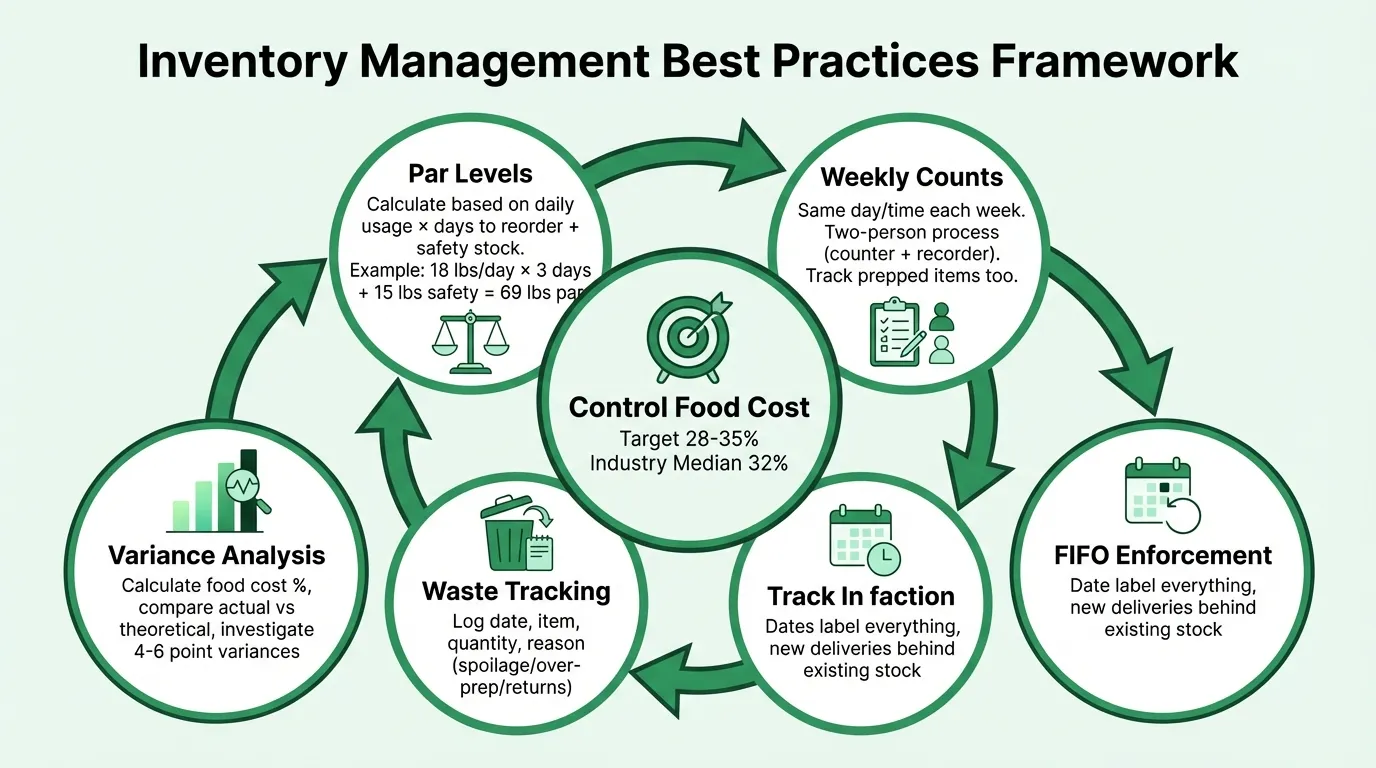
Food cost is the clearest window into how well a restaurant is being managed. And food cost is only as accurate as the inventory data behind it.
The National Restaurant Association's 2024 data puts median food costs at 32.0% of sales for full-service restaurants and 32.4% for limited-service. With net margins that typically run 3–5%, a food cost running two or three percentage points above target can wipe out profitability entirely. The difference between a well-managed inventory system and a loose one often shows up as precisely those two or three points.
Here are the practices that make the biggest operational difference.
Set Par Levels Based on Real Usage Data
A par level is the floor — the minimum quantity of an ingredient you need on hand to last through your ordering cycle without running out. When stock drops to par, you order.
The formula:
Par Level = (Average daily usage × Days between orders) + Safety stock
Safety stock is typically 20–25% of average weekly usage, providing a buffer against delivery delays or an unexpectedly busy stretch.
Example: You use 18 pounds of ground beef per day on average and receive deliveries every 3 days. Safety stock is 15 lbs.
Par Level = (18 × 3) + 15 = 69 lbs
Order quantity = Par Level − Current on-hand inventory. If you have 25 lbs on hand, you order 44 lbs.
The most common mistake with par levels is setting them once and never revisiting. Par levels set for a summer menu will be wrong in January. Set a quarterly reminder to review and adjust based on current POS data — or immediately after menu changes or delivery schedule shifts.
Count Inventory Weekly, Not Monthly
Monthly inventory counts mean problems go undetected for three to four weeks. A food cost spike that appears in a monthly report could have been running for weeks before you see it. Weekly counts catch it within days.
The mechanics matter as much as the frequency:
- Count on the same day and time every week (Sunday evening or Monday morning before deliveries are common)
- Count sheet should mirror the physical layout of your storage areas — walk-in, dry storage, freezer, prep area — not alphabetical order
- Use two people: one counts, one records. This eliminates transcription errors and creates a natural check
- Count prepped items as well as raw ingredients. Prepped items that aren't tracked will show as variances that can't be explained
For high-cost perishables — proteins, seafood, dairy, and fresh produce — a daily spot count is worth the five minutes it takes. A miscounted case of salmon or an unopened case of shrimp sitting behind something will surface in your daily count, not your weekly one.
| Item Category | Count Frequency | Reason |
|---|---|---|
| Proteins, seafood | Daily spot + weekly full | High cost, high theft risk |
| Dairy, fresh produce | Daily spot + weekly full | High spoilage rate |
| Dry goods, canned items | Weekly | Low perishability |
| Alcohol, bar inventory | Daily or shift-end | High value, high theft risk |
| Cleaning, paper goods | Weekly or bi-weekly | Low cost variance risk |
Apply FIFO — and Actually Enforce It
First-In, First-Out (FIFO) is standard practice in every food safety curriculum, but enforcement breaks down at the operational level. New deliveries get stacked in front because it's faster. Prep staff grab the closest container without checking dates. A box of chicken thighs from Tuesday ends up behind Friday's delivery.
The fix isn't more reminders — it's removing the ability to do it wrong:
- Date-label every item when it comes in, including packages, bins, and containers
- New deliveries go behind existing stock, not in front of it. This applies in the walk-in, the freezer, and on dry storage shelves
- Storage layout should make FIFO the path of least resistance. If staff have to move items to get to older stock, the system will fail under time pressure
- During service, when prep staff are pulling from mise en place, the oldest items should be at the front or top
The point of FIFO isn't just food safety — it's reducing the spoilage that shows up as unexplained food cost variance. Ingredients that spoil before they're used have already been counted in your beginning inventory but produce no revenue. The restaurant pricing guide explains how these waste-driven cost overruns quietly erode your margins even when menu prices look right.
Track Waste at the Source
Waste logs feel like extra paperwork, but they're the fastest way to find specific food cost leaks. Without them, you know your food cost is high — you just don't know whether it's spoilage in the walk-in, over-portioning at the grill station, trim waste on proteins, or returns from the dining room.
A basic waste log records: the date, the item, the quantity, the reason (spoilage, over-prep, returned plate, wrong order, trim), and the approximate cost. This doesn't have to be elaborate — a laminated sheet next to each waste station is enough.
Review waste logs weekly alongside your inventory count. After a few weeks, patterns emerge: a specific prep cook over-portioning, a garnish ingredient that consistently spoils before use, a menu item that generates an unusually high return rate.
The math on waste reduction is favorable. Restaurants typically operate on 3–5% net margins. At a 7% margin, preventing $1 of food waste is equivalent to generating roughly $14 in additional revenue — because every dollar of waste avoided goes directly to the bottom line, while new revenue must first cover the cost of goods and variable expenses.

Need a ready-made expense tracker template for your restaurant?
Download a pre-built spreadsheet with industry-specific categories, formulas, and formatting.
Calculate and Monitor Food Cost Variance
Your actual food cost is what you measured. Your theoretical food cost is what it should have been based on your recipes and portion standards. The variance between the two is where the investigation starts.
Food Cost % = (Beginning Inventory + Purchases − Ending Inventory) ÷ Total Sales × 100
Run this calculation weekly. Then compare it to your theoretical food cost — the figure you'd get if every portion were perfect, every delivery were accurate, and nothing spoiled.
A 1–2 point variance between theoretical and actual is typical. A consistent 4–6 point variance signals a specific problem:
- Receiving errors: You're paying for product you didn't receive, or receiving short weights
- Over-portioning: Portion sizes drifting above recipe standards
- Waste and spoilage: Items expiring before use, FIFO failures
- Theft: Particularly visible in alcohol, proteins, and high-value prepared items
- Menu costing errors: A recipe was costed inaccurately or ingredient prices changed without updating theoretical cost
Weekly variance tracking lets you notice when a metric changes and catch it before it compounds. If your food cost runs 31% for six weeks and then spikes to 35%, something specific changed. Monthly tracking may not reveal when the spike started. Use the restaurant food cost calculator to quickly check whether a spike is driven by price changes or volume shifts.
Tighten Your Receiving Process
A significant share of inventory inaccuracies originates at the receiving dock. Vendor short-shipments, incorrect weights, and invoicing errors that aren't caught at delivery create phantom inventory — your system shows stock you don't have. Every calculation downstream, including food cost, is built on a false foundation.
A reliable receiving process:
- Count and weigh every delivery before signing off. Don't assume the packing slip matches what's in the box. Weigh protein deliveries individually, not as a case total
- Check temperatures on refrigerated and frozen deliveries. Items arriving outside safe temperature ranges should be refused, not accepted and refrigerated
- Compare against the purchase order, not just the packing slip. A vendor can substitute items or adjust quantities without noting it on the packing slip
- Note exceptions immediately on the delivery receipt. Damage claims and short-shipment credits are much harder to recover after the driver leaves
- Enter received quantities the same day. Paperwork that sits until tomorrow creates a window where inventory counts are unreliable
A two-person receiving process — one verifying against the PO, one counting and weighing — catches most discrepancies at the point where they're easiest to resolve.
Connect Inventory to Your Financial Statements
Inventory management data is most valuable when it flows into your financial picture. Food cost percentage is a line item on your Restaurant Income Statement Template — and the accuracy of that line item depends entirely on reliable weekly counts and purchasing records.
The same data feeds into your Restaurant P&L Template, where you can track food cost trends month over month, benchmark against your own history, and monitor prime cost (food plus labor) as a combined percentage of revenue.
For operators also managing cash flow around deliveries and vendor payments, the Restaurant Cash Flow Template tracks the timing of food purchases against incoming revenue — which matters when multiple large vendor invoices land in the same week as payroll.
What Consistent Inventory Management Looks Like in Practice
The operators who manage food cost well share one habit: they treat inventory counts as non-negotiable, not optional. This same discipline shows up on the restaurant profit and loss example as the difference between a 32% food cost and a 35% food cost — which at typical restaurant margins is the difference between profit and breakeven. The count happens on Sunday evening whether service was busy or not. The waste log gets reviewed on Monday. The variance report goes to the kitchen manager before the week's ordering is done.
None of these are complex tasks. The challenge is consistency — running the same process week after week, adjusting par levels when usage changes, investigating variances rather than ignoring them.
Most restaurant food cost problems don't appear suddenly. They accumulate through skipped counts, unchanged par levels, and uninvestigated variances. A consistent weekly review catches most of them before they turn into a financial problem.
Last updated: March 25, 2026
Frequently Asked Questions
Related Articles
Auto Repair Pricing Guide: How to Price Your Shop Profitably
How auto repair shop owners should price labor and parts — covering labor rate calculation, flat-rate hours, parts markup matrices, diagnostic fees, and the metrics that matter.
Cleaning Service Pricing Guide: How to Price Your Business Profitably
A practical guide to cleaning service pricing — covering hourly vs. flat rate vs. per square foot models, price benchmarks by service type, labor cost math, and the common mistakes that keep cleaning businesses from hitting their margin targets.
Construction Pricing Guide: How to Price Your Work Profitably
How contractors should price construction work — covering labor burden, overhead recovery, material markup, pricing methods, and the mistakes that quietly erode margin.
Electrical Pricing Guide: How to Price Your Work Profitably
How electricians and electrical contractors should price their work — covering hourly rates, flat-rate pricing, overhead recovery, material markup, and common mistakes that erode margin.
Hotel Sales Forecast: A Practical Example and Guide
How to build a hotel sales forecast — covering rooms, F&B, events revenue, key metrics like RevPAR and ADR, booking pace, and the rolling forecast structure that keeps you ahead.
Landscaping Pricing Guide: How to Price Your Work Profitably
A practical guide to landscaping pricing — covering hourly rates, per-square-foot benchmarks, overhead recovery, and the markup math that determines whether you're making money.