Restaurant Cash Flow Template
See exactly when cash comes in and goes out — daily sales, vendor payments, payroll cycles, and rent — with a cash flow template built for restaurant operators.
What's Inside This Restaurant Cash Flow Template
This template includes 5 worksheets, each designed for a specific part of your restaurant financial workflow:
Weekly Cash Flow
A 13-week rolling cash flow projection broken down by week — the right planning horizon for most restaurant operators.
Monthly Cash Flow
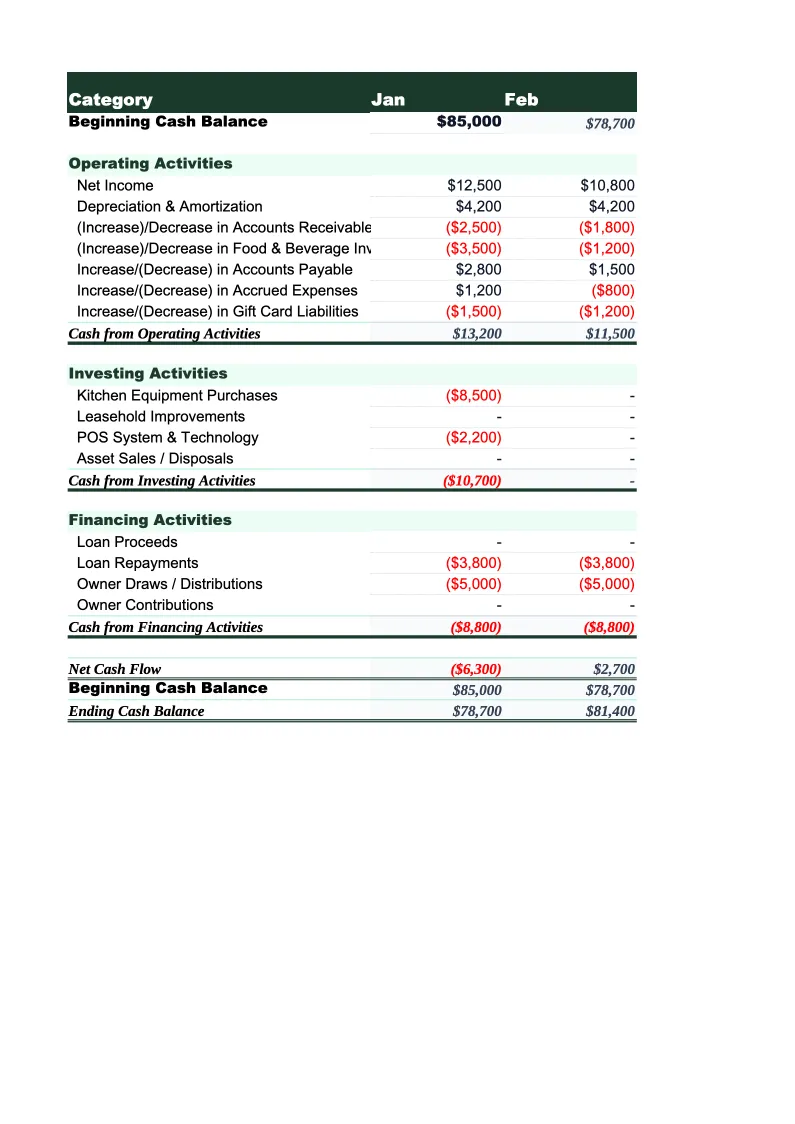
A 12-month view of cash inflows and outflows, organized by operating, investing, and financing activities.
Seasonality Planner
A planning sheet that lets you enter monthly revenue adjustments based on your restaurant's seasonal patterns, then projects the cash impact forward.
Vendor Payment Schedule
A tracker for your recurring supplier obligations — food distributors, beverage vendors, linen services, cleaning supply companies, and any other accounts payable with regular payment cycles.
Dashboard
A single-page visual summary showing current cash balance, 13-week cash runway, weekly cash flow trend, and a breakdown of where cash is going (food costs, labor, rent, and other).
Restaurant Cash Flow Template Features
- 13-week rolling cash flow with restaurant-specific line items (sales, vendor payments, payroll, rent)
- Monthly cash flow statement formatted for bank and SBA lender review
- Seasonality planner with monthly revenue index adjustments
- Vendor payment schedule tracking net terms and weekly cash-out totals
- Credit card settlement timing built into daily cash receipts
- Visual dashboard with 13-week cash runway and weekly trend chart
How to Use This Restaurant Cash Flow Spreadsheet
Start with the Weekly Cash Flow sheet. Download the file, open it in Excel or Google Sheets, and enter your current bank balance in the starting cash cell. Then fill in your expected cash inflows for the next 13 weeks: projected weekly sales by revenue type (dine-in, takeout, delivery, catering, alcohol), estimated catering deposits, and any other income. Use your last 4-8 weeks of POS reports as a baseline — most operators complete the inflow side in about 20 minutes. Then fill in the outflow side using your accounts payable aging and payroll schedule.
Set up the Vendor Payment Schedule with your regular supplier obligations. List each vendor, the typical invoice amount, and their payment terms. This usually takes 15-20 minutes if you have your accounts payable list handy. Once the vendor schedule is complete, the Weekly Cash Flow sheet picks up those cash-out totals automatically. Pay special attention to weeks where multiple large invoices fall due at the same time — your broadline food distributor, your beverage vendor, and your linen service may all invoice on similar cycles, creating a predictable cash crunch midmonth.
15 minutes from download to your first cash flow projection
Download the template, enter your current balance and upcoming sales, and see your restaurant's 13-week cash position at a glance.
Why Every Restaurant Needs a Cash Flow Template
Restaurants fail financially not because they're unprofitable — they fail because they run out of cash. The timing mismatch is built into the industry: customers pay immediately, but food costs arrive as invoices due in 7-30 days, payroll runs weekly or bi-weekly, and rent hits on the first of the month. Add a slow week from bad weather or a road construction project cutting foot traffic, and an otherwise healthy restaurant can find itself unable to make payroll — even with a packed calendar of reservations for the following weekend.
The cash dynamics that matter most in restaurants are different from the line items on your P&L. Credit card settlements take 1-3 business days to hit your account, which means a Friday night dinner rush doesn't fund Monday's produce delivery. Food distributor invoices often cluster mid-month, creating a predictable cash trough. Seasonal revenue swings can reach 30-40% between peak and slow months for many concepts — a restaurant that's flush in December may be genuinely tight in February. A proper cash flow view surfaces all of this, while a P&L or budget spreadsheet alone cannot.
Restaurant Industry at a Glance
Financial templates built for restaurants — from fast-casual to fine dining. Pre-loaded with food cost categories, labor splits, and industry-standard KPIs.
Revenue Drivers
- Dine-in sales
- Takeout & delivery
- Catering
- Alcohol sales
Key Cost Categories
- Food costs (COGS)
- Labor
- Rent & occupancy
- Utilities
- Marketing
- Equipment & maintenance
Typical Margins
Gross: 60-70% · Net: 3-9%
Seasonality
Higher revenue in summer and holiday seasons; January-February typically slowest months.
Key Performance Indicators
Restaurant Cash Flow Template FAQ
More Restaurant Templates
Restaurant Balance Sheet Template for Excel
$29
Restaurant Budget Template for Excel
$29
Restaurant Business Plan Template for Excel
$39
Restaurant Expense Tracker Template for Excel
$29
Restaurant Financial Model Template for Excel
$29
Restaurant Income Statement Template for Excel
$29
Restaurant Invoice Template for Excel
$29
Restaurant KPI Dashboard Template for Excel
$29
Restaurant P&L Template for Excel
$29
Restaurant Pro Forma Template for Excel
$29
Restaurant Project Budget Template for Excel
$29
Restaurant Sales Forecast Template for Excel
$29
Restaurant Valuation Template for Excel
$29
Restaurant Cash Flow Template
$29