Construction Cash Flow Example: How It Actually Works
A real-world construction cash flow example showing how retainage, draw schedules, and payment delays create cash gaps — and how to plan around them.
Construction is one of the few industries where you can complete profitable work and still run out of cash before the job is done. The numbers show it: slow payments cost the U.S. construction industry an estimated $280 billion in 2024, and 82% of general contractors now face payment delays of more than 30 days.
The problem isn't profit margins — it's timing. Here's what that timing actually looks like in practice.
A Real Construction Cash Flow Example
Take a general contractor running a $500,000 commercial renovation project. The contract is standard: monthly progress billing with 10% retainage held until project completion, payment due within 30 days of the owner approving each Application for Payment.
Here's what the cash flow looks like month by month:
| Month | Work Completed | Billed | Retainage Held | Net Payment | Cumulative Costs Paid |
|---|---|---|---|---|---|
| 1 | $60,000 | $60,000 | $6,000 | $54,000 | $55,000 |
| 2 | $100,000 | $100,000 | $10,000 | $90,000 | $100,000 |
| 3 | $120,000 | $120,000 | $12,000 | $108,000 | $115,000 |
| 4 | $130,000 | $130,000 | $13,000 | $117,000 | $125,000 |
| 5 | $70,000 | $70,000 | $7,000 | $63,000 | $65,000 |
| 6 | $20,000 | $20,000 | $2,000 | $18,000 | $22,000 |
| Retainage | — | — | — | $50,000 | — |
The $50,000 retainage release happens weeks or months after Month 6. Meanwhile, every subcontractor, supplier, and laborer on the job got paid during the work.
The gap between costs paid and cash collected — before the retainage release — is the cash flow problem. This contractor spent $482,000 to earn $500,000 in revenue. But during the project, there were multiple weeks where costs hit before payment arrived.
Why Construction Cash Flow Is Structurally Different
Most businesses bill when they deliver and collect shortly after. Construction doesn't work that way.
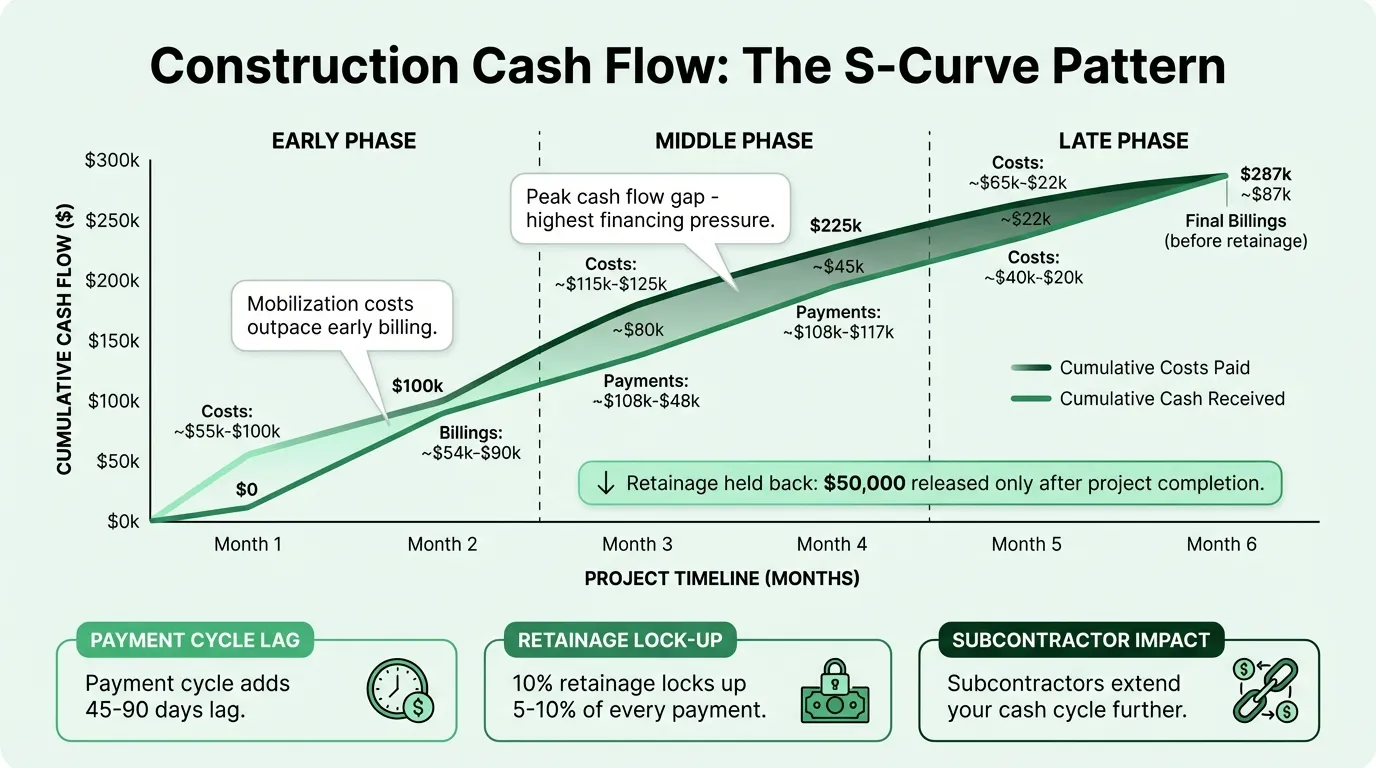
The payment cycle adds 45–90 days of lag. A contractor completes work in January, submits an Application for Payment (typically using AIA G702/G703 forms), waits for architect approval (5–15 days), then waits for the owner to fund the draw (another 14–30 days). The cash arrives in March for work done in January.
Costs front-load every project. Before any significant billing, a contractor has already spent on mobilization — equipment rental, permits, site setup, temporary utilities. Some contracts include a mobilization line item in the Schedule of Values that can be billed immediately; many don't. That upfront spend sits in the red until the first draw clears. The construction budget example breaks down exactly which hard and soft cost categories front-load the heaviest.
Retainage locks up 5–10% of every payment. Industry standard is 10% retainage withheld until the project is 50% complete, dropping to 5% thereafter. On a $500,000 project at 10%, that's $50,000 that's earned but uncollectable for the entire project duration.
Subcontractors extend your cash cycle further. Most GCs hold the same retainage from subs that the owner holds from them — sometimes more. A sub completing $200,000 of work in months 1–3 may not see their retainage release until month 8 or 9. That creates cash pressure that flows up the chain: subs running short call the GC asking for early payment.
The WIP Report: Your Cash Flow Visibility Tool
Work-in-Progress (WIP) reports are the primary tool contractors use to see where cash is going on active projects. A WIP report shows three key numbers for each project:
- Costs incurred to date
- Revenue earned to date (based on percentage of completion)
- Amount billed to date
The gap between what's earned and what's billed is either overbilling or underbilling — and both create cash problems.
Overbilling (billed more than earned) is a short-term cash boost. You've front-loaded your billing relative to actual completion. It feels good now, but in later project phases you'll have completion percentages that don't support new billings — and cash flow dries up when you need it most.
Underbilling (earned more than billed) is an immediate cash drain. You've completed the work, incurred the costs, but haven't collected. An underbilled project is effectively a loan to the owner, funded by your working capital.
Reviewing the WIP monthly catches both problems before they become emergencies. A project that looks healthy on the P&L can be quietly destroying cash flow if it's consistently underbilled. For a line-by-line walkthrough of how overbilling and underbilling appear on your financials, see the construction balance sheet example.
The S-Curve Cash Flow Pattern
Every construction project follows a predictable cash flow pattern called an S-curve. Understanding it lets you forecast when cash gets tight.
Early phase (slow start): Mobilization, site preparation, planning. Costs ramp up gradually. Billing is low because completion percentage is low. Cash outflows exceed inflows.
Middle phase (peak activity): Bulk of labor and materials. Billing accelerates as completion percentage rises. This is where cash flow is most stressed — high payroll, high materials, high subcontractor invoices, all paid before monthly draws clear.
Late phase (taper): Punch list, inspections, commissioning. Costs drop sharply. Final billings come in. Retainage release looms.
The cash flow gap is widest during the middle phase. For a 6-month project, months 2–4 typically show the largest negative gap between costs paid and cash received. That's when a line of credit gets used — and when companies without one get into trouble.
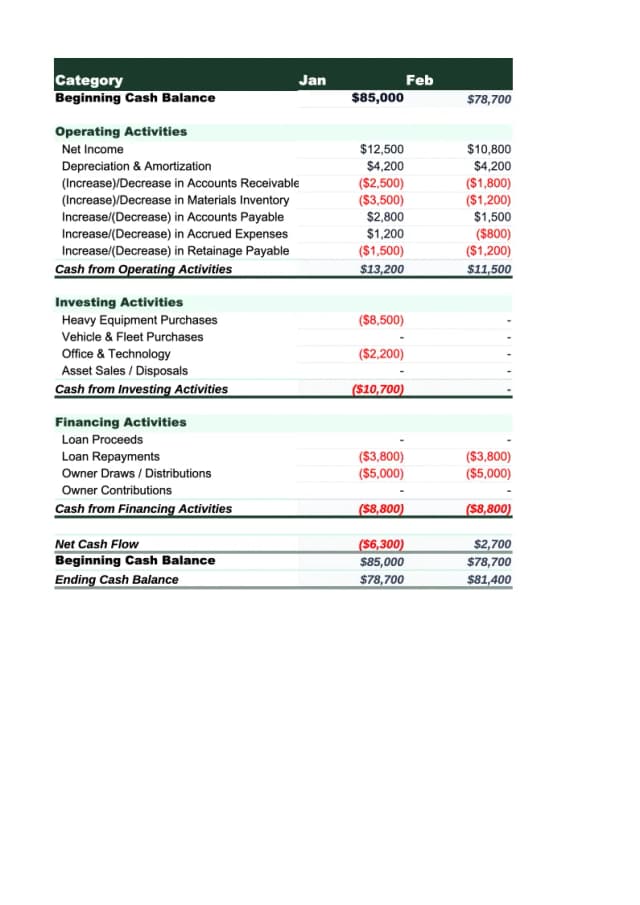
Need a ready-made cash flow template for your construction?
Download a pre-built spreadsheet with industry-specific categories, formulas, and formatting.
Managing the Draw Schedule
The draw schedule is your contract-specified billing roadmap. It defines how much you can bill at each milestone or time period, based on the Schedule of Values — a line-item breakdown of the contract totaling the full contract amount.
A well-built Schedule of Values can meaningfully improve cash flow:
Front-load where possible. Items completed early (mobilization, demolition, site work) should carry as much value as is defensible. This isn't overbilling — it's accurate representation of early completion. An architect or owner who pushes back on front-loading is common; the goal is to negotiate a Schedule of Values that reflects actual cost sequencing.
Include a mobilization line item. If your contract allows it, include mobilization as a billable line item worth 2–5% of the contract. This lets you collect something in Month 1 before significant physical work is complete.
Bill as early in the month as possible. If your contract allows monthly billing with a defined cutoff date, billing on the 1st vs. the 20th of the month means 20 additional days to collect before month-end. On a $100,000 monthly billing, that's real money.
Tracking Cash Flow at the Company Level
Project-level cash flow shows you where each job stands. Company-level cash flow shows you whether you can make payroll Friday.
A 13-week rolling cash flow projection — the same tool restaurants and retailers use — is the right planning horizon for most construction companies. It should track:
Weekly cash inflows:
- Expected draw receipts by project (estimated by applying payment cycle timing to billing dates)
- Retainage receipts (by project, when release is expected)
- Change order payments
- Bonding or financing proceeds
Weekly cash outflows:
- Payroll (your most predictable, inflexible outflow)
- Subcontractor payments (often on net-30 terms from your payment of the draw)
- Material supplier invoices (net-30 or less)
- Equipment lease payments
- Overhead: rent, utilities, insurance, admin
The projection calculates week-by-week ending cash balance. When a future week shows a balance below your minimum operating threshold, you have 3–6 weeks to act — draw on a line of credit, accelerate a billing, defer a discretionary payment.
The Construction Cash Flow Template is built with both the project-level S-curve view and the company-level 13-week forecast, with construction-specific categories already set up.
The Subcontractor Cash Flow Squeeze
Subcontractors face a compressed version of every problem GCs face. A typical sub's cash cycle:
- Perform work in weeks 1–4
- Submit invoice to GC at month end
- GC submits their Application for Payment to owner
- Owner approves and funds (15–45 days)
- GC pays sub (7–30 days after receipt, per pay-when-paid terms)
- Sub collects approximately 60–90 days after completing the work
Meanwhile, the sub paid its own workers weekly, paid material suppliers on net-30, and had 10% retainage withheld from each payment. A subcontractor doing $50,000/month of work is financing $50,000–$75,000 of receivables and retainage at any given time.
This is why subcontractor businesses fail at high rates even when their job margins are healthy. The work is profitable; the cash timing is brutal. Use the construction break-even calculator to determine the minimum revenue needed to cover your costs through these payment gaps.
What Lenders and Bonding Companies Want to See
Banks extending construction lines of credit and surety companies issuing bonds both look at cash flow statements and WIP reports to assess financial health. Specifically:
- Current ratio (current assets ÷ current liabilities): CFMA benchmarks the construction industry average at 1.6. A ratio below 1.0 suggests working capital problems.
- Days in AR: CFMA's 2024 data shows an industry average of 56.6 days. Above 75 days signals collection problems.
- Days cash on hand: CFMA average is roughly 21 days — most advisors recommend targeting 30–60 days minimum.
- WIP schedule: Lenders want to see underbilled amounts (which are assets) vs. overbilled amounts (which are liabilities) across all active projects.
If you're applying for a construction line of credit or increasing your bonding capacity, having a clean 12-month cash flow statement — historical actuals plus 12-month forward projection — is standard documentation. Generating it on demand when the bank asks suggests you aren't running the business with financial rigor. Having it ready signals the opposite.
The Construction Cash Flow Template produces the format lenders expect. If you're also managing project-level profitability, the Construction Budget Template tracks estimated vs. actual costs by project phase.
The Most Common Cash Flow Mistakes in Construction
Treating a contract award as cash. Signing a $2 million contract doesn't put a dollar in your bank account. Many contractors ramp up overhead — new equipment, additional hires — on the strength of a signed contract before any payments arrive.
Ignoring retainage accumulation. On a project portfolio doing $5 million annually at 10% retainage, you could have $500,000 of earned but uncollectable revenue floating in retainage. Not tracking this as a separate asset — and not following up aggressively on retainage release — is a common source of phantom profitability.
Not billing promptly. Every day between completing work and submitting a billing application is a day added to your collection cycle. On a $150,000 monthly billing, submitting two weeks late adds two weeks to your cash receipt — effectively a $75,000 interest-free loan to the owner. The Construction Invoice Template streamlines this with progress billing fields and retainage tracking built in.
Relying on one large project. When 60% of your revenue comes from one project, your company's cash flow is tied to that project's payment cycle. Delays or disputes on one job can threaten payroll company-wide.
Cash flow in construction is harder to manage than in almost any other industry. But contractors who build the habit of projecting 13 weeks out — updating it weekly as draws clear and costs hit — consistently navigate the gaps better than those running on feel.
Last updated: March 23, 2026
Frequently Asked Questions
Related Articles
Hotel Cash Flow Example: Why Occupancy Doesn't Equal Cash
A real hotel cash flow example covering OTA commission timing, advance deposits, RevPAR gaps, and how to build a projection that prevents off-season surprises.
Restaurant Cash Flow Example: Real Numbers, Real Format
A complete restaurant cash flow example with real benchmark numbers — monthly statement, weekly view, and what each line actually means for your operation.
How to Manage Restaurant Cash Flow (Without Losing Sleep)
A practical guide to restaurant cash flow management — covering the timing mismatches, seasonal swings, and vendor payment cycles that catch operators off guard.