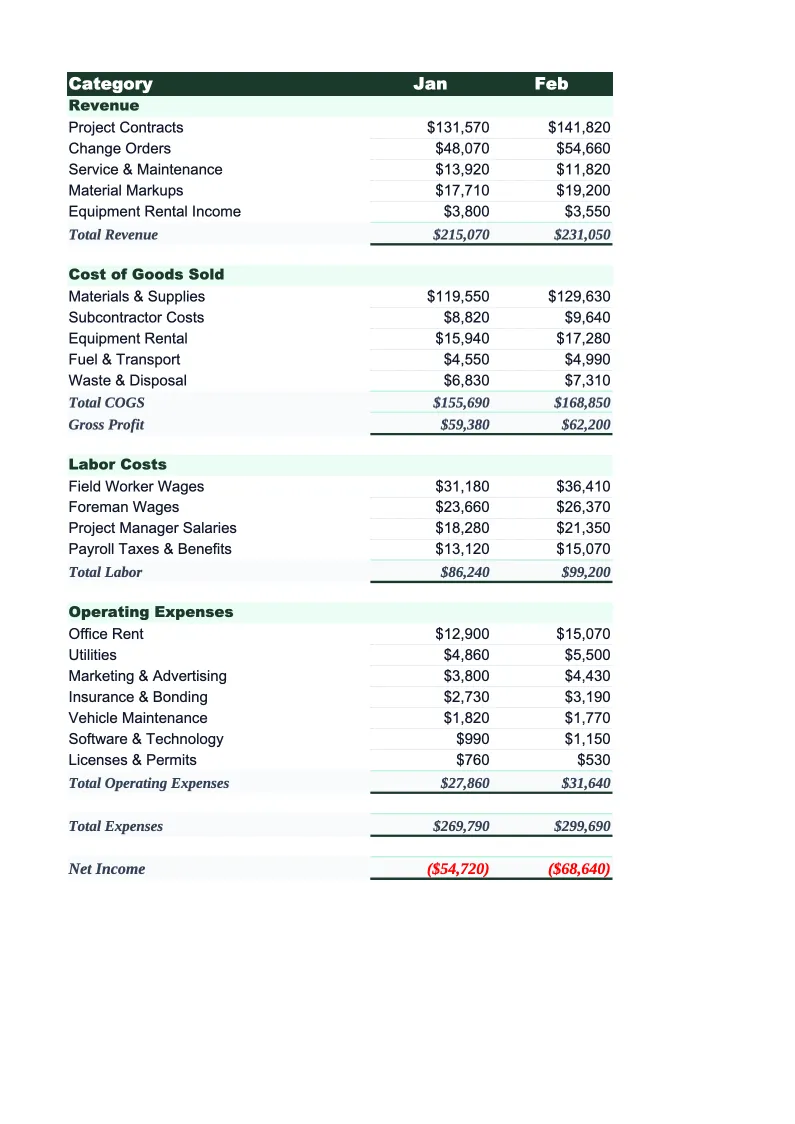
Construction Budget Template
Budget your construction company's overhead and job costs in one spreadsheet — pre-loaded with contractor-specific categories, job cost tracking, and variance analysis.
What's Inside This Construction Budget Template
This template includes 5 worksheets, each designed for a specific part of your construction financial workflow:
Company Overhead Budget
Tracks the fixed and semi-fixed costs of running the business independent of any single project — office rent, administrative salaries, insurance, vehicle expenses, equipment lease payments, software subscriptions, marketing, and professional services.
Job Cost Budget
A per-project budgeting worksheet where you estimate and track the four main cost buckets for any construction job: materials, direct labor, subcontractors, and equipment rental.
Annual Summary
A 12-month rollup of both overhead and project revenue that pulls from your monthly inputs automatically.
Budget vs Actual
Side-by-side comparison of planned versus actual figures for both company overhead and project costs.
Dashboard
A visual summary with pre-built charts covering revenue trend, gross margin by month, overhead as a percentage of revenue, and total cost breakdown by category.
Construction Budget Template Features
- Separate overhead and job cost budgeting — tracks company-level and project-level costs independently
- Job cost variance tracking with color-coded over/under budget indicators
- Overhead rate calculator — shows overhead as a percentage of revenue for accurate job markup
- 12-month annual summary with gross and net margin by month
- Pre-loaded with contractor cost categories: materials, labor, subs, equipment, permits
- Visual dashboard with revenue trend and margin charts
How to Use This Construction Budget Spreadsheet
Start with the Company Overhead Budget sheet. Download the .xlsx file and open it in Excel or Google Sheets — no macros or add-ins needed. Review the pre-loaded overhead categories and remove any that don't apply to your business, or add line items specific to your operation. Enter your fixed monthly overhead costs (rent, salaries, insurance) and any variable overhead (vehicle costs, tool supplies, marketing spend). This gives you your monthly overhead burden, which you'll use to calculate the markup rate you need on jobs to stay profitable.
Next, set up the Job Cost Budget sheet for your current or upcoming projects. Enter the contract value and your estimated costs by category — materials, direct labor, subcontractors, equipment rental, and permits. As costs come in during the project, update the actual figures. The sheet will show you cost variance by category in real time, so you know immediately when materials are running over estimate or when a subcontractor change order is eating into your margin. Construction profit lives and dies in job cost control, and this is where that work happens.
15 minutes from download to your first construction budget
Download the template, enter your overhead and job costs, and see your construction company's full financial picture — company budget, job cost tracking, and variance analysis included.
Why Every Construction Company Needs a Budget Template
Construction companies operate on thin net margins — typically 2–7% for general contractors — which means a single job that runs over budget can wipe out the profit from two or three jobs that went well. The challenge is that costs are split across two distinct layers: company overhead (the cost of keeping the doors open regardless of project volume) and direct job costs (materials, labor, subs, and equipment that vary by project). Most budget problems in construction happen because contractors only track one layer and miss what's happening in the other.
A well-structured construction budget addresses both layers separately. On the overhead side, the key number is your overhead rate — total overhead as a percentage of revenue. For small contractors, this typically runs 20–25%. That number needs to be built into every bid you submit; if you're marking up direct costs by 10% but your overhead rate is 22%, you're losing money on every job before profit is even considered. On the job cost side, the standard categories — materials, direct labor, subcontractors, and equipment — need to be broken out individually because they behave differently. Materials and subcontractor costs can be locked in early; labor is where overruns usually appear.
Construction Industry at a Glance
Financial templates built for construction companies — from general contractors to specialty trades. Pre-loaded with job costing categories, bid tracking, and project-based financials.
Revenue Drivers
- Project contracts
- Change orders
- Service & maintenance
- Material markups
Key Cost Categories
- Materials
- Labor (direct)
- Subcontractors
- Equipment rental
- Permits & insurance
- Overhead
Typical Margins
Gross: 20-35% · Net: 2-7%
Seasonality
Peak activity spring through fall; winter slowdown in northern climates. Year-end push to close projects.
Key Performance Indicators
Construction Budget Template FAQ
More Construction Templates
Construction Balance Sheet Template for Excel
$29
Construction Business Plan Template for Excel
$39
Construction Cash Flow Template for Excel
$29
Construction Expense Tracker Template for Excel
$29
Construction Financial Model Template for Excel
$29
Construction Income Statement Template for Excel
$29
Construction Invoice Template for Excel
$29
Construction KPI Dashboard Template for Excel
$29
Construction P&L Template for Excel
$29
Construction Pro Forma Template for Excel
$29
Construction Project Budget Template for Excel
$29
Construction Sales Forecast Template for Excel
$29
Construction Business Valuation Template for Excel
$29
Construction Budget Template
$29