Construction Cash Flow Template
Track cash in and out across active projects with a cash flow template built for contractors — covering draws, retainage, subcontractor payments, and equipment costs.
What's Inside This Construction Cash Flow Template
This template includes 5 worksheets, each designed for a specific part of your construction financial workflow:
Weekly Cash Flow
A 13-week rolling cash flow view broken down by week, which is the standard planning horizon for most construction contractors.
Project Cash Flow
A per-project cash flow tracker where you enter the contract value, payment schedule, and cost commitments for each active job.
Annual Cash Flow
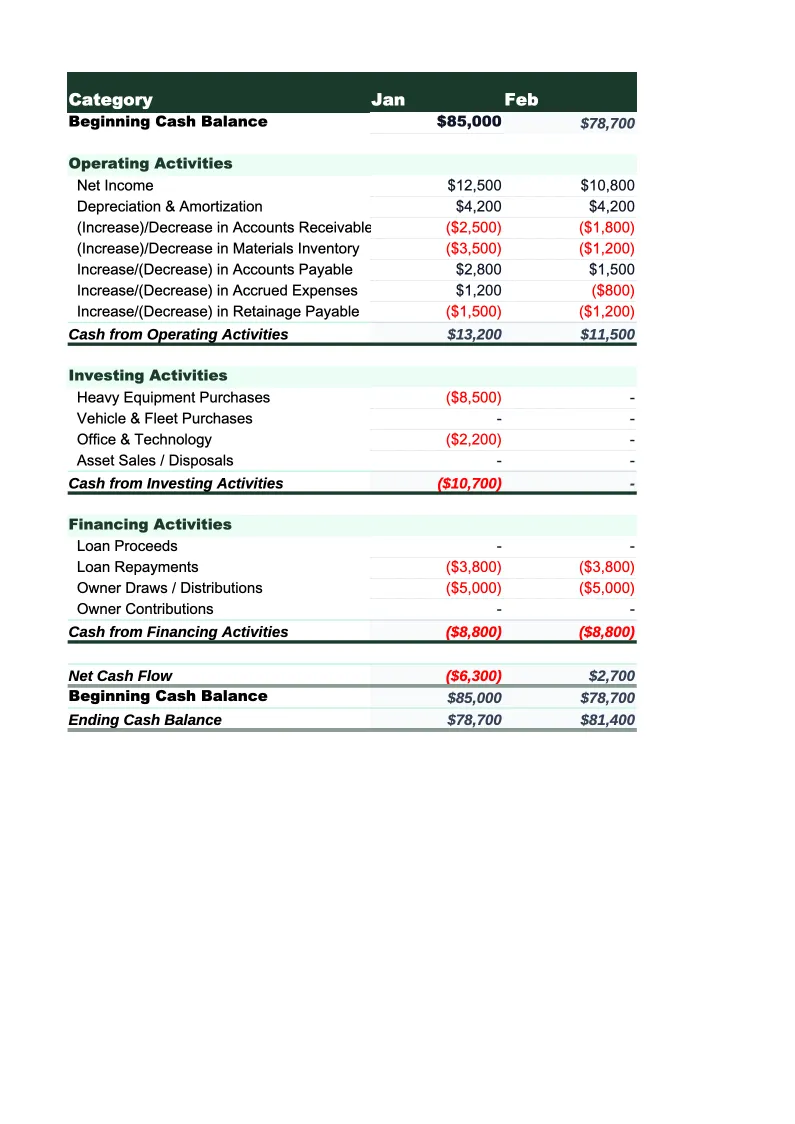
A 12-month cash flow statement using the indirect method, starting from net income and adjusting for non-cash items, changes in working capital (accounts receivable, retainage held, accounts payable), and capital expenditures.
Retainage Tracker
A dedicated sheet for tracking retainage — the portion of each draw that owners withhold until project completion, typically 5–10% of contract value.
Dashboard
A single-page visual summary showing current cash position, 13-week cash runway, total retainage outstanding, and a bar chart of weekly cash inflows vs.
Construction Cash Flow Template Features
- 13-week rolling cash flow with construction-specific line items (draws, retainage, subs)
- Per-project cash flow tracker showing billing vs. cost timing by job
- Retainage receivable tracker with expected release dates and totals
- Annual cash flow statement formatted for lender and bonding company review
- Ending cash balance and weekly runway calculated automatically
- Visual dashboard with current position and 13-week cash projection
How to Use This Construction Cash Flow Spreadsheet
Start with the Weekly Cash Flow sheet. Download the file and open it in Excel or Google Sheets — no macros or plugins needed. Enter your current cash balance in the starting balance cell, then fill in expected cash inflows for the next 13 weeks: scheduled draw payments from owners, any retainage releases due, and other income. The categories are pre-loaded with construction-specific line items, so most contractors can complete this in about 20 minutes using their draw schedule and accounts payable aging report.
Set up the Project Cash Flow sheet for each active job. Enter the contract value, the draw schedule (milestone or monthly), and the projected cost timing for materials, labor, and subs. The sheet will show you, week by week, when each project is cash-positive vs. cash-negative. This is where most contractors find surprises — a project that looks profitable on paper is often cash-negative for the first 60–90 days while material and sub costs run ahead of billings.
15 minutes from download to your first cash flow projection
Download the template, enter your draw schedule and upcoming costs, and see your construction company's 13-week cash position at a glance.
Why Construction Companies Need a Cash Flow Template
Construction is one of the few industries where a profitable company can run out of cash. The core problem is timing: material costs, subcontractor payments, and payroll run on weekly or monthly cycles, while owner draws often follow 30–60 day billing schedules and retainage sits locked up until project completion. A $2M project with a 15% gross margin looks fine on a P&L, but if the owner pays 45 days after billing and you're fronting $80K in materials upfront, you need $80K of working capital to bridge the gap — per project, every month.
The numbers that matter most in construction cash flow are different from general business. Retainage outstanding tells you how much money is technically yours but not yet collectable — for contractors doing $5M+ in annual revenue, this figure often exceeds $300K and represents a meaningful liquidity risk if projects stall or owners dispute final payment. Accounts receivable aging beyond 60 days is another warning sign, since construction payment disputes and slow-paying owners are the most common cause of contractor insolvency even when backlog looks healthy. A proper cash flow template surfaces both of these in one place.
Construction Industry at a Glance
Financial templates built for construction companies — from general contractors to specialty trades. Pre-loaded with job costing categories, bid tracking, and project-based financials.
Revenue Drivers
- Project contracts
- Change orders
- Service & maintenance
- Material markups
Key Cost Categories
- Materials
- Labor (direct)
- Subcontractors
- Equipment rental
- Permits & insurance
- Overhead
Typical Margins
Gross: 20-35% · Net: 2-7%
Seasonality
Peak activity spring through fall; winter slowdown in northern climates. Year-end push to close projects.
Key Performance Indicators
Construction Cash Flow Template FAQ
More Construction Templates
Construction Balance Sheet Template for Excel
$29
Construction Budget Template for Excel
$29
Construction Business Plan Template for Excel
$39
Construction Expense Tracker Template for Excel
$29
Construction Financial Model Template for Excel
$29
Construction Income Statement Template for Excel
$29
Construction Invoice Template for Excel
$29
Construction KPI Dashboard Template for Excel
$29
Construction P&L Template for Excel
$29
Construction Pro Forma Template for Excel
$29
Construction Project Budget Template for Excel
$29
Construction Sales Forecast Template for Excel
$29
Construction Business Valuation Template for Excel
$29
Construction Cash Flow Template
$29