Restaurant Startup Costs: A Realistic Breakdown
A detailed breakdown of restaurant startup costs — from buildout and equipment to working capital and licenses — with ranges for fast casual vs. full-service.
Most people who budget for opening a restaurant underestimate one thing: there are two separate cost problems. The first is getting the doors open. The second is keeping them open while the business finds its footing. Both require real money, and only the first one shows up on most startup cost lists.
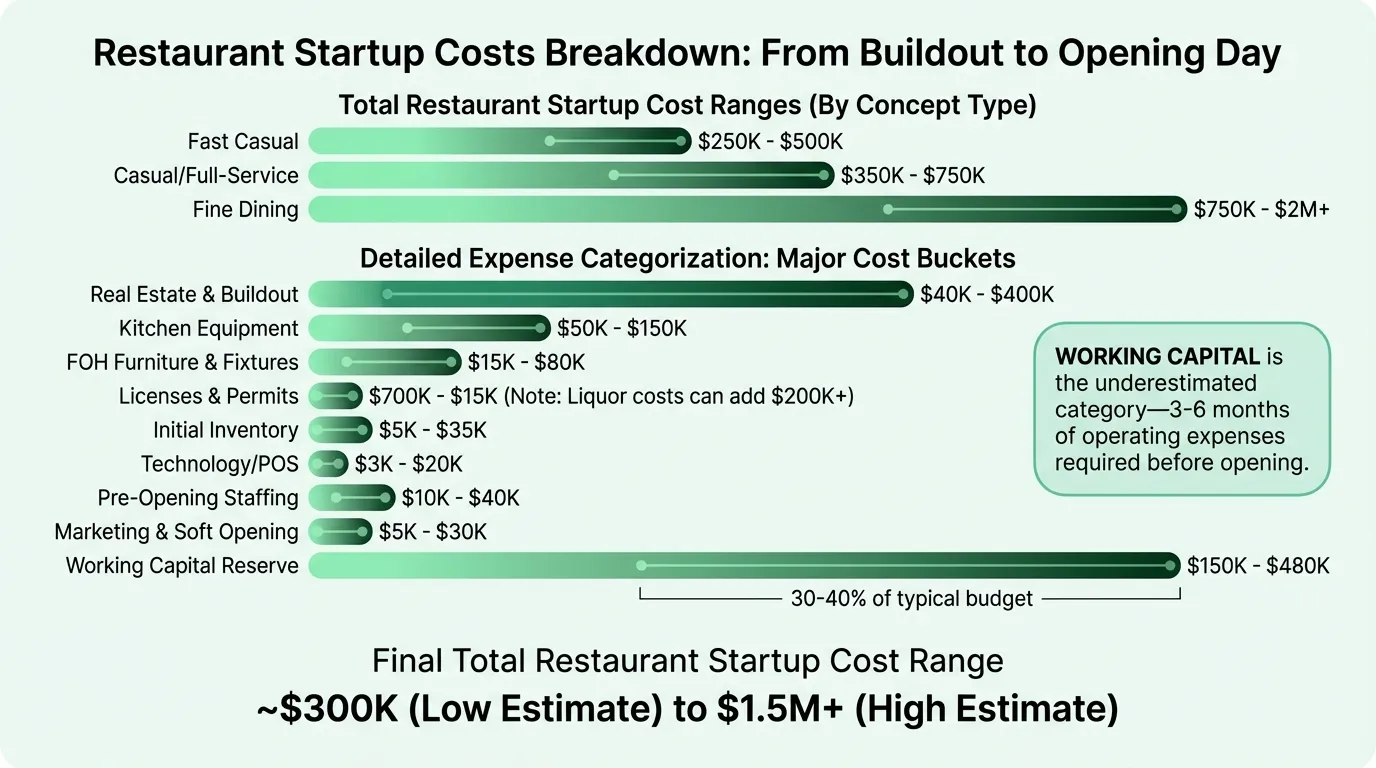
Here's a realistic breakdown of what it actually costs to open a restaurant — by category, by concept type, and including the reserves that keep you operating through the early months.
Total Ranges by Concept Type
Before getting into categories, here's what the full picture looks like by restaurant type:
| Concept Type | Typical Startup Range | Notes |
|---|---|---|
| Food truck / ghost kitchen | $50,000–$175,000 | Lowest barrier; shared kitchens under $50K possible |
| Fast casual (counter service) | $250,000–$500,000 | Lower FOH labor; simpler equipment and decor |
| Casual / full-service | $350,000–$750,000 | Median ~$475,500 per industry survey data |
| Fine dining | $750,000–$2,000,000+ | Premium buildout, equipment, wine program, high staffing ratio |
A survey of more than 350 independent U.S. restaurant owners found a median total startup cost of $375,500. The gap between the low and high end of any range is almost always explained by three factors: location (rent and labor market), buildout condition (raw space vs. second-generation restaurant space), and concept complexity.
Real Estate and Buildout
The single largest cost category for most restaurants.
Security deposit: Typically 3–6 months of rent paid upfront. In a market where rent runs $5,000/month, expect $15,000–$30,000 in security deposit before you touch a wall.
Renovation and buildout: This is the variable that blows startup budgets most often. A second-generation restaurant space (formerly a restaurant, with working kitchen infrastructure already in place) dramatically reduces costs. A raw retail shell that needs commercial plumbing, ventilation, grease traps, fire suppression, and ADA upgrades can run $100–$800 per square foot.
For a 2,000 sq ft space:
- Second-generation space with light renovation: $40,000–$80,000
- Mid-range buildout of a prepared shell: $100,000–$200,000
- Full buildout of a raw space: $200,000–$400,000+
ADA compliance adds $10,000–$30,000 in markets where it requires structural changes. Local codes on ventilation and fire suppression vary considerably — get a contractor estimate for your specific space before finalizing the lease.
Commercial Kitchen Equipment
A fully equipped commercial kitchen runs $50,000–$150,000 depending on concept. Here's what that includes:
| Equipment Category | Typical Range |
|---|---|
| Cooking line (ranges, fryers, broilers, ovens) | $15,000–$50,000 |
| Refrigeration (walk-ins, reach-ins, undercounter) | $10,000–$30,000 |
| Prep equipment (slicers, mixers, food processors) | $3,000–$15,000 |
| Dishwasher and warewashing | $3,000–$12,000 |
| Smallwares (pots, pans, utensils, cutting boards) | $2,000–$8,000 |
| Ventilation hood (if not existing) | $8,000–$20,000 |
Front-of-house furniture, fixtures, and tableware (tables, chairs, bar stools, plateware, glassware, linens) add another $20,000–$80,000, with fine dining skewing toward the top of that range.
One option that reduces upfront capital: equipment leasing. Leasing spreads costs over monthly payments and reduces the initial cash requirement, but the total cost over the lease term is higher than purchasing outright. It's a reasonable trade-off when cash is tight in the early months.
Licenses and Permits
The range here is surprisingly wide, mostly because of liquor licensing.
Base licenses and permits (without liquor):
- Business license: $50–$400
- Health and food service permit: $50–$1,000
- Signage permit, occupancy certificate: $200–$2,000
- Food handler certifications: $100–$500 per employee
Without a liquor license, plan for $700–$15,000 depending on your jurisdiction and concept complexity.
Liquor licensing: This is the category to research before signing a lease. State-issued fees range from $300 for a beer-and-wine permit to well over $100,000 for a full liquor license in quota states. In California and Florida, full spirits licenses are bought on a secondary market — prices can reach $200,000 or more in high-demand cities. Most operators outside quota markets can plan for $2,000–$15,000 for the license itself.
Insurance: General liability, property, and (if applicable) liquor liability insurance runs $3,000–$10,000 per year. Budget roughly $500–$800 per month and confirm your certificate of insurance requirement with your landlord before signing the lease.
Initial Inventory
Opening inventory runs $5,000–$35,000 depending on menu complexity, number of seatings, and concept type.
This is higher than your ongoing weekly purchasing because you're stocking non-perishables, specialty ingredients, and a broader range of items before you know your actual menu mix. A useful rule of thumb: budget 25–35% of projected first-month food and beverage revenue for your opening inventory.
For a restaurant projecting $60,000 in first-month food and beverage sales, that's $15,000–$21,000 in opening inventory — before you've generated a dollar of revenue.
Technology
POS system:
- Hardware (terminals, receipt printers, card readers): $2,000–$15,000
- Multi-terminal systems with kitchen display screens: $12,500–$20,000
- Monthly software subscriptions (POS, reservations, scheduling): $100–$500/month
Other technology costs: Online ordering integration, inventory management software, and accounting software add $100–$300/month in ongoing subscriptions. Plan for $5,000–$20,000 in upfront technology costs.
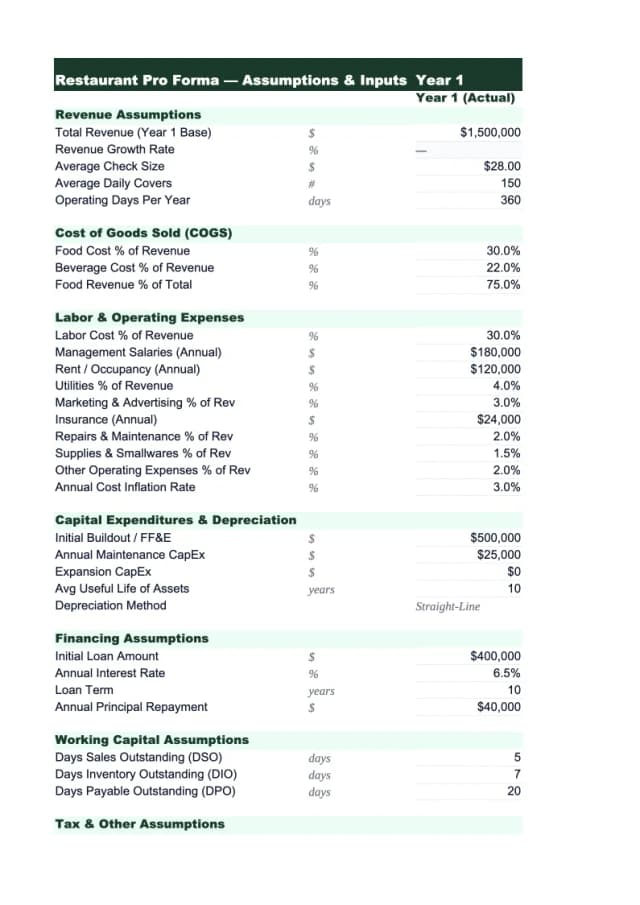
Need a ready-made pro forma template for your restaurant?
Download a pre-built spreadsheet with industry-specific categories, formulas, and formatting.
Pre-Opening Staffing and Training
Full-service restaurants require 1–3 weeks of paid training before opening. The cost:
- Recruitment and job posting: $500–$3,000
- Paid training wages for full crew: $5,000–$25,000
- Friends-and-family soft opening (discounted or complimentary service while staff practices): $2,000–$10,000
Total pre-opening staffing costs typically run $10,000–$40,000 for a full-service restaurant. Fast-casual concepts on the lower end; fine dining on the higher end.
Marketing and Soft Opening
Pre-opening and launch marketing:
- Brand identity (logo, menu design): $1,000–$10,000 (or $0 if using a designer on your team)
- Signage, exterior: $1,500–$8,000
- Website: $500–$5,000
- Social media setup and pre-launch promotion: $1,000–$5,000
- Soft opening event costs (food, drink, invited guests): $2,000–$10,000
Total pre-opening marketing: $5,000–$30,000. Ongoing marketing typically benchmarks at 3–6% of annual revenue.
Working Capital Reserves
This is the most important category that doesn't appear on most startup cost lists.
Most restaurants take 6–14 months to stabilize revenue. During that period, you still pay full rent, full payroll, and full food costs — regardless of what the dining room looks like on a Tuesday night in month three.
Industry advisors consistently recommend holding 3–6 months of operating expenses as a reserve before opening. For a restaurant with $50,000–$80,000 in monthly operating costs, that's $150,000–$480,000 set aside before you open the door.
Most operators who run out of money in year one didn't fail because the concept was wrong. They failed because they spent everything on buildout and equipment and had nothing left to survive the ramp-up period. Use the restaurant break-even calculator to determine how many months of operating costs your reserves need to cover before the business reaches profitability.
Build vs. Buy vs. Franchise
One decision that dramatically changes startup costs:
Opening from scratch (independent): Full creative control, highest risk, longest ramp-up, no proven customer base. Financing is hardest to obtain for first-time operators.
Buying an existing restaurant: Independent restaurants typically sell for 2–2.5x owner earnings. The real advantage is access to actual financial history — you can evaluate real food cost percentages, labor ratios, and revenue patterns before committing, instead of projecting from assumptions. Review the seller's restaurant balance sheet to understand existing debt, equipment value, and lease obligations before making an offer. Equipment and lease are already in place, often reducing your capital requirement compared to a full buildout.
Franchise: Proven operating system, brand recognition, easier financing — but ongoing royalties of 4–12% of gross sales reduce long-term margin significantly. Initial franchise fees run $20,000–$100,000 before buildout costs.
For first-time operators with limited capital, buying a profitable existing restaurant often provides better risk-adjusted value than building from scratch.
Building Your Startup Budget
A practical startup cost estimate should include all of the following line items:
| Category | Low Estimate | High Estimate |
|---|---|---|
| Security deposit + first/last month rent | $15,000 | $50,000 |
| Buildout and renovation | $40,000 | $350,000 |
| Kitchen equipment | $50,000 | $150,000 |
| FOH furniture, fixtures, tableware | $15,000 | $80,000 |
| Licenses and permits (excl. liquor) | $1,000 | $15,000 |
| Liquor license | $2,000 | $200,000+ |
| Insurance (first year) | $3,000 | $10,000 |
| Initial inventory | $5,000 | $35,000 |
| Technology (POS, software) | $3,000 | $20,000 |
| Pre-opening staffing and training | $10,000 | $40,000 |
| Marketing and soft opening | $5,000 | $30,000 |
| Working capital reserve (3–6 months) | $150,000 | $480,000 |
| Total | ~$300,000 | $1,500,000+ |
For most casual full-service restaurant concepts in mid-tier markets, a realistic working budget lands in the $400,000–$600,000 range when working capital is included.
Tracking the Numbers Before You Open
A startup budget is a different document from an operating budget. The startup budget tracks one-time capital expenditures. Once you're open, you need a recurring budget that tracks monthly food cost, labor, occupancy, and overhead against actual P&L results. The restaurant pro forma example bridges these two phases — it models how startup costs translate into ongoing monthly operating economics.
The Restaurant Budget Template is built for ongoing operations — monthly tracking, budget-vs-actual comparison, and seasonality adjustments. The Restaurant Cash Flow Template handles the weekly cash view, which matters most during the ramp-up period when revenue is unpredictable.
The startup budget determines whether you can open. The operating budget and cash flow projection determine whether you can stay open.
Last updated: March 23, 2026
Frequently Asked Questions
Related Articles
Coffee Shop Budget Example: Real Numbers and Benchmarks
A practical coffee shop budget example with real cost benchmarks — covering beverage COGS, labor, rent, equipment maintenance, and the line items most operators underestimate.
Church Budget Example: Categories, Percentages, and What to Include
A practical church budget example with real percentages for staff, facilities, missions, and programs — plus the line items most churches overlook.
Construction Budget Example: Line Items, Percentages, and What to Include
A practical construction budget example covering hard costs, soft costs, overhead allocation, and the line items most contractors underestimate.
Daycare Budget Example: Categories, Benchmarks, and What to Watch
A practical daycare budget example covering revenue sources, expense ratios, occupancy thresholds, and the line items that determine whether a center stays financially viable.
Event Planning Budget Example: Real Numbers for Your Business
A practical event planning budget example covering agency overhead, per-event costs, revenue models, and the benchmarks every planner needs to protect margins.
Hotel Budget Example: Departments, Benchmarks, and Real Numbers
A practical hotel budget example covering the USALI department structure, labor benchmarks, GOP targets, and the line items independent hoteliers most often miss.