Wedding Planning Budget Guide: Categories, Benchmarks, Real Numbers
A practical wedding planning budget guide covering category allocations, hidden costs that blow budgets, and how to track every dollar from deposit to final invoice.
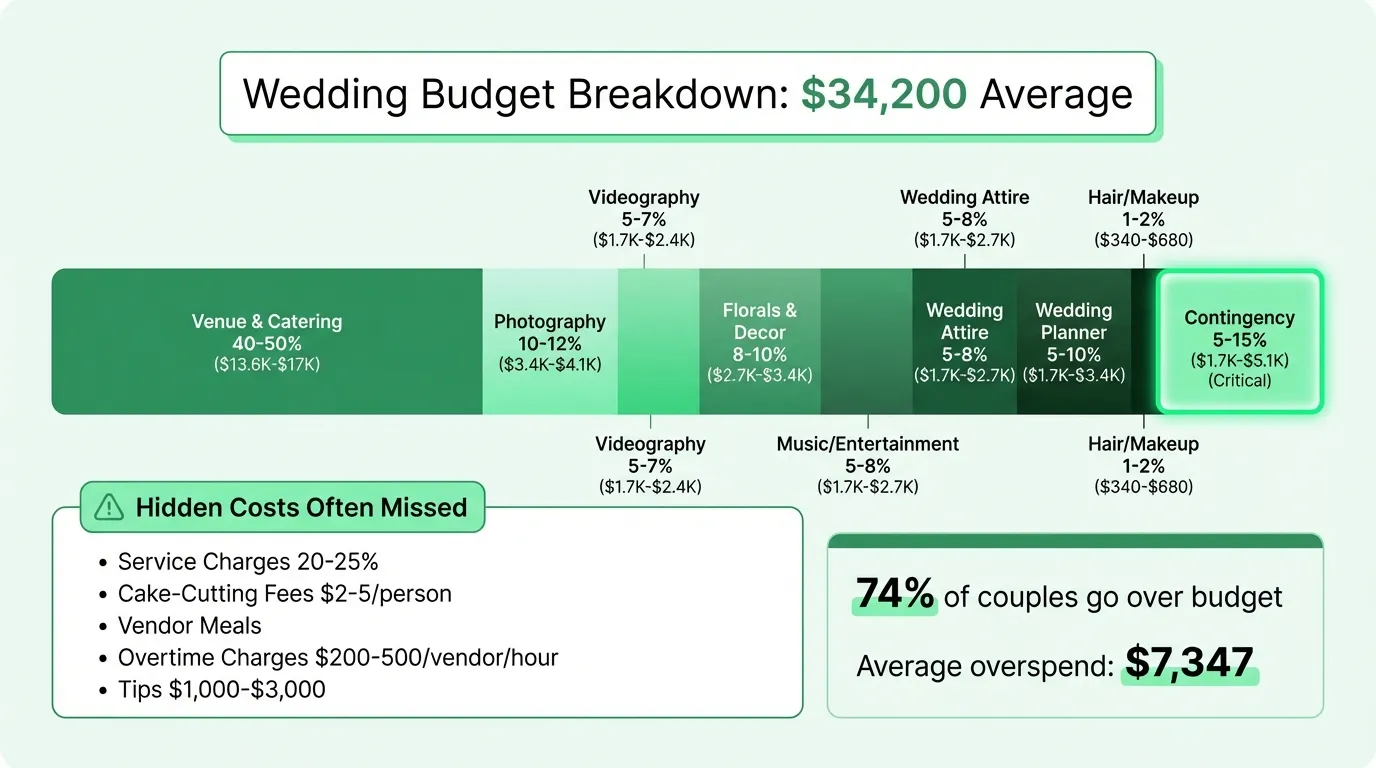
74% of couples go over their wedding budget. The average overspend is $7,347, according to The Knot's 2026 Real Weddings Study. That's not a rounding error — it's a second vacation, a year of loan payments, or the start of a house fund.
The root cause is almost never spending on the wrong things. It's building the budget wrong in the first place: setting a number based on intuition instead of actual vendor research, then discovering that the first three quotes already exceed the plan.
This guide covers how to build a budget that reflects what weddings actually cost, where couples consistently underestimate, and how to track spending before it gets away from you.
Start with the Real National Benchmarks
The national average wedding cost was $34,200 in 2025 (The Knot 2026 Real Weddings Study, 10,474 couples). Average guest count: 117. Average per-guest cost: $292.
Both numbers vary sharply by location:
| State | Average Wedding Cost |
|---|---|
| New Jersey | $57,000 |
| Rhode Island | $51,000 |
| Illinois | $39,000 |
| Utah | $18,000 |
| Iowa | $19,000 |
| Nevada | $20,000 |
A 150-guest wedding in San Francisco averages approximately $85,000 — nearly double the $43,000 average in Milwaukee for the same event structure, according to Joy's 2025 cost data.
The median wedding cost is around $10,000, much lower than the mean. High-spend events pull the national average up. If you're planning in a mid-cost market with 75–100 guests, a realistic budget is $20,000–$30,000 for a modest celebration and $35,000–$50,000 for something more upscale.
Budget Category Breakdown
Build your budget by category from real local quotes — not as a single number that you divide up later. Here are the standard allocations used by wedding planners, with dollar equivalents on a $34,000 budget:
| Category | % of Budget | Dollar Range ($34K budget) |
|---|---|---|
| Venue and catering | 40–50% | $13,600–$17,000 |
| Photography | 10–12% | $3,400–$4,080 |
| Videography | 5–7% | $1,700–$2,380 |
| Florals and decor | 8–10% | $2,720–$3,400 |
| Music and entertainment | 5–8% | $1,700–$2,720 |
| Wedding planner/coordinator | 5–10% | $1,700–$3,400 |
| Wedding attire | 5–8% | $1,700–$2,720 |
| Cake and desserts | 2–3% | $680–$1,020 |
| Hair and makeup | 1–2% | $340–$680 |
| Stationery and invitations | 1–2% | $340–$680 |
| Transportation | 2–3% | $680–$1,020 |
| Officiant | 1% | $300–$400 |
| Favors and gifts | 1–2% | $340–$680 |
| Contingency | 5–15% | $1,700–$5,100 |
The contingency line isn't optional. 74% of couples overspend — the ones who budget a buffer absorb the overruns without crisis. The ones who don't have to scramble when the floral quote comes in $800 higher than expected.
The Wedding Planning Budget Template structures these categories with budget-vs-actual tracking, deposit schedules, and a running total so you can see exactly where you stand.
What Vendors Actually Cost
Percentages are useful for initial allocation. Real quotes look like this, based on The Knot's 2026 national data:
| Vendor | National Average | Typical Range |
|---|---|---|
| Photography | $4,400 | $3,500–$5,300 |
| Videography | $2,300 | $1,500–$3,500 |
| Live band | $4,475 | $2,000–$12,000 |
| DJ | $1,689 | $1,000–$5,000 |
| Florals | $2,723 | $1,343–$3,457 |
| Full-service planner | $7,000–$10,000 | Up to $12,000 |
| Day-of coordination | $1,400 | $800–$3,395 |
| Wedding dress | $2,100 | $1,200–$3,200+ |
These are national averages. Major metro markets run 30–60% higher. Get at least two quotes per category from local vendors before finalizing your budget — treat this research as part of the planning process, not a step you skip.
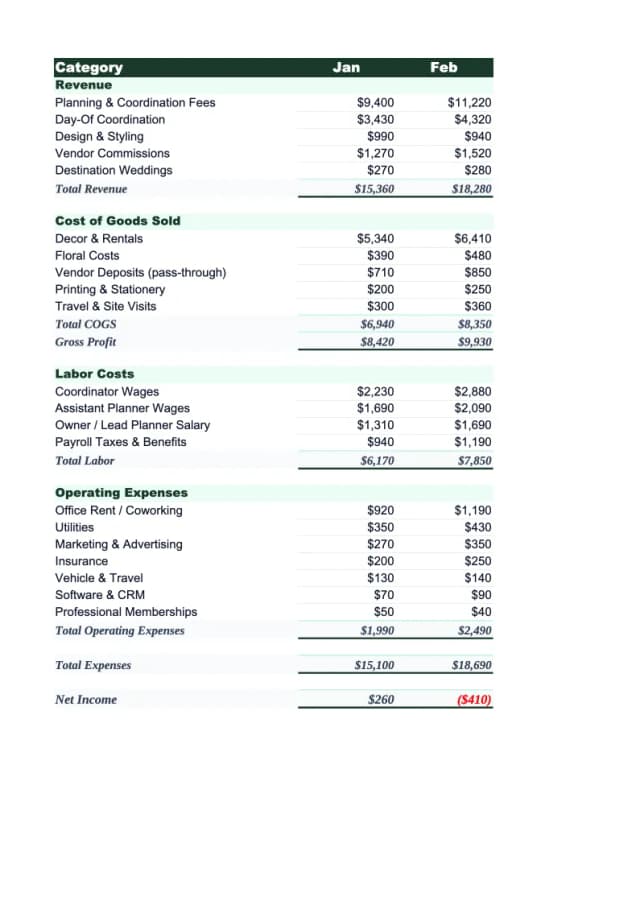
Need a ready-made budget template for your wedding planning?
Download a pre-built spreadsheet with industry-specific categories, formulas, and formatting.
The Hidden Costs That Blow Budgets
Vendor quotes and final invoices are not the same thing. The gap is where most budget overruns happen.
Service charges and gratuity. Venue and catering quotes often list a food and beverage minimum, not the total cost. Add 20–25% service charge plus sales tax and gratuity, and a $10,000 food and beverage minimum becomes $13,500–$14,500 on the final invoice. Budget the gross number, not the quote.
Chair and linen rentals. Many venues provide bare tables and chairs and rent linens, chair covers, and specialty seating as extras. These line items rarely appear in initial proposals.
Cake-cutting fees. Some venues charge $2–$5 per person to cut and serve a cake you bring in from an outside baker. On 120 guests, that's $240–$600 you didn't expect.
Vendor meals. Most vendor contracts require that you feed the vendors working your event — photographer, videographer, DJ, planner. Plan for one meal per vendor at roughly the cost of a guest meal.
Overtime charges. Photographers, DJs, and venue staff typically charge for time beyond the contracted hours. If the reception runs long, the overage can be $200–$500 per vendor per hour. The Wedding Planning Expense Tracker Template captures these hidden costs alongside your vendor contracts so nothing falls through the cracks.
Alterations and accessories. The average wedding dress costs $2,100, but alterations add $300–$600 and accessories (veil, shoes, jewelry, undergarments) easily add another $500–$1,000.
Tips. Gratuities for all vendors — photographers, catering staff, drivers, hair and makeup, setup crew — are standard but almost never in quotes. Budget $1,000–$3,000 as a separate line item.
How to Track the Budget Without Losing the Thread
A spreadsheet is the right tool for wedding budget tracking. The structure that works:
Three columns for every vendor line:
- Budget — what you planned to spend
- Contracted — what the signed contract says
- Paid to date — deposits and payments made
This lets you see the variance between plan and reality as soon as contracts are signed, not after the wedding.
A separate payment calendar. Most vendors require a deposit at contract signing (25–50%) with the balance due 30 days before the wedding. Map every payment to a date so you can see upcoming cash needs. A payment cluster — multiple vendors due in the same two-week window — will catch you off guard if you don't see it coming.
Update on every transaction, not monthly. The only budget that works is one that reflects what's actually been agreed and paid. Update it every time a contract is signed or a payment is made.
Run a category-level review after every major booking. If florals came in $800 over budget, identify where the offset comes from before booking the next vendor. Don't assume it will work out. The Wedding Planning Project Budget Template structures this review with budget-vs-contracted columns for every vendor category.
The Levers That Actually Save Money
Not all savings are equal. These are the high-impact options:
Guest count. The single most powerful lever. Every guest affects per-person catering, seating, favors, and cake simultaneously. Cutting from 150 to 120 guests at $100/head in catering costs alone saves $3,000 before service charges. In practical terms, trimming 20 guests can fund better photography or an upgraded venue.
Day of week. Friday and Sunday weddings typically cost 20–30% less than Saturday at the same venue. If guest travel logistics allow it, this is one of the cleanest savings available.
Season. November through April (excluding holiday weekends) carries lower venue pricing in most U.S. markets. Peak season — May through October — commands premium pricing, especially from June through September.
DJ vs. live band. The national average gap is $2,786 ($4,475 for a live band vs. $1,689 for a DJ, per The Knot). Approximately 70% of couples chose a DJ in 2024. Music quality differences are real, but so is the savings.
Bar service. Beer-and-wine-only service runs $8–$10 per person vs. $15–$45 for a full open bar. On 120 guests, that difference is $840–$4,200.
Early booking. Vendors — especially photographers and popular venues — raise prices seasonally. Booking 12–18 months in advance locks pricing before the next increase. The Wedding Planning Cash Flow Template maps deposit schedules across your full vendor list so you can plan payment timing alongside booking decisions.
Putting It Together
The couples who stay close to their budgets share one habit: they build the plan by category from real quotes before committing to any number. The ones who go over by $7,000 typically started with a number, got emotionally attached to vendors who came in above it, and stretched the budget one item at a time.
The Wedding Planning Budget Template is built for this process — start with the category framework, input your quotes as you collect them, and track deposits and payments through to the final invoice. If you're also coordinating multiple events or managing client funds as a planner, the Event Planning Budget Template handles the vendor and client payment tracking for a full event portfolio.
A realistic budget, built from real numbers, is the one thing that keeps the planning process from becoming a financial stress you carry into the marriage.
Last updated: March 23, 2026
Frequently Asked Questions
Related Articles
Coffee Shop Budget Example: Real Numbers and Benchmarks
A practical coffee shop budget example with real cost benchmarks — covering beverage COGS, labor, rent, equipment maintenance, and the line items most operators underestimate.
Church Budget Example: Categories, Percentages, and What to Include
A practical church budget example with real percentages for staff, facilities, missions, and programs — plus the line items most churches overlook.
Construction Budget Example: Line Items, Percentages, and What to Include
A practical construction budget example covering hard costs, soft costs, overhead allocation, and the line items most contractors underestimate.
Daycare Budget Example: Categories, Benchmarks, and What to Watch
A practical daycare budget example covering revenue sources, expense ratios, occupancy thresholds, and the line items that determine whether a center stays financially viable.
Event Planning Budget Example: Real Numbers for Your Business
A practical event planning budget example covering agency overhead, per-event costs, revenue models, and the benchmarks every planner needs to protect margins.
Hotel Budget Example: Departments, Benchmarks, and Real Numbers
A practical hotel budget example covering the USALI department structure, labor benchmarks, GOP targets, and the line items independent hoteliers most often miss.