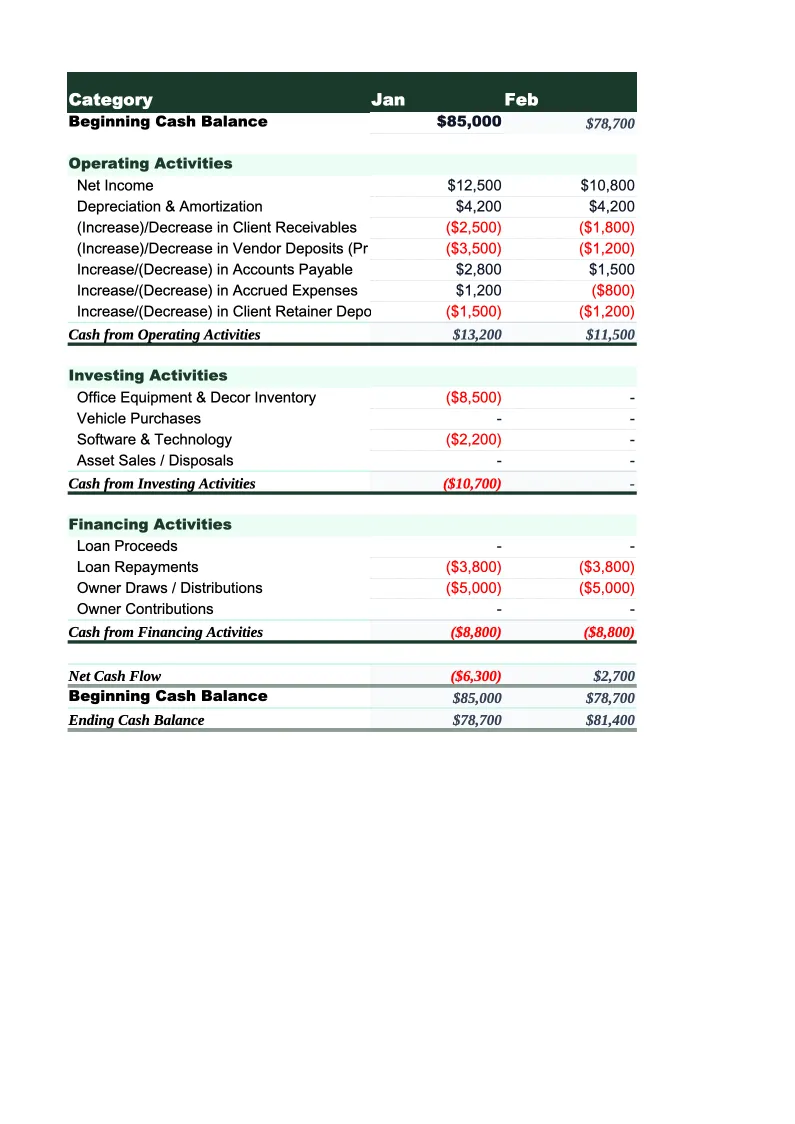
Wedding Planning Cash Flow Template
Track and project cash flow for your wedding planning business — with client deposit tracking, vendor payment timing, milestone billing, and a 13-week projection built around the seasonal, event-driven cash cycles wedding planners actually manage.
What's Inside This Wedding Planning Cash Flow Template
This template includes 4 worksheets, each designed for a specific part of your wedding planning financial workflow:
13-Week Cash Flow
A rolling 13-week cash projection covering the most actionable planning window for a wedding planning business.
Monthly Cash Flow
A 12-month indirect-method cash flow statement organized into operating, investing, and financing activities.
Wedding & Client Tracker
A dedicated sheet for managing every booked wedding, outstanding client payment, and vendor pass-through obligation — the cash flow engine behind the 13-week projection.
Annual Summary
A full-year rollup of revenue by type, operating cash flow, and the KPIs that wedding planning business owners and potential buyers use to evaluate the business.
Wedding Planning Cash Flow Template Features
- 13-week cash projection with client deposits, milestone payments, and vendor pass-through collections tracked as separate inflows — each arriving on a different schedule relative to the wedding date
- Wedding & Client Tracker with upcoming client payments and vendor disbursements displayed side-by-side for the next 90 days, showing net cash position by month across the active wedding calendar
- Deferred revenue and vendor pass-through liability adjustments in the monthly indirect cash flow — separating the cash a planner holds in trust for vendors from the cash the business has actually earned
- Net planning revenue calculation that strips out vendor pass-throughs, showing the actual scale and margins of the planning business rather than gross receipts inflated by pass-through flows
- Automatic flagging of late client milestone payments with vendor disbursement due dates in the same window — surfacing timing risk before a late collection creates a vendor payment problem
- Seasonal cash flow visualization showing deposit-heavy booking season (January–March) versus disbursement-heavy wedding season (May–October) and the cash management discipline required to bridge the two
How to Use This Wedding Planner Cash Flow Spreadsheet
Download the .xlsx file and open it in Excel or Google Sheets. Start with the Wedding & Client Tracker — enter every booked wedding: the wedding date, total contract value, deposits received to date, upcoming milestone payment amounts and due dates, and any vendor pass-through amounts you're managing for the client. For each wedding with pass-through obligations, enter both the client collection date and the vendor payment due date separately. This step takes 30–45 minutes for a full booked calendar and immediately shows your net cash position — what's in the bank, what's committed to future vendor payments, and what you can actually spend on business operations. Most planners find this first pass reveals a meaningful difference between their bank balance and their available operating cash.
Move to the 13-Week Cash Flow sheet and fill in weekly inflows and outflows. Use the Wedding & Client Tracker as your source: pull each upcoming client milestone payment into the week it's due, enter pass-through collections in the weeks they're scheduled, and enter vendor disbursements in the weeks they're owed. For outflows, enter assistant wages in the weeks they're worked, contractor fees in the weeks they're due, marketing costs on their billing dates, and fixed expenses on their regular schedule. The ending cash balance row at the bottom of each week shows your projected cash position — run this projection at the start of each month to catch weeks where vendor disbursements exceed expected client collections.
15 minutes from download to your first cash flow projection
Download the template, enter your booked weddings and outstanding payments, and see your planning business's full cash picture — 13-week projection, client tracker, and annual summary included.
Why Wedding Planners Need a Dedicated Cash Flow Template
Wedding planning has a cash flow structure that looks healthy on paper until you separate the money that passes through the business from the money it actually keeps. A planner managing $400,000 in total annual receipts — planning fees plus vendor pass-throughs — might have net planning revenue of $120,000 after disbursing $280,000 to vendors. The bank balance during booking season, when deposits are arriving and vendor payments haven't started, can look dramatically better than the real operating cash position. The planners who run into trouble aren't the ones who undercharge — they're the ones who spend operating cash that's actually earmarked for an October caterer payment because January's bank balance looked flush. Cash flow management in wedding planning starts with separating what you've collected from what you've earned.
The seasonal pattern creates a second layer of complexity: wedding planning businesses collect most of their deposits in January through March (when holiday-engaged couples are booking), deliver most of their events in May through June and September through October, and experience their slowest event calendar in November through February — the same months when the next year's bookings are coming in. This means a well-run planning business in January is simultaneously receiving deposits for weddings 8–12 months away, disbursing final payments to vendors from December events, and managing the cash gap between those two. The planners with the most stable operations maintain a cash reserve equal to at least 60 days of operating expenses — enough to cover the slow-event months without touching the deposit float.
Wedding Planning Industry at a Glance
Financial templates built for wedding planners and coordinators — from day-of coordinators to full-service agencies. Pre-loaded with fee structures, payment milestone tracking, and vendor pass-through categories.
Revenue Drivers
- Full-service planning fees
- Day-of coordination packages
- Vendor referral commissions
- Vendor pass-through markups
- Add-on services (rehearsal dinner, elopements)
Key Cost Categories
- Assistant coordinator wages
- Contractor/sub-planner fees
- Vendor pass-through costs
- Marketing (Knot/WeddingWire listings)
- Planning software subscriptions
- Professional liability insurance
- Transportation and mileage
Typical Margins
Gross: 55-70% · Net: 15-25%
Seasonality
Peak weddings in May-June (spring) and September-October (fall). January-February slowest for events but highest for new bookings from holiday-engaged couples.
Key Performance Indicators
Wedding Planning Cash Flow Template FAQ
More Wedding Planning Templates
Wedding Planning Balance Sheet Template for Excel
$29
Wedding Planning Budget Template for Excel
$29
Wedding Planning Business Plan Template for Excel
$39
Wedding Planning Expense Tracker Template for Excel
$29
Wedding Planning Financial Model Template for Excel
$29
Wedding Planning Income Statement Template for Excel
$29
Wedding Planning Invoice Template for Excel
$29
Wedding Planner KPI Dashboard Template for Excel
$29
Wedding Planner P&L Template for Excel
$29
Wedding Planning Pro Forma Template for Excel
$29
Wedding Planning Project Budget Template for Excel
$29
Wedding Planning Sales Forecast Template for Excel
$29
Wedding Planning Business Valuation Template for Excel
$29
Wedding Planning Cash Flow Template
$29