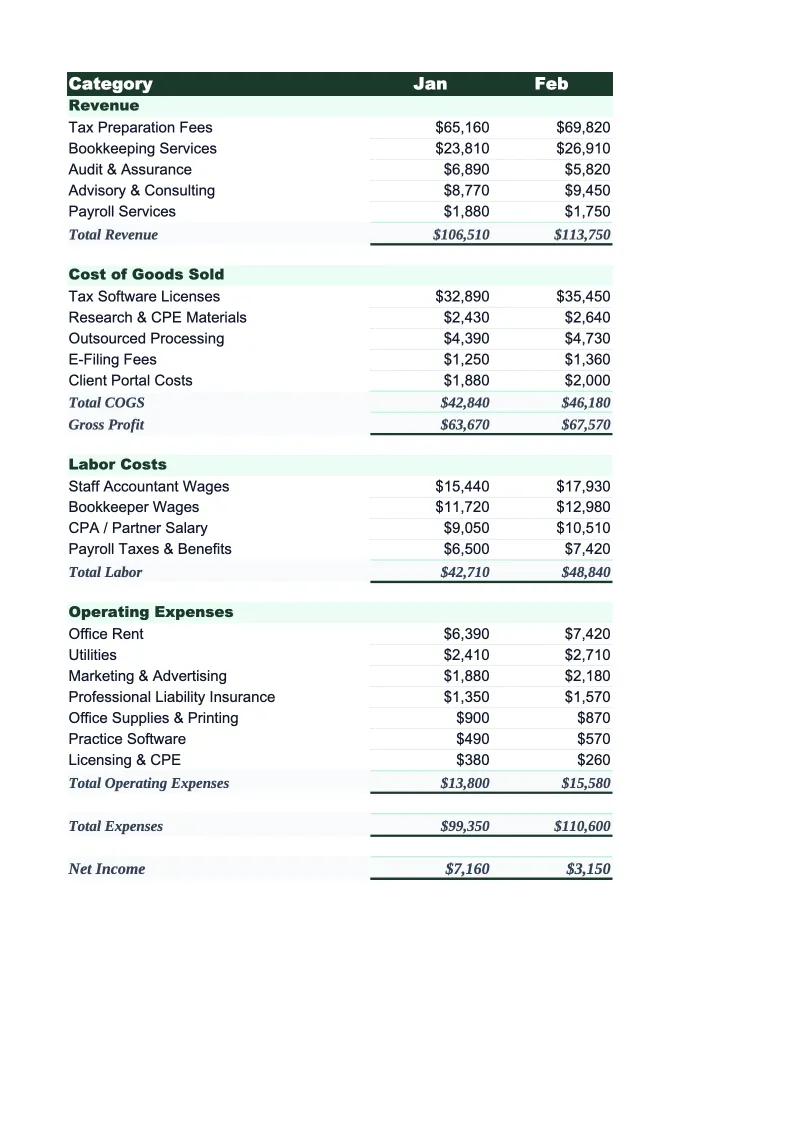
Accounting Firm Budget Template
Plan and track your accounting firm's finances with a budget template built around billable hours, service line revenue, and the busy-season cost patterns that define public accounting.
What's Inside This Accounting Firm Budget Template
This template includes 5 worksheets, each designed for a specific part of your accounting firm financial workflow:
Monthly Budget
The core worksheet where you plan each month's revenue and expenses.
Annual Summary
A 12-month rollup that pulls from each monthly sheet and displays full-year revenue by service line, total expenses by category, and net profit.
Budget vs Actual
Track planned figures against what actually happened each month and year-to-date.
Capacity & Utilization
Plan your billable hours capacity and track utilization rate by staff level — partners, managers, seniors, staff, and administrative.
Dashboard
A visual summary with pre-built charts for revenue by service line, expense breakdown, utilization rate by month, and net margin trend.
Accounting Firm Budget Template Features
- Revenue split by service line: tax, audit, CAS, advisory, and payroll
- Capacity planning sheet to model utilization rate and revenue per FTE by staff level
- Monthly budget with 12-month annual rollup and seasonality visibility
- Budget vs actual variance tracking with color-coded alerts
- Staff cost tracking by professional level including benefits and CPE
- Visual dashboard with charts for margin trend, utilization, and service line mix
How to Use This Accounting Firm Budget Spreadsheet
Start with the Capacity & Utilization sheet before you touch revenue. Enter your current headcount by level — partners, managers, seniors, and staff — along with each level's total available hours, target utilization rate, and standard billing rate. The sheet will calculate the revenue your firm can realistically generate at those headcount levels. This becomes your revenue ceiling and the starting point for the rest of the budget. Most firms find that grounding the budget in capacity first prevents the mistake of projecting revenue that requires headcount you don't have.
Once capacity is set, move to the Monthly Budget sheet and allocate that revenue across service lines. Split your projected billings between tax preparation, audit, bookkeeping and CAS, advisory, and payroll based on how your current client mix actually breaks down — not how you'd like it to. Then fill in your expense categories: salaries and benefits are largely fixed, so start there, and work toward the variable items like subcontractors, CPE, and marketing. Adjust the seasonal weighting across months to reflect your firm's typical Q1 surge and summer slowdown.
15 minutes from download to your first firm budget
Download the template, plug in your headcount and service line revenue, and see your accounting firm's full financial picture — capacity, seasonality, and variance tracking included.
Why Every CPA Practice Needs a Budget Template
Accounting firms have unusually predictable revenue patterns — and unusually concentrated risk. A well-run CPA practice earns a large portion of its annual revenue between January and April 15, with a smaller spike around the September and October extension deadlines. The rest of the year is slower, and firms that don't plan for that seasonal shape often find themselves cash-light in July and August despite strong annual profits. A budget built around that seasonality gives managing partners a tool to answer the question that matters most: do we have enough to cover fixed costs in the slow months without touching busy-season cash?
The two numbers that drive accounting firm profitability more than any other are utilization rate and realization rate. Utilization is billable hours divided by total available hours — most well-run firms target 65–80% depending on staff level, with partners lower than seniors. Realization is actual billed revenue divided by the standard-rate value of hours worked — a measure of how much of your work you actually collect. A firm with strong utilization but poor realization is often under-billing, over-discounting, or carrying clients who aren't worth keeping. This template builds utilization planning directly into the budget so you can see the revenue impact before the year starts rather than after it ends.
Accounting Firm Industry at a Glance
Financial templates built for accounting firms and CPA practices — from solo practitioners to multi-partner firms. Pre-loaded with billable hour tracking, realization rate calculations, and service categories that reflect how accounting firms actually bill.
Revenue Drivers
- Tax preparation and planning
- Audit and assurance
- Bookkeeping and client accounting services (CAS)
- Advisory and fractional CFO services
- Payroll processing
Key Cost Categories
- Professional staff salaries and benefits
- Administrative staff
- Occupancy and rent
- Technology and software (tax, practice management)
- Malpractice (E&O) insurance
- Marketing and business development
- CPE and professional development
- Subcontractors and offshore staff
Typical Margins
Gross: 50-65% · Net: 20-35%
Seasonality
Heavy busy season January through April 15; secondary crunch in September through October 15 for extensions. Slowest months are July and August.
Key Performance Indicators
Accounting Firm Budget Template FAQ
More Accounting Firm Templates
Accounting Firm Balance Sheet Template for Excel
$29
Accounting Firm Business Plan Template for Excel
$39
Accounting Firm Cash Flow Template for Excel
$29
Accounting Firm Expense Tracker Template for Excel
$29
Accounting Firm Financial Model Template for Excel
$29
Accounting Firm Income Statement Template for Excel
$29
Accounting Firm Invoice Template for Excel
$29
Accounting Firm KPI Dashboard Template for Excel
$29
Accounting Firm P&L Template for Excel
$29
Accounting Firm Pro Forma Template for Excel
$29
Accounting Firm Project Budget Template for Excel
$29
Accounting Firm Sales Forecast Template for Excel
$29
Accounting Firm Valuation Template for Excel
$29
Accounting Firm Budget Template
$29