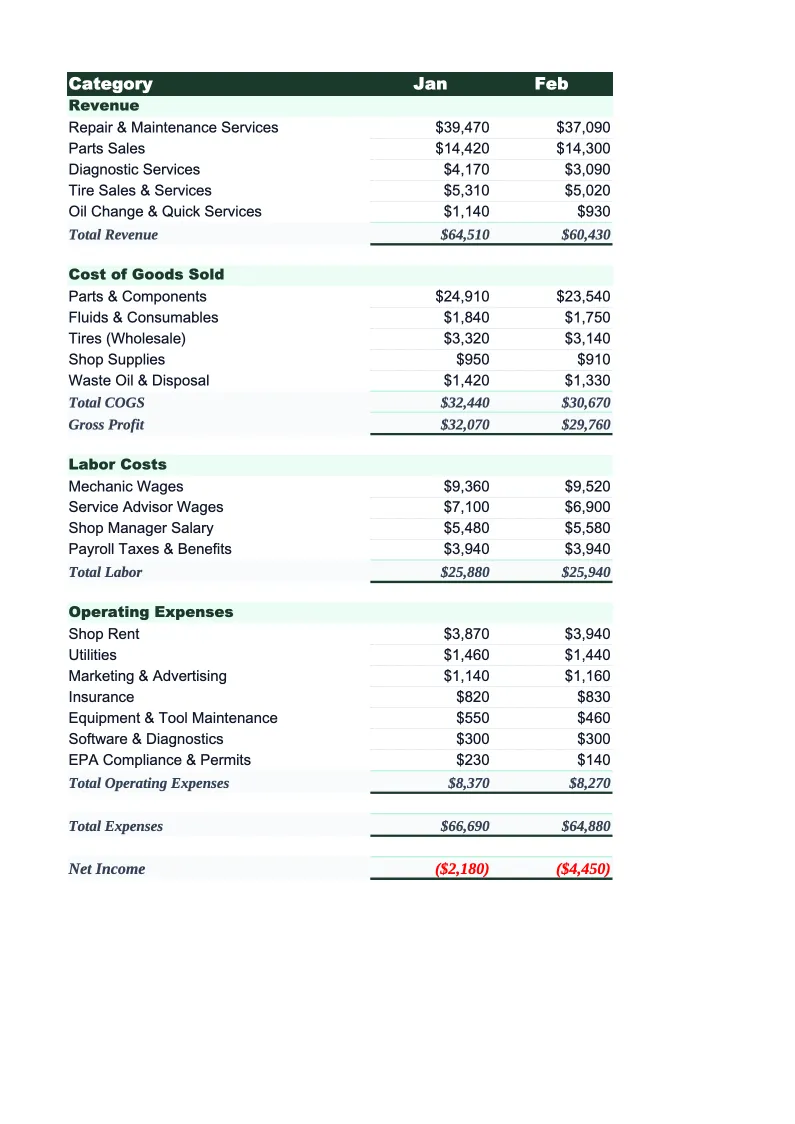
Auto Repair Budget Template
Plan and track your auto repair shop's finances with a budget template built for the automotive service industry. Pre-loaded with labor, parts, and shop overhead categories.
What's Inside This Auto Repair Shop Budget Template
This template includes 5 worksheets, each designed for a specific part of your auto repair financial workflow:
Monthly Budget
The core worksheet where you plan each month's revenue and expenses.
Annual Summary
A 12-month rollup that pulls data from each monthly sheet automatically.
Budget vs Actual
Enter your actual monthly revenue and expense figures alongside your budget and this sheet calculates the dollar and percentage variance for every line item.
KPI Tracker
Tracks the auto repair industry's key performance indicators alongside your financial data.
Dashboard
A visual summary with pre-built charts showing revenue by service type, gross margin trend, labor vs parts revenue split, and expense breakdown by category.
Auto Repair Shop Budget Template Features
- Revenue split by labor, parts, oil changes, diagnostics, tires, and shop fees
- Technician labor and parts COGS tracked separately from fixed overhead
- Monthly budget with 12-month annual rollup
- Budget vs actual variance tracking with color-coded alerts
- KPI Tracker for ARO, ELR, car count, and parts-to-labor ratio
- Visual dashboard with charts for margin trends and revenue mix
How to Use This Auto Repair Budget Spreadsheet
Getting started takes about 15 minutes. Download the .xlsx file and open it in Excel or Google Sheets — no macros or plugins needed. Start on the Monthly Budget sheet and review the pre-loaded categories. Most independent shops and service centers will recognize the line items immediately and only need to adjust a few labels to match their specific service mix. If you don't have formal bookkeeping, pull your last 2–3 bank and card statements to use as a baseline for your first month.
Once the categories are set, enter your revenue targets by service type and your projected costs for the month. The parts and labor split is the most important one to get right — use your shop management software reports if you have them, or estimate based on your typical repair order mix. The KPI Tracker sheet is worth filling in monthly even if you're not tracking it anywhere else; ARO and ELR in particular will tell you faster than any other number whether the shop is performing.
15 minutes from download to your first budget
Download the template, plug in your shop's numbers, and see your full financial picture — monthly budget, annual rollup, KPI tracking, and variance analysis included.
Why Every Auto Repair Shop Needs a Budget Template
Auto repair shops operate on thinner margins than most owners expect. Gross margins of 50–60% sound healthy until you account for fixed overhead — rent, equipment payments, insurance, and a full technician payroll that doesn't scale down on slow weeks. Net margins typically land between 5–15%, which means a 10% swing in car count or a parts cost increase of a few percentage points can turn a profitable month into a break-even one. Without a structured budget, those swings are usually discovered too late to course-correct.
Budgeting for an auto repair shop requires separating two distinct cost structures. Parts and materials are variable — they move directly with repair volume — and your gross margin on parts is one of the most controllable levers in the business. Technician labor, by contrast, is mostly fixed: you pay your techs whether the bays are full or not. That means a shop's profitability is disproportionately sensitive to car count and Average Repair Order. Tracking both in the same budget gives you a clear picture of which lever to pull when the numbers drift.
Auto Repair Industry at a Glance
Financial templates built for auto repair shops — from single-bay independents to multi-location service centers. Pre-loaded with labor, parts, and overhead categories specific to the automotive service industry.
Revenue Drivers
- Labor (repair services)
- Parts sales
- Oil changes & maintenance
- Diagnostics & inspections
- Tire sales
- Shop supplies fees
Key Cost Categories
- Parts & materials (COGS)
- Technician labor
- Rent & occupancy
- Equipment & tools
- Utilities
- Insurance
- Marketing & advertising
- Shop supplies
Typical Margins
Gross: 50-60% · Net: 5-15%
Seasonality
Busiest in summer (June–August) and spring (March–May) for maintenance and travel prep; January–February are consistently the slowest months.
Key Performance Indicators
Auto Repair Shop Budget Template FAQ
More Auto Repair Templates
Auto Repair Shop Balance Sheet Template for Excel
$29
Auto Repair Shop Business Plan Template for Excel
$39
Auto Repair Shop Cash Flow Template for Excel
$29
Auto Repair Expense Tracker Template for Excel
$29
Auto Repair Financial Model Template for Excel
$29
Auto Repair Income Statement Template for Excel
$29
Auto Repair Invoice Template for Excel
$29
Auto Repair KPI Dashboard Template for Excel
$29
Auto Repair P&L Template for Excel
$29
Auto Repair Shop Pro Forma Template for Excel
$29
Auto Repair Shop Project Budget Template for Excel
$29
Auto Repair Sales Forecast Template for Excel
$29
Auto Repair Shop Valuation Template for Excel
$29
Auto Repair Budget Template
$29