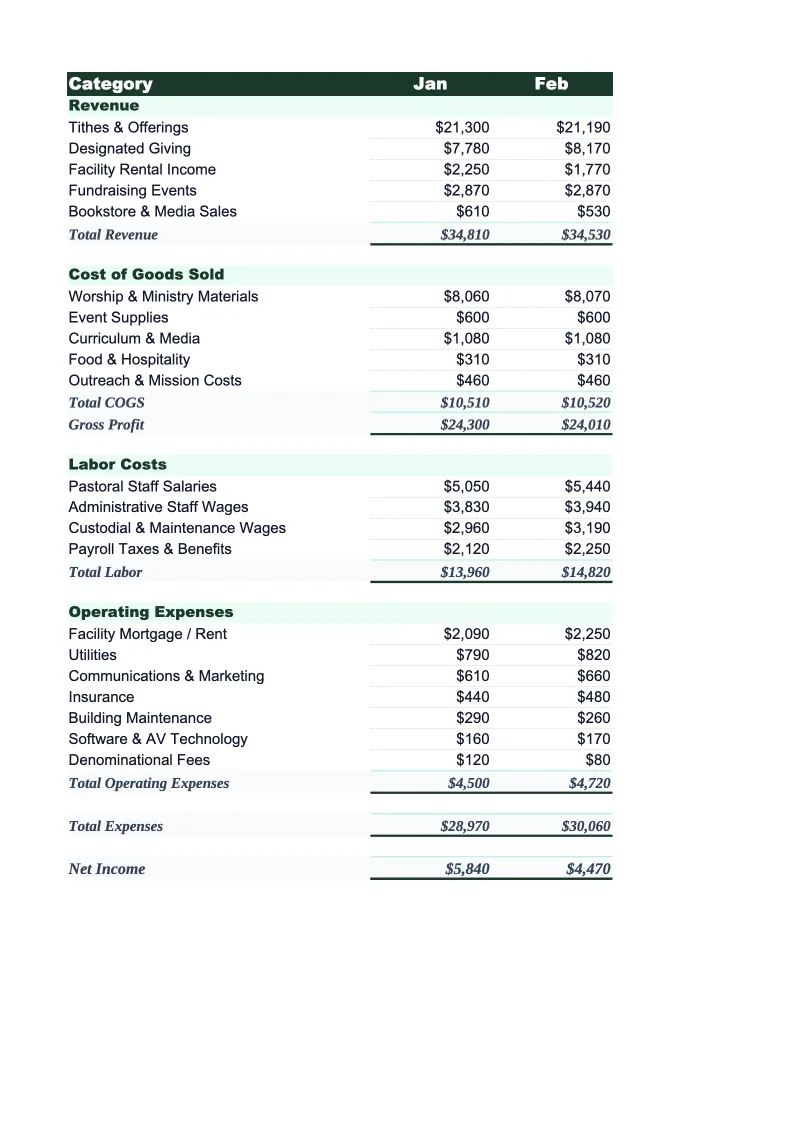
Church Budget Template
Plan and track your church's finances with a budget template built for religious organizations. Pre-loaded with giving, ministry, personnel, and facilities categories.
What's Inside This Church Budget Template
This template includes 5 worksheets, each designed for a specific part of your church financial workflow:
Annual Budget
The core planning worksheet where you set your full-year revenue and expense targets by category.
Monthly Breakdown
A 12-month view of your annual budget spread across the calendar year, accounting for giving seasonality.
Budget vs Actual
Track what you planned against what was actually received and spent, month by month.
Ministry Budgets
A supplemental worksheet where you can break out budget allocations for individual ministries — children's ministry, youth, worship, small groups, missions, and outreach, for example.
Dashboard
A visual summary with pre-built charts showing giving trends by month, expense breakdown by category, budget vs actual variance, and key financial ratios.
Church Budget Template Features
- Pre-built giving categories: tithes, special offerings, facility rental, tuition
- Expense categories for personnel, facilities, ministry programs, missions, and debt service
- Monthly giving seasonality built into the 12-month breakdown
- Per-ministry budget tracking with allocated vs spent view
- Budget vs actual variance tracking with color-coded alerts
- Dashboard with giving trends, expense breakdown, and key ratios
How to Use This Church Budget Spreadsheet
Getting started takes about 15 minutes. Download the .xlsx file and open it in Excel or Google Sheets — no macros or plugins required. Start with the Annual Budget sheet: review the income and expense categories and adjust them to match your church's chart of accounts. Most churches keep 80% of the pre-loaded categories and rename or add a few to match their specific ministry structure. If your church uses fund accounting, you can rename the ministry categories on the Ministry Budgets sheet to match your designated funds.
Once categories are set up, enter your projected giving for the year. If you have prior-year giving records, use them as a baseline — actual prior-year figures are more reliable than optimistic projections. Enter your expense budget by category based on your staffing plan, facility lease or mortgage, and planned ministry activities. Then open the Monthly Breakdown sheet and adjust the seasonal distribution to reflect your congregation's giving patterns: most churches see higher giving in December and a summer dip of 10–20%.
15 minutes from download to your first church budget
Download the template, plug in your giving projections and expense plan, and walk into your next finance committee meeting with a complete church budget.
Why Every Church Needs a Budget Template
Church finances operate differently from any other organization. Most of your revenue is discretionary giving from people who could stop at any time — it's not invoiced, not contracted, and it fluctuates with attendance, economic conditions, and the seasonal rhythms of the church calendar. A single bad quarter of giving, combined with fixed personnel and facility costs, can push a healthy church into a deficit position before leadership has time to respond. A structured annual budget with monthly tracking is the difference between reacting to a crisis and catching it early.
Effective church budgeting follows a few established principles. Personnel costs typically represent 45–55% of a church's total operating budget and are largely fixed — salaries, housing allowances, benefits, and payroll taxes don't move with weekly attendance. Facilities — mortgage or rent, utilities, insurance, and maintenance — run another 15–25%. What remains, roughly 20–35%, covers actual ministry: programs, missions, outreach, worship, and administration. Tracking these three buckets separately lets your finance committee see at a glance whether your ministry spending ratio is healthy or being crowded out by overhead.
Church Industry at a Glance
Financial templates built for churches and religious organizations — facility rentals, ceremony fees, staff payroll, and ministry budgets.
Revenue Drivers
- Tithes and weekly offerings
- Facility rental income
- Special offerings (Christmas, Easter)
- School and childcare tuition
- Cemetery and memorial service fees
Key Cost Categories
- Personnel and housing allowance
- Facilities and occupancy
- Worship and ministry programs
- Missions and benevolence
- Administration and software
- Debt service
Typical Margins
Gross: N/A · Net: 0-5% operating surplus
Seasonality
Giving peaks at Christmas and Easter; summer typically sees 10-20% attendance and giving decline. Year-end giving surge in December is common for tax purposes.
Key Performance Indicators
Church Budget Template FAQ
More Church Templates
Church Balance Sheet Template for Excel
$29
Church Budget & Financial Plan Template for Excel
$39
Church Cash Flow Template for Excel
$29
Church Expense Tracker Template for Excel
$29
Church Financial Model Template for Excel
$29
Church Income Statement Template for Excel
$29
Church Invoice Template for Excel
$29
Church KPI Dashboard Template for Excel
$29
Church P&L Template for Excel
$29
Church Pro Forma Template for Excel
$29
Church Project Budget Template for Excel
$29
Church Revenue Forecast Template for Excel
$29
Church Valuation Template for Excel
$29
Church Budget Template
$29