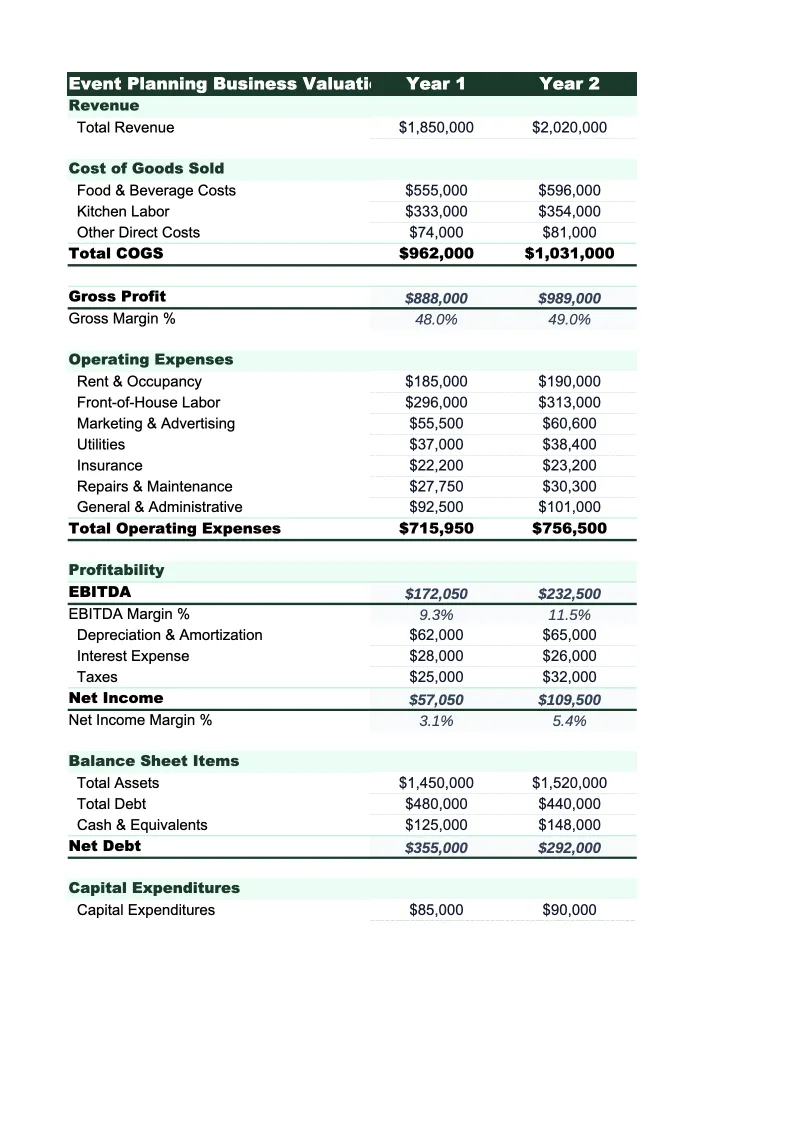
Event Planning Valuation Template
Calculate what your event planning business is worth using SDE multiples, revenue multiples, and intangible asset scoring for your corporate client roster, vendor relationships, and recurring contract pipeline — all in one structured spreadsheet built for event planners and coordinators.
What's Inside This Event Planning Valuation Template
This template includes 5 worksheets, each designed for a specific part of your event planning financial workflow:
Business Inputs
The foundation sheet where you enter three years of financial and operational data that drives every valuation method in the template.
SDE & Income Approach
The primary valuation method for owner-operated event planning businesses, built around seller's discretionary earnings — the total economic benefit a full-time owner-operator derives from the business including salary, benefits, and personal expenses run through the company.
Market Multiples
A market approach analysis applying revenue multiples and EBITDA multiples observed in comparable business sales for event planning and event management companies.
Intangible Asset Assessment
A scoring and valuation framework for the intangible assets that drive the premium buyers pay above base cash flow value in an event planning acquisition — assets that don't appear on a balance sheet but represent the real competitive moat of the business.
Valuation Summary
A single-page output consolidating the SDE income approach, market multiples approach, and intangible asset assessment into a weighted average valuation range and central estimate.
Event Planning Business Valuation Template Features
- SDE (seller's discretionary earnings) calculation with a full owner add-back worksheet and a scored multiple range (2x–4x) that adjusts based on recurring revenue percentage, owner dependency, staff depth, and client roster transferability — the specific factors that drive event planning multiples up or down
- Revenue multiple and EBITDA multiple market approach applying transaction data ranges for event planning and professional services firms, with the applicable multiple adjusted for gross margin, recurring revenue mix, and client concentration
- Corporate client roster scoring that evaluates client tenure, number of events per client annually, whether relationships are under formal service agreements or are personal to the owner, and client industry diversification — the primary value driver in corporate event planning acquisitions
- Intangible asset assessment covering vendor relationships and formal partnership agreements, staff operational capability and team brand identity, and documented systems quality — the factors that determine whether the business's value transfers intact to a new owner
- Weighted valuation summary combining all three methods into a low/central/high range with adjustable method weights and a deal structure notes section on earn-outs, staff non-competes, vendor agreement transferability, and online reputation ownership
- Business risk assessment scoring owner dependency, recurring revenue stability, client concentration, staff depth, and geographic concentration — the five factors buyers and lenders scrutinize in event planning acquisitions
How to Use This Event Planning Valuation Spreadsheet
Start with the Business Inputs sheet and pull three years of revenue and expense data from your accounting software or tax returns. The template organizes revenue by event type and revenue stream, so you'll need to separate your corporate planning fees from social event fees, your retainer revenue from project-based revenue, and your planning fees from vendor pass-throughs. That distinction matters more in this template than in most financial documents because recurring retainer revenue is valued at a higher multiple than equivalent one-off project revenue — blending them together understates the value of your most defensible revenue. The owner add-back section in the SDE sheet is where most event planners leave value on the table: every dollar of salary, health insurance, retirement contributions, personal vehicle use, and personal expenses run through the business adds back to the SDE that determines your multiple base.
Work through the Intangible Asset Assessment carefully before reviewing the Valuation Summary numbers, because the scoring there directly adjusts the multiple range that applies to your business. The corporate client roster section is the most important for event planning firms — document each corporate client, how long they've been a client, how many events you plan for them annually, what the total annual fee is, and whether the relationship is under a formal service agreement or is a personal relationship with you as the owner. Buyers and their advisors will ask these questions during due diligence, and having the answers documented now both improves your negotiating position and reveals which client relationships need to be formalized before a sale is viable. Score the vendor relationships section honestly: preferred vendor status and formal pricing agreements with high-demand venues and caterers are transferable assets; informal "they know me" relationships are not.
Know what your event planning business is actually worth
Enter your revenue, expenses, corporate client roster, and pipeline data — and get a complete valuation range with the SDE multiple, revenue multiple, and intangible asset premium calculated in one place.
How Event Planning Businesses Are Valued
Event planning businesses are valued on a combination of cash flow and the quality of the client and vendor relationships that generate it — because the tangible asset base is minimal. Most event planning firms own some AV and decor equipment, a vehicle, and software subscriptions; everything else is relationships, reputation, and operational capability. The key distinction that drives valuation multiples is the revenue mix: a firm where 40–50% of revenue comes from recurring corporate retainer contracts — annual conference agreements, quarterly event service retainers, or multi-year corporate account relationships — is valued fundamentally differently from one where every event is a new sale. Recurring revenue transfers to a buyer with far less risk than project revenue, and buyers price that difference into the multiple they're willing to pay.
The SDE multiple is the standard valuation method for event planning businesses under $600K in annual revenue. SDE typically ranges from $50,000 to $200,000 for a solo or small-team planning firm, and buyers apply multiples of 2x to 4x depending on transferability. The multiple range for event planning is slightly higher than for wedding planning because corporate event clients tend to have longer and more contractually stable relationships than wedding clients, reducing the transition risk that buyers are paying to mitigate. Owner dependency is still the biggest single discount factor: a firm where the owner handles all client communication, all vendor negotiations, and all on-site event management is worth 2–2.5x SDE because the buyer is purchasing a client list that may or may not re-sign after the owner leaves. A firm with two trained event coordinators who independently manage their own client portfolios, a team brand identity, and formal corporate service agreements commands 3–4x SDE because the revenue is more demonstrably transferable. Gross margin percentage also matters: event planning firms with strong planning fee revenue run 50–65% gross margins, while those with heavy vendor pass-through activity run 30–45% and create revenue that inflates top-line numbers without adding proportional earnings.
Event Planning Industry at a Glance
Financial templates built for event planners and event management businesses — from independent coordinators to full-service agencies handling weddings, corporate events, and conferences.
Revenue Drivers
- Planning and coordination fees
- Day-of coordination
- Vendor commissions or markups
- Design and decor services
- Event production fees
Key Cost Categories
- Venue rental
- Catering and bar service
- Staffing and labor
- Decor and florals
- AV and lighting equipment
- Photography and videography
- Transportation and logistics
Typical Margins
Gross: 40-60% · Net: 10-25%
Seasonality
Peak season in spring (April-June) and fall (September-November) for weddings; corporate events spike in Q1 and Q4.
Key Performance Indicators
Event Planning Business Valuation FAQ
More Event Planning Templates
Event Planning Balance Sheet Template for Excel
$29
Event Planning Budget Template for Excel
$29
Event Planning Business Plan Template for Excel
$39
Event Planning Cash Flow Template for Excel
$29
Event Planning Expense Tracker Template for Excel
$29
Event Planning Financial Model Template for Excel
$29
Event Planning Income Statement Template for Excel
$29
Event Planning Invoice Template for Excel
$29
Event Planning KPI Dashboard Template for Excel
$29
Event Planning P&L Template for Excel
$29
Event Planning Pro Forma Template for Excel
$29
Event Planning Project Budget Template for Excel
$29
Event Planning Sales Forecast Template for Excel
$29
Event Planning Valuation Template
$29