Cleaning Service Business Plan Template
Build a realistic cleaning service business plan with recurring customer model, team capacity, and a 3-year financial projection accounting for seasonal demand, pricing by service type, and scaling with multiple teams.
What's Inside This Cleaning Service Business Plan Template
This template includes 5 worksheets, each designed for a specific part of your cleaning service financial workflow:
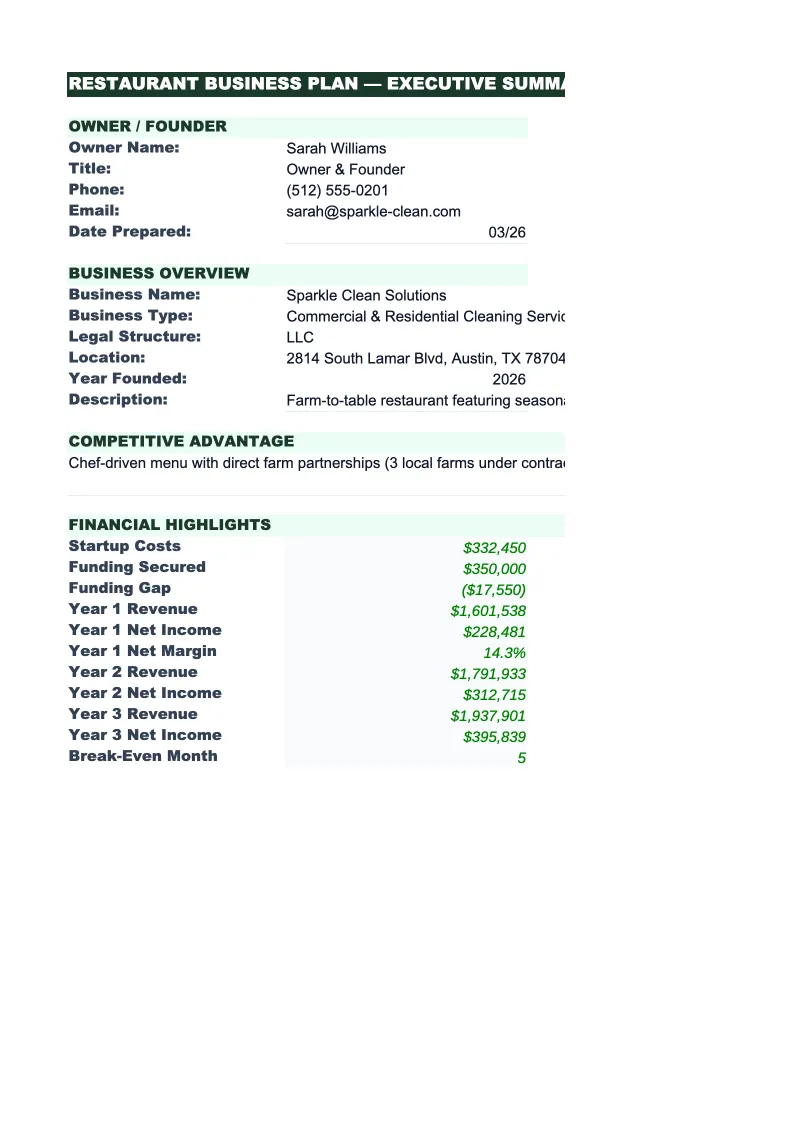
Executive Summary
A strategic overview of your cleaning service business, including service offerings (residential, commercial, specialized cleaning), target market (homeowners, office managers, property managers, hospitals), and competitive positioning (reliability, pricing, eco-friendly products, technology).
Startup Costs & Funding
Details capital required to launch a cleaning service, typically $10,000–$50,000.
Revenue Forecast
A 12-month detailed revenue projection for year one, then annual summaries for years two and three.
Projected P&L
Annual profit and loss statement showing revenue by service type, cost of goods sold (cleaning supplies, chemicals, typically 8–15% of revenue), labor (cleaning team wages, typically 40–60% of revenue depending on whether you're doing the work or hiring staff), vehicle costs (fuel, maintenance, insurance, depreciation, typically 8–12% of revenue), occupancy (office space, storage, if applicable, typically 3–8% of revenue), and operating expenses (insurance, licenses, marketing, scheduling software, supplies, training).
Dashboard
A visual management tool showing: total startup investment and funding required, monthly and annual revenue by year, customer count by service type, customer acquisition rate and retention %, average revenue per customer, revenue per cleaning visit, break-even customer count (the number of recurring customers needed to cover all fixed costs), labor cost % of revenue, supplies COGS % of revenue, vehicle cost % of revenue, net profit margin %, and 36-month cumulative cash flow.
Cleaning Service Business Plan Template Features
- Recurring customer model with customer acquisition and retention rate tracking
- Revenue breakdown by service type (residential, commercial, specialty) with different pricing
- Service frequency model (weekly, bi-weekly, monthly) with customer scheduling
- Team scaling model: start solo or with one team, add additional teams as customer base grows
- Startup costs for equipment, vehicle, insurance, and working capital
- Break-even analysis showing required number of recurring customers to cover costs
How to Use This Cleaning Service Business Plan Spreadsheet
Start by deciding on your service model: do you want to do the cleaning yourself (owner-operated) or build a team-based business? Owner-operated cleaning services start with minimal capital ($10,000–$15,000) and have high profit margins (50%+ after all expenses) because you're not paying crew wages. Team-based services require more capital (vehicles, equipment, staff) but can scale larger. Define your target customer: residential (homeowners—lower price, easier to acquire but higher churn) or commercial (offices, buildings—higher price, better contract terms but more competition). Gather startup costs for the Startup Costs sheet: if starting solo with your car, budget $10,000–$15,000 for equipment and insurance; if starting with a vehicle and team, budget $30,000–$50,000. Research your local market rates for residential ($100–$200 per 2–3 hour visit) and commercial ($300–$1,000+ per visit).
Move to the Revenue Forecast sheet and model your customer acquisition conservatively. Most cleaning businesses start by acquiring 2–5 customers per month (friends, family, word-of-mouth, Nextdoor referrals, Google Local) and accelerate to 10–20 customers/month by month three to four as reputation and word-of-mouth build. Estimate retention rate: residential cleaning has 85–95% monthly retention (customers are sticky once you prove reliable); commercial has 80–90% retention (lower due to organizational changes, budget cuts, or service consolidation). Model revenue per customer: a residential customer paying $150 bi-weekly generates $300/month; a commercial account paying $500 weekly generates $2,000/month. Build a customer acquisition forecast: if you acquire 3 customers/month in months 1–2, 10/month in months 3–6, and 15/month in months 7–12, with 90% retention, you end the year with roughly 50–60 customers generating $5,000–$10,000/month in recurring revenue. Scale team size based on customer count: one person can typically service 15–20 residential customers (at weekly or bi-weekly frequency) or 5–8 commercial accounts, depending on job size and complexity.
From service concept to lender-ready projections in an afternoon
Enter your service types, pricing, customer acquisition plan, and team structure—the model builds your 3-year financial outlook, break-even customer count, and startup capital requirement automatically.
Why Cleaning Service Operators Need a Detailed Business Plan
Cleaning service economics are straightforward when owner-operated: revenue minus supplies cost and vehicle cost equals profit. A solo operator with 20 customers generating $3,000/month and $400/month in expenses has $2,600 monthly profit—a sustainable living. The challenge is scaling: as your customer base grows beyond what you can service solo (typically 20–25 customers if doing weekly visits, more if bi-weekly), you need to hire team members. Adding one employee at $15/hour, 40 hours/week adds $2,600/month in payroll, which compresses margins substantially. To maintain profitability while scaling, you need higher pricing or more customers per team member. Commercial cleaning can support higher pricing ($500–$2,000+ per job) and allows larger crews to service multiple locations efficiently, which improves unit economics.
Customer acquisition is the limiting factor in cleaning services. You can acquire customers through word-of-mouth (free but slow), Google Local (steady, medium cost), paid ads (Facebook, Google Ads—higher cost, fastest growth), direct outreach/flyers (low cost, medium effectiveness), or partnerships with property managers or corporate facilities teams. Most successful cleaning operators combine methods: start with word-of-mouth and referrals (lowest cost), add Google Local/reviews to capture high-intent customers, and eventually add paid advertising once the business model is proven and margins are clear. A customer acquisition cost of $50–$150 per customer is acceptable if the customer lifetime value is $1,000+ (e.g., a $150 monthly customer with 12+ month retention has $1,800+ lifetime value).
Cleaning Service Industry at a Glance
Financial templates built for residential and commercial cleaning businesses — pre-loaded with labor, supplies, and overhead categories, and structured around the recurring contract model most cleaning companies run on.
Revenue Drivers
- Recurring residential contracts
- Commercial cleaning contracts
- One-time deep cleans
- Move-in/move-out cleaning
- Post-construction cleanup
Key Cost Categories
- Labor (wages & payroll taxes)
- Cleaning supplies & chemicals
- Equipment & tools
- Vehicle & transportation
- Liability insurance
- Marketing & advertising
Typical Margins
Gross: 40-55% · Net: 10-20%
Seasonality
Spring (March-April) peaks with spring cleaning demand; back-to-school surge in August-September; summer slightly slower as clients vacation; commercial cleaning demand is relatively steady year-round.
Key Performance Indicators
Cleaning Service Business Plan Template FAQ
More Cleaning Service Templates
Cleaning Service Balance Sheet Template for Excel
$29
Cleaning Service Budget Template for Excel
$29
Cleaning Service Cash Flow Template for Excel
$29
Cleaning Service Expense Tracker Template for Excel
$29
Cleaning Service Financial Model Template for Excel
$29
Cleaning Service Income Statement Template for Excel
$29
Cleaning Service Invoice Template for Excel
$29
Cleaning Service KPI Dashboard Template for Excel
$29
Cleaning Service P&L Template for Excel
$29
Cleaning Service Pro Forma Template for Excel
$29
Cleaning Service Project Budget Template for Excel
$29
Cleaning Service Sales Forecast Template for Excel
$29
Cleaning Service Business Valuation Template for Excel
$29
More Business Plan Templates
Cleaning Service Business Plan Template
$39