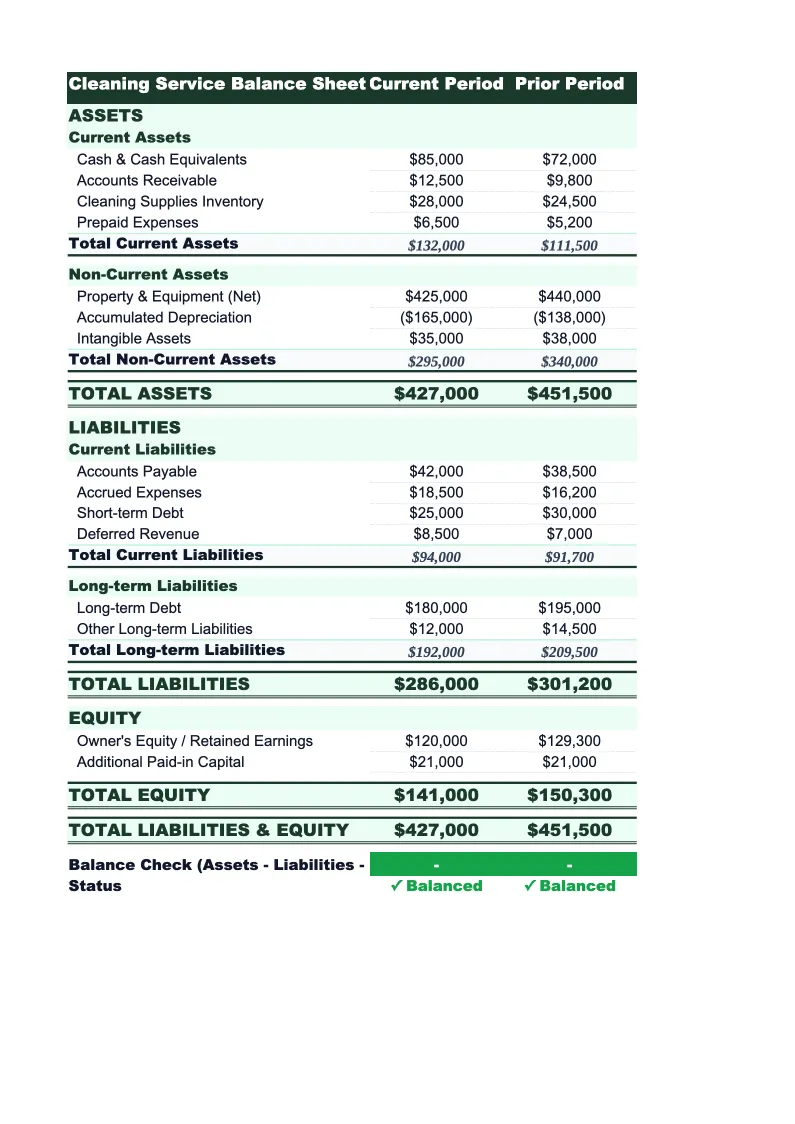
Cleaning Service Balance Sheet Template
See exactly what your cleaning business owns, owes, and is worth — with a balance sheet built around the equipment, vehicles, and recurring receivables that cleaning companies actually carry.
What's Inside This Cleaning Service Balance Sheet Template
This template includes 4 worksheets, each designed for a specific part of your cleaning service financial workflow:
Balance Sheet
The main worksheet organized into three sections: assets, liabilities, and owner's equity.
Prior Period Comparison
Side-by-side view of the current balance sheet against a prior period — typically the same date last year or the previous quarter-end.
Asset Schedule
A detailed register of every fixed asset the business owns: cleaning machines, commercial vacuums, floor buffers, pressure washers, company vehicles, and any owned equipment racks or trailers.
Working Capital Summary
A focused view of short-term liquidity: current assets minus current liabilities, the number that tells you whether the business can cover its near-term obligations without touching a line of credit.
Cleaning Service Balance Sheet Template Features
- Pre-built accounts receivable section for recurring residential and commercial contracts
- Fixed asset register with straight-line depreciation for equipment and vehicles
- Prior period comparison to track growth in contracts, equity, and loan payoffs
- Working capital and current ratio calculation built in
- Automatic balance check — assets always equal liabilities plus equity
- Organized for cleaning business chart of accounts: supplies inventory, vehicle loans, owner draws
How to Use This Cleaning Service Balance Sheet Spreadsheet
Getting started takes about 20 minutes. Download the .xlsx file, open it in Excel or Google Sheets, and begin with the Asset Schedule sheet. List every piece of equipment and every vehicle the business owns — even older items — with the original purchase price and purchase date. The sheet calculates depreciation and net book value automatically, and those figures feed directly into the main Balance Sheet. Getting this right up front means the template stays accurate as equipment ages and gets replaced.
With the assets entered, move to the main Balance Sheet sheet and fill in your current figures: cash on hand, bank balances, what clients currently owe you, what you owe suppliers, and any outstanding loan balances. For recurring contract businesses, your accounts receivable balance is one of the most important numbers on the sheet — it represents revenue that's been earned but not yet collected. Enter your equity section last: what you originally put into the business, how much you've taken out as draws, and the retained earnings figure from your income statement.
20 minutes from download to your first balance sheet
Download the template, enter your assets, liabilities, and equity, and see your cleaning business's true financial position — with depreciation, working capital, and period comparisons built in.
Why Every Cleaning Business Needs a Balance Sheet
Most cleaning business owners track cash flow closely but rarely look at their balance sheet — which means they often don't know what the business is actually worth or how close it is to a liquidity problem. Cleaning services carry more assets than people realize: a fleet of two or three work vehicles can represent $40,000–$80,000 in value, commercial cleaning equipment another $10,000–$30,000, and accounts receivable from recurring contracts often exceeds a month's revenue. Without a balance sheet, those assets and the loans attached to them are invisible.
The balance sheet is also where you see the two financial risks most specific to cleaning businesses. The first is accounts receivable: commercial clients in particular can run 45–60 days before paying, and if you're growing fast and adding contracts, it's easy to be profitable on paper while running low on cash. The second is the liability side: vehicle loans and equipment leases look manageable month-to-month but add up quickly. A balance sheet shows you total debt against total equity, which is the number lenders use to assess whether you can take on more financing.
Cleaning Service Industry at a Glance
Financial templates built for residential and commercial cleaning businesses — pre-loaded with labor, supplies, and overhead categories, and structured around the recurring contract model most cleaning companies run on.
Revenue Drivers
- Recurring residential contracts
- Commercial cleaning contracts
- One-time deep cleans
- Move-in/move-out cleaning
- Post-construction cleanup
Key Cost Categories
- Labor (wages & payroll taxes)
- Cleaning supplies & chemicals
- Equipment & tools
- Vehicle & transportation
- Liability insurance
- Marketing & advertising
Typical Margins
Gross: 40-55% · Net: 10-20%
Seasonality
Spring (March-April) peaks with spring cleaning demand; back-to-school surge in August-September; summer slightly slower as clients vacation; commercial cleaning demand is relatively steady year-round.
Key Performance Indicators
Cleaning Service Balance Sheet Template FAQ
More Cleaning Service Templates
Cleaning Service Budget Template for Excel
$29
Cleaning Service Business Plan Template for Excel
$39
Cleaning Service Cash Flow Template for Excel
$29
Cleaning Service Expense Tracker Template for Excel
$29
Cleaning Service Financial Model Template for Excel
$29
Cleaning Service Income Statement Template for Excel
$29
Cleaning Service Invoice Template for Excel
$29
Cleaning Service KPI Dashboard Template for Excel
$29
Cleaning Service P&L Template for Excel
$29
Cleaning Service Pro Forma Template for Excel
$29
Cleaning Service Project Budget Template for Excel
$29
Cleaning Service Sales Forecast Template for Excel
$29
Cleaning Service Business Valuation Template for Excel
$29
More Balance Sheet Templates
Cleaning Service Balance Sheet Template
$29