Cleaning Service Pro Forma Template
Project revenue by residential, commercial, and specialty cleaning, model labor at loaded cost, and see your cleaning business's cash position month by month — built for cleaning companies from solo operators to multi-crew businesses.
What's Inside This Cleaning Service Pro Forma Template
This template includes 7 worksheets, each designed for a specific part of your cleaning service financial workflow:
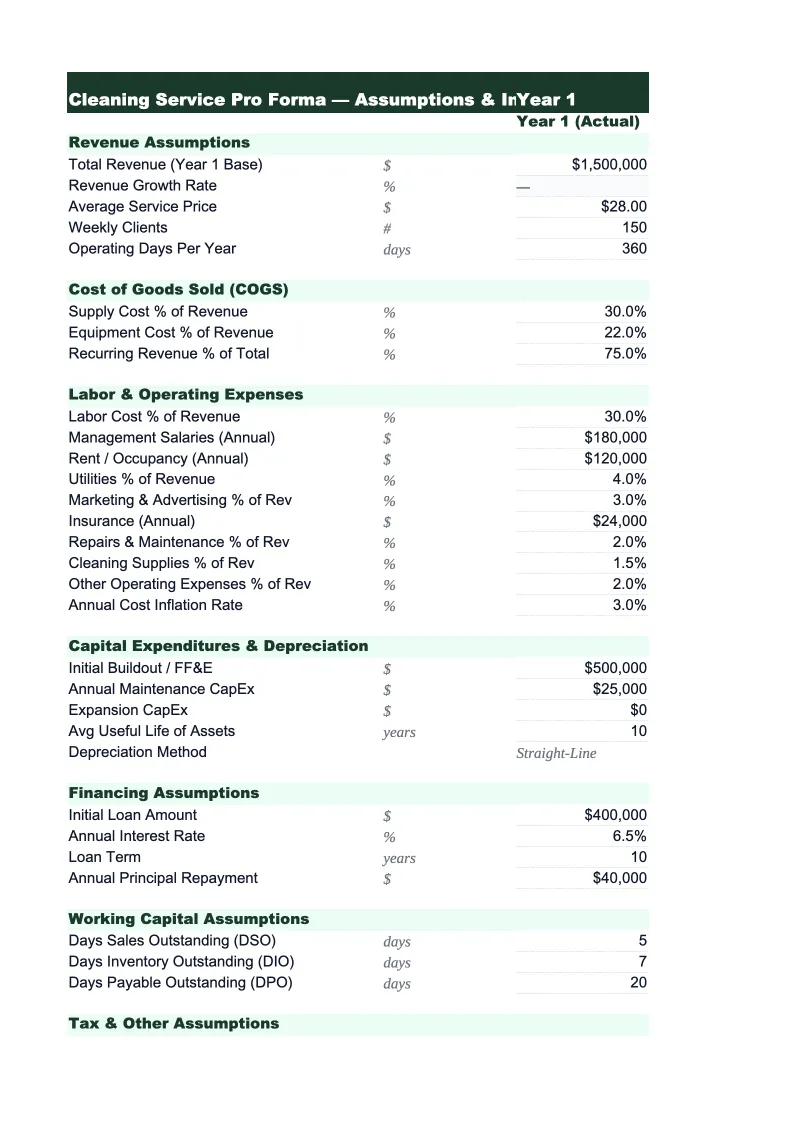
Assumptions
The central input panel that drives the entire model.
Revenue Projections
A month-by-month revenue forecast split across your three main service categories: residential cleaning (weekly and biweekly household accounts), commercial/janitorial contracts (nightly or weekly office and facility cleaning), and specialty services (carpet cleaning, move-in/move-out deep cleans, post-construction cleanups, window cleaning).
Labor Plan
Projects staffing costs across the forecast period by crew type.
Supplies & Equipment
Tracks the two main non-labor operating costs: consumable supplies and equipment.
Monthly P&L
A full monthly income statement covering three years of projections.
Cash Flow Forecast
Projects your monthly cash position, which for cleaning businesses is primarily driven by the timing of recurring client payments and payroll cycles.
Summary Dashboard
A single-page financial summary designed for lenders, business partners, or investors who need a clear picture without reading the full model.
Cleaning Service Pro Forma Template Features
- Revenue split by residential accounts, commercial contracts, and specialty cleaning jobs
- Client count model with monthly churn rate and new client acquisition built in
- Loaded labor cost calculation including payroll taxes, workers' comp, and benefits
- Supply cost tracking with separate rates for residential and commercial accounts
- Cash flow timing model accounting for commercial invoice payment delays
- 36-month P&L with gross margin and net margin by month
How to Use This Cleaning Service Pro Forma Spreadsheet
Start with the Assumptions sheet and configure the model to match your business. Enter your service mix — roughly what share of revenue comes from residential accounts, commercial contracts, and specialty work — along with your average job values and visit frequency. Set your billing rate per cleaner-hour and your loaded labor cost. If you're projecting a startup, use market research for your area as a starting point; if you're planning growth for an existing business, enter your current revenue mix and client count as the Year 1 baseline. Most inputs have guidance notes built in, and the entire model updates as you adjust a single assumption.
Move to the Revenue Projections sheet and review the monthly client count and revenue by service type. Adjust the new client acquisition rate and churn rate to reflect your actual experience — or your realistic targets for a new business. Then check the Labor Plan: confirm the cleaner count, hours per job, and loaded wage rate match your staffing reality. This is often where cleaning business owners realize their pricing doesn't cover true labor cost once taxes and workers' comp are included. Review the Supplies & Equipment sheet to make sure your consumable costs and vehicle expenses are realistic.
15 minutes from download to your first cleaning service pro forma
Download the template, enter your service mix and crew rates, and see your cleaning business's full three-year financial picture — revenue, labor, cash flow, and margins included.
Why Every Cleaning Business Needs a Pro Forma
Most cleaning businesses are started by skilled operators who know how to clean but haven't built financial projections before. The first time a bank asks for a pro forma — usually when you apply for a vehicle loan, a line of credit, or an SBA microloan to hire your first employees — it's tempting to hand them a one-page estimate and hope for the best. A proper cleaning service pro forma forces you to work out the actual math: how many clients do you need to cover your labor costs and overhead, what does one new cleaner add to your revenue capacity and your cost structure, and does the number actually work after insurance and supplies? For a cleaning business at $80K–$500K in revenue, that exercise often surfaces pricing or staffing problems that intuition had been hiding.
The economics of a cleaning business turn almost entirely on labor efficiency. Direct labor is typically 50–65% of revenue, which means your gross margin is essentially determined by how well you schedule crews, how low your turnover is, and whether your pricing covers loaded labor cost — not just wages. Commercial janitorial contracts look attractive because they're recurring and predictable, but they often run lower gross margins than residential because of higher supply intensity and competitive bidding pressure. Residential cleaning businesses typically command higher margins (40–50% gross) but carry more client churn. A well-built pro forma shows you the margin profile of each service type so you can make intentional decisions about which work to take.
Cleaning Service Industry at a Glance
Financial templates built for residential and commercial cleaning businesses — pre-loaded with labor, supplies, and overhead categories, and structured around the recurring contract model most cleaning companies run on.
Revenue Drivers
- Recurring residential contracts
- Commercial cleaning contracts
- One-time deep cleans
- Move-in/move-out cleaning
- Post-construction cleanup
Key Cost Categories
- Labor (wages & payroll taxes)
- Cleaning supplies & chemicals
- Equipment & tools
- Vehicle & transportation
- Liability insurance
- Marketing & advertising
Typical Margins
Gross: 40-55% · Net: 10-20%
Seasonality
Spring (March-April) peaks with spring cleaning demand; back-to-school surge in August-September; summer slightly slower as clients vacation; commercial cleaning demand is relatively steady year-round.
Key Performance Indicators
Cleaning Service Pro Forma Template FAQ
More Cleaning Service Templates
Cleaning Service Balance Sheet Template for Excel
$29
Cleaning Service Budget Template for Excel
$29
Cleaning Service Business Plan Template for Excel
$39
Cleaning Service Cash Flow Template for Excel
$29
Cleaning Service Expense Tracker Template for Excel
$29
Cleaning Service Financial Model Template for Excel
$29
Cleaning Service Income Statement Template for Excel
$29
Cleaning Service Invoice Template for Excel
$29
Cleaning Service KPI Dashboard Template for Excel
$29
Cleaning Service P&L Template for Excel
$29
Cleaning Service Project Budget Template for Excel
$29
Cleaning Service Sales Forecast Template for Excel
$29
Cleaning Service Business Valuation Template for Excel
$29
Cleaning Service Pro Forma Template
$29