Accounting Firm Business Plan Template
Build a complete financial roadmap for your accounting firm with startup costs, client assumptions, and 3-year P&L projections — pre-built for solo CPA, small firm, or niche specialization.
What's Inside This Accounting Firm Business Plan Template
This template includes 5 worksheets, each designed for a specific part of your accounting firm financial workflow:
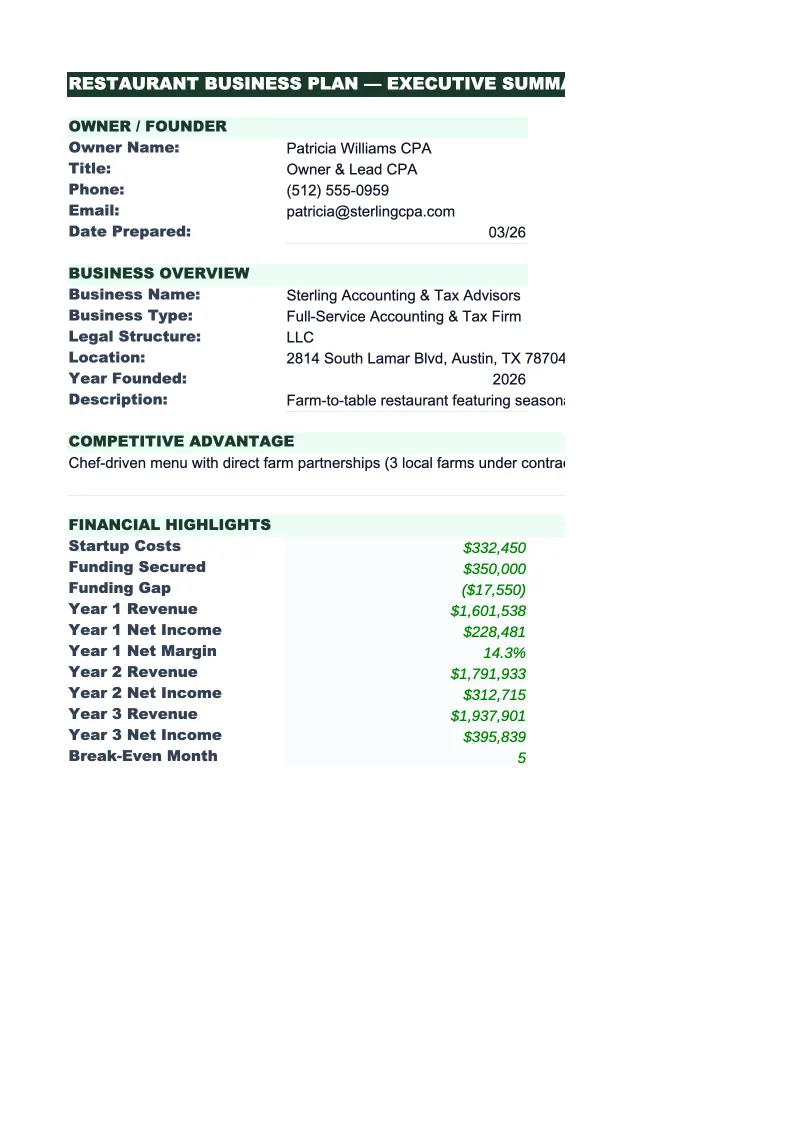
Executive Summary
A one-page overview of your accounting firm showing your specializations (tax, bookkeeping, audit, CFO services, payroll, niche clients), target market (small business, individuals, nonprofits, corporate), and key financial metrics.
Startup Costs & Funding
A detailed tracker for your initial investment including accounting software licenses (QuickBooks, Xero, ProConnect—$3,000–$10,000 annually), office setup (if not working from home—$5,000–$20,000), CPA licensing and continuing education ($2,000–$5,000), professional liability insurance ($2,000–$5,000/year), business licenses and registrations ($500–$2,000), website and client portal ($1,000–$3,000), marketing and initial client acquisition ($2,000–$5,000), and working capital ($5,000–$15,000).
Revenue Forecast
Projects monthly revenue based on number of active clients, average fee per client per month, and service mix.
Projected P&L
Annual and monthly profit & loss statement showing revenue, cost of goods sold (subcontractor accountants if outsourcing, software licenses, continuing education), gross profit, and operating expenses (office rent if applicable, insurance, payroll if hiring staff, marketing, technology).
Dashboard
A visual overview of key metrics including total revenue, profit, active clients, average revenue per client, billable hours utilization, revenue per hour, break-even analysis, and profitability timeline.
Accounting Firm Business Plan Features
- Startup costs for software, office, licensing, insurance, and working capital
- Revenue model based on active clients, average fee per client, and service mix
- Client acquisition ramp—CPAs reach 60% of target clients by month 6, 80%+ by month 12
- Service diversification tracking (bookkeeping, tax, audit, advisory)
- 3-year P&L with EBITDA and net margin showing path to profitability
- Break-even analysis showing client count and fees needed to cover fixed costs
How to Use This Business Plan Spreadsheet
Start with the Startup Costs sheet and determine your model: solo CPA working from home (lowest startup) or small office with staff (higher startup). Budget: accounting software ($3,000–$10,000/year for QuickBooks, Xero, tax software—most offer discounts for firms), office (home office is $0; small office $1,000–$5,000/month rent), professional liability insurance ($2,000–$5,000/year), CPA licensing and continuing education ($2,000–$5,000 initial, $500–$1,500/year renewal), business licenses ($500–$2,000), website and client portal ($1,000–$3,000), marketing ($2,000–$5,000 initial), and 3–4 months working capital ($5,000–$15,000). Solo CPA from home: $15,000–$25,000. Small office with staff: $50,000–$100,000+.
Move to the Revenue Forecast sheet and set your assumptions: how many clients you'll have in month one (realistically 10–20 if starting from scratch, more if converting from a previous firm), your average monthly revenue per client by service type, and your growth rate. Monthly bookkeeping clients: $500–$3,000 per client/month (recurring revenue). Tax preparation: $1,500–$5,000 per client per year (seasonal, concentrated Jan–Apr). Audit/review: $5,000–$25,000+ per engagement (project-based). CFO/advisory: $150–$500/hour ($3,000–$10,000/month per client). Most practices diversify: 40–50% recurring bookkeeping, 30–40% tax, 10–20% advisory. At maturity, sustainable client load is 80–120 per accountant.
From launch to investor-ready business plan in one sitting
Enter your startup costs, client targets, and average fees by service—the model projects your 3-year revenue, profitability, and cash runway automatically.
Why Accounting Firms Need a Business Plan
Accounting is a knowledge-based service business with exceptional margins once you build a stable client base. Your profitability depends on: number of active clients, average revenue per client (recurring bookkeeping vs. project-based tax), and utilization rate (percent of your time generating billable revenue vs. admin/marketing). A CPA with 60 bookkeeping clients at $1,500/month average = $90,000/month recurring revenue ($1.08M annually). With 70% gross margin ($756K), 30% operating expenses ($324K), you generate $432K net profit (40% net margin). The same CPA with only 20 clients generates $30,000/month or $360K annually—much leaner. Client acquisition and retention are your limiting factors in years 1–2.
The second critical factor is service mix and recurring revenue. One-time tax returns provide cash flow but require constant client acquisition. Recurring monthly bookkeeping provides stable, predictable revenue and higher customer lifetime value. A bookkeeping client at $2,000/month is worth $24,000 annually; acquiring one bookkeeping client has high initial marketing cost but long-term payoff. Most successful practices aim for 50–70% recurring revenue from bookkeeping and payroll services, which smooths cash flow and reduces customer acquisition pressure. Tax prep and advisory services are add-ons to bookkeeping clients (cross-sell higher-margin services) or new customer acquisition channels.
Accounting Firm Industry at a Glance
Financial templates built for accounting firms and CPA practices — from solo practitioners to multi-partner firms. Pre-loaded with billable hour tracking, realization rate calculations, and service categories that reflect how accounting firms actually bill.
Revenue Drivers
- Tax preparation and planning
- Audit and assurance
- Bookkeeping and client accounting services (CAS)
- Advisory and fractional CFO services
- Payroll processing
Key Cost Categories
- Professional staff salaries and benefits
- Administrative staff
- Occupancy and rent
- Technology and software (tax, practice management)
- Malpractice (E&O) insurance
- Marketing and business development
- CPE and professional development
- Subcontractors and offshore staff
Typical Margins
Gross: 50-65% · Net: 20-35%
Seasonality
Heavy busy season January through April 15; secondary crunch in September through October 15 for extensions. Slowest months are July and August.
Key Performance Indicators
Accounting Firm Business Plan FAQ
More Accounting Firm Templates
Accounting Firm Balance Sheet Template for Excel
$29
Accounting Firm Budget Template for Excel
$29
Accounting Firm Cash Flow Template for Excel
$29
Accounting Firm Expense Tracker Template for Excel
$29
Accounting Firm Financial Model Template for Excel
$29
Accounting Firm Income Statement Template for Excel
$29
Accounting Firm Invoice Template for Excel
$29
Accounting Firm KPI Dashboard Template for Excel
$29
Accounting Firm P&L Template for Excel
$29
Accounting Firm Pro Forma Template for Excel
$29
Accounting Firm Project Budget Template for Excel
$29
Accounting Firm Sales Forecast Template for Excel
$29
Accounting Firm Valuation Template for Excel
$29
More Business Plan Templates
Accounting Firm Business Plan Template
$39