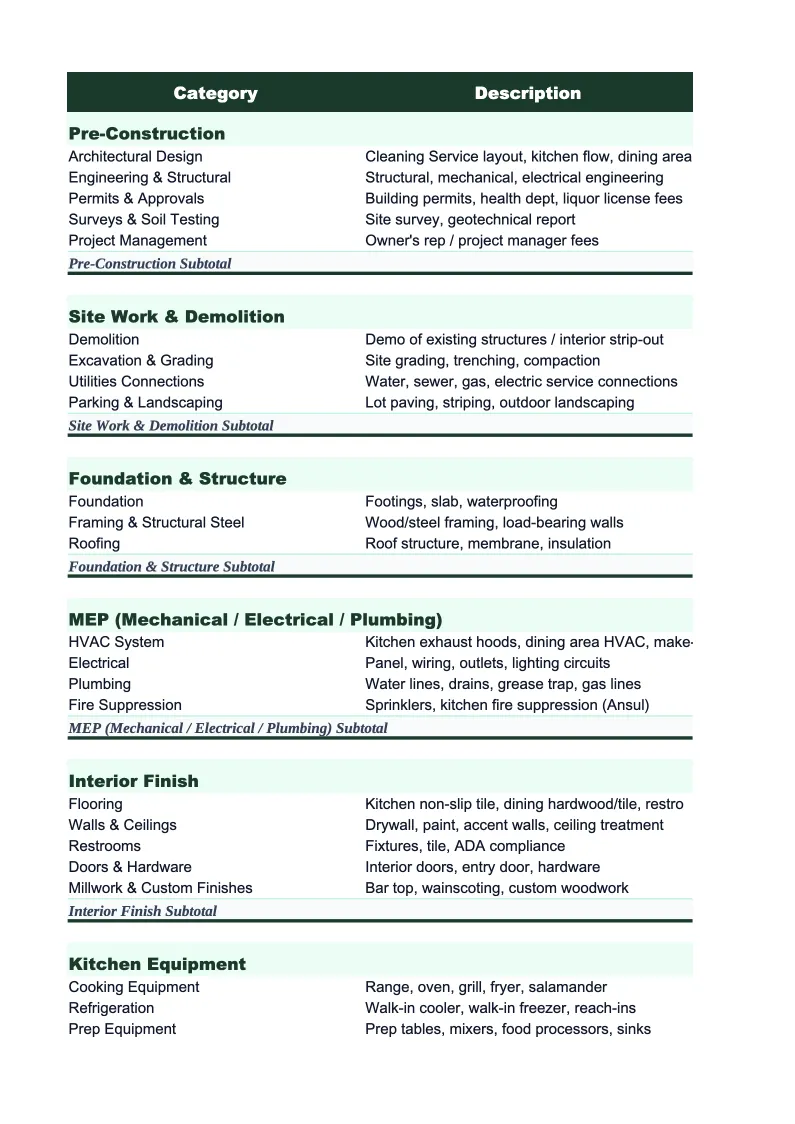
Cleaning Service Project Budget Template
Budget individual cleaning jobs or contracts — from one-time residential cleans to multi-site commercial accounts — with a spreadsheet built for cleaning businesses.
What's Inside This Cleaning Service Project Budget Template
This template includes 5 worksheets, each designed for a specific part of your cleaning service financial workflow:
Project Budget
The core sheet for building a budget around a single cleaning job or contract.
Job Tracker
A running log of all active projects and their budget status.
Labor Calculator
A worksheet for estimating labor costs before you quote a job.
Budget vs Actual
A comparison sheet for tracking what you budgeted for a project against what you actually spent.
Supplies & Equipment
A reference sheet for tracking the cost of supplies and equipment assigned to each job.
Cleaning Service Project Budget Template Features
- Labor calculator with square-footage-based hour estimates
- Pre-built categories for chemicals, equipment, and transportation
- Multi-job tracker with per-account margin visibility
- Budget vs actual variance tracking for each project
- Equipment depreciation cost allocation per job
- Cost-per-square-foot output for accurate quoting
How to Use This Cleaning Business Budget Spreadsheet
Start by setting up the Labor Calculator with your actual hourly wages and the productivity rates your crew achieves. Most residential cleaners cover 800–1,200 square feet per hour for a standard clean; commercial crews on routine maintenance cleans often do more. Enter a few recent jobs where you know the actual hours, calibrate the rates until the output matches reality, and the calculator becomes your quoting baseline going forward. This initial setup takes about 30 minutes and pays for itself on the first job you quote accurately.
For each new project, open the Project Budget sheet and fill in the job details: square footage, clean type, estimated hours from the calculator, supply requirements, and any equipment or transportation costs. Enter your quoted price at the top and watch the margin calculate automatically. If the margin looks thin, you can see exactly which cost line is driving it and decide whether to adjust your quote or find a way to reduce the cost. Add the job to the Job Tracker so you have a running record of your pipeline.
Quote your next job with confidence
Download the template, calibrate the labor calculator to your crew, and start pricing every job based on actual cost — not gut feel.
Why Cleaning Businesses Need a Project Budget Template
Cleaning businesses lose money in two predictable ways: underestimating labor hours when quoting and failing to account for supply and equipment costs on a per-job basis. Labor is the dominant cost — typically 50–65% of revenue for residential services and 40–55% for commercial — and a single hour of underestimated time per visit, multiplied across a recurring weekly account, turns a profitable contract into one that loses money over the year. Without a project budget that forces you to estimate hours before you quote, underpricing becomes invisible until you check the bank balance.
Supply costs are the second area where cleaning businesses bleed margin without realizing it. Chemicals, microfiber cloths, vacuums, and equipment all have real per-job costs that rarely get factored into quotes. A vacuum that costs $400 and lasts 1,000 hours adds $0.40 per hour to your true cost — small per job but significant across hundreds of jobs per year. The same applies to floor machines, steam cleaners, and carpet extractors. Building equipment depreciation into your project budget means your pricing reflects the true cost of delivering the service, not just labor and chemicals.
Cleaning Service Industry at a Glance
Financial templates built for residential and commercial cleaning businesses — pre-loaded with labor, supplies, and overhead categories, and structured around the recurring contract model most cleaning companies run on.
Revenue Drivers
- Recurring residential contracts
- Commercial cleaning contracts
- One-time deep cleans
- Move-in/move-out cleaning
- Post-construction cleanup
Key Cost Categories
- Labor (wages & payroll taxes)
- Cleaning supplies & chemicals
- Equipment & tools
- Vehicle & transportation
- Liability insurance
- Marketing & advertising
Typical Margins
Gross: 40-55% · Net: 10-20%
Seasonality
Spring (March-April) peaks with spring cleaning demand; back-to-school surge in August-September; summer slightly slower as clients vacation; commercial cleaning demand is relatively steady year-round.
Key Performance Indicators
Cleaning Service Project Budget Template FAQ
More Cleaning Service Templates
Cleaning Service Balance Sheet Template for Excel
$29
Cleaning Service Budget Template for Excel
$29
Cleaning Service Business Plan Template for Excel
$39
Cleaning Service Cash Flow Template for Excel
$29
Cleaning Service Expense Tracker Template for Excel
$29
Cleaning Service Financial Model Template for Excel
$29
Cleaning Service Income Statement Template for Excel
$29
Cleaning Service Invoice Template for Excel
$29
Cleaning Service KPI Dashboard Template for Excel
$29
Cleaning Service P&L Template for Excel
$29
Cleaning Service Pro Forma Template for Excel
$29
Cleaning Service Sales Forecast Template for Excel
$29
Cleaning Service Business Valuation Template for Excel
$29
More Project Budget Templates
Cleaning Service Project Budget Template
$29