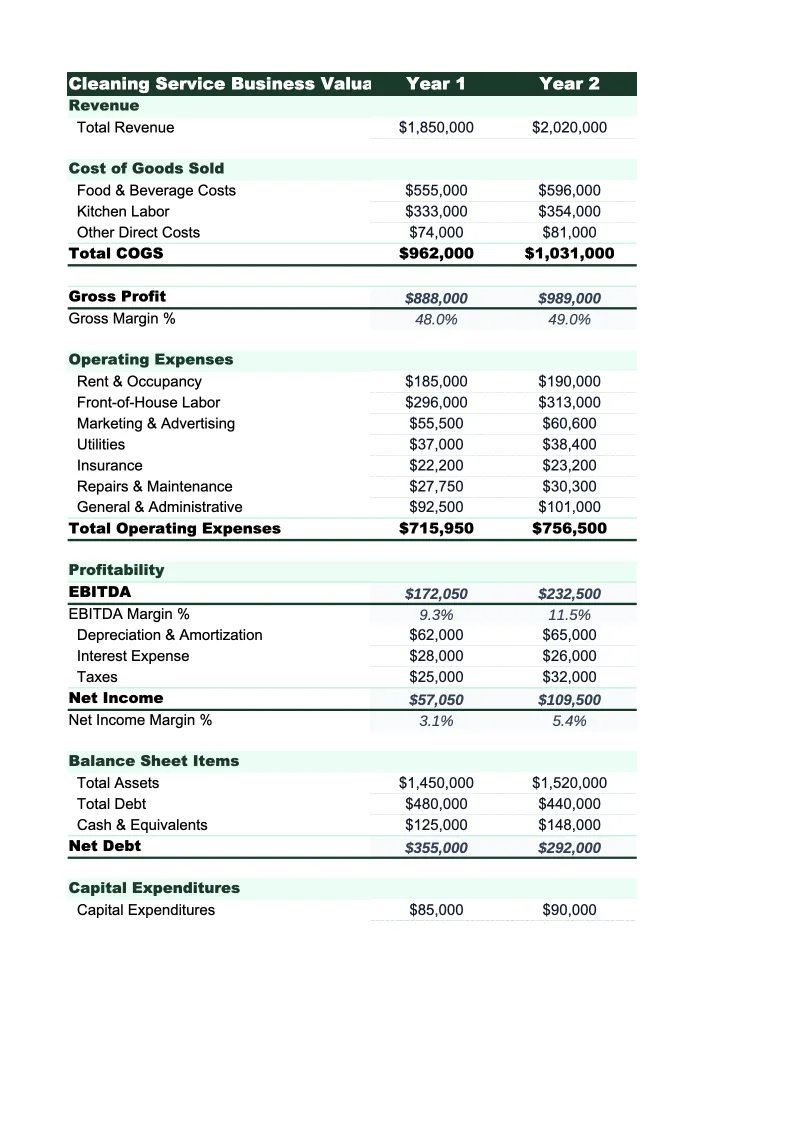
Cleaning Service Valuation Template
Value your cleaning business using SDE multiples, a recurring contract scorecard, and route profitability analysis — with benchmarks built around how residential and commercial cleaning companies actually sell.
What's Inside This Cleaning Service Valuation Template
This template includes 6 worksheets, each designed for a specific part of your cleaning service financial workflow:
Business Inputs
The foundation of the entire valuation model. Enter your trailing twelve-month revenue broken out by service line — recurring residential cleaning contracts, recurring commercial janitorial accounts, one-time deep cleans, move-in/move-out cleans, post-construction cleanup, and any specialty services like carpet cleaning or window washing. On the cost side, the sheet captures direct labor (wages and payroll taxes for cleaning staff), cleaning supplies and chemicals, equipment and vacuums, vehicle and transportation costs, liability insurance, and business overhead (scheduling software, marketing, office, admin). Owner compensation — salary, draws, and any personal expenses run through the business — gets its own section because it's the most important normalization in a cleaning service SDE calculation. Operational data is also captured here: total number of active recurring accounts by type (residential vs. commercial), average weekly revenue per account, number of active cleaners, and whether the business runs as a solo owner-operator or has a management layer. All downstream sheets pull from these inputs.
SDE Multiple Approach
The primary valuation method for owner-operated and small-to-mid-size cleaning companies. SDE — Seller's Discretionary Earnings — represents the total financial benefit the working owner extracts from the business, including salary, profit, and personal expenses run through the company. This sheet calculates SDE by starting with net income and adding back owner compensation above a replacement operations manager wage, one-time or non-recurring expenses (a new van purchase, equipment replacement, litigation costs), personal expenses charged to the business, depreciation, and interest. Cleaning businesses typically sell at 1.5–3.5x SDE, with the wide range driven by how dependent operations are on the owner, how large and stable the recurring account base is, and whether the business has commercial contracts with multi-year terms versus month-to-month residential clients. The multiple selection matrix walks you through the specific factors that move cleaning businesses up or down in the range — contract stability, owner dependence, staff reliability, client concentration, and revenue consistency — and maps them to a defensible multiple for your specific operation.
Asset-Based Valuation
Calculates the tangible asset floor of your cleaning business — the minimum value below which no rational seller should transact. Because cleaning businesses are labor-intensive with relatively low physical asset bases, this sheet focuses on the core business assets at fair market value: commercial-grade vacuums and floor equipment, steam cleaners and pressure washers, cleaning carts and supply storage, company vehicles and vans, and any specialty equipment (carpet extractors, window cleaning equipment). The sheet also captures non-equipment assets: supply inventory on hand, branded uniforms and gear, website and domain value, scheduling and CRM software (and whether it transfers), and the client list itself as an intangible. Signed commercial cleaning contracts with remaining term — particularly multi-year janitorial agreements — are captured as a separate intangible line item with calculable value, since a buyer is acquiring predictable future revenue, not just equipment and goodwill. The net asset total sets the floor for any sale negotiation.
Revenue Multiple Check
A secondary validation method using revenue multiples, which business brokers commonly apply as a quick sanity check in cleaning company transactions. This sheet calculates your total annual gross revenue and applies the typical range of 0.25–0.6x revenue that cleaning business sales fall within. Residential-only operations with high owner involvement and month-to-month client relationships tend to trade at the lower end, around 0.25–0.4x gross revenue. Businesses with a meaningful percentage of commercial janitorial contracts — particularly multi-year office, retail, or property management agreements — and cleaners who operate independently of the owner reach 0.4–0.6x gross revenue. The sheet compares the implied revenue multiple from your SDE approach against the raw revenue multiple range, flagging significant discrepancies. A large gap often signals either unusually high or low profitability relative to the industry, which is exactly what buyers probe during due diligence on a cleaning business.
Value Drivers Scorecard
A structured scoring model for the qualitative factors that push a cleaning business's SDE multiple toward the top or bottom of its range. The scorecard evaluates ten dimensions specific to the cleaning industry: recurring contract base as a percentage of total revenue (the single most important factor — a book of clients on weekly or bi-weekly recurring contracts is worth far more than the same revenue driven by one-time bookings), average client tenure and churn rate, commercial contract mix and remaining contract term, staff reliability and turnover rate (the most operationally risky aspect of any cleaning business), owner dependence for scheduling and client communications, client concentration risk (a business where one commercial account represents 20%+ of revenue flags immediately in due diligence), geographic density of client routes (tight routes reduce drive time and allow more cleans per day per cleaner), year-over-year revenue growth, documented operations and onboarding processes, and whether the business has an online booking or scheduling system. Each factor is scored 1–5, and the composite score maps to a multiple adjustment within the 1.5–3.5x SDE range.
Valuation Summary
A single-page output consolidating all methods into one view across conservative, base, and optimistic scenarios. The summary shows your SDE multiple range, the tangible asset floor (typically quite low for cleaning businesses — vehicles and equipment often total $15,000–$60,000), and the revenue multiple cross-check side by side so you can see where the methods converge. For most cleaning businesses, the SDE multiple approach anchors the valuation, and buyers are primarily acquiring the client book and staff, not physical assets. A sensitivity table shows how the base valuation shifts as the SDE multiple moves in 0.25x increments, giving you a clear picture of the full negotiation range. Most profitable owner-operated cleaning businesses with 30+ recurring residential accounts sell for $50,000–$200,000, while larger multi-staff operations with commercial contracts regularly reach $200,000–$600,000 or more when the right combination of contract stability, staff depth, and owner independence is present.
Cleaning Service Valuation Template Features
- SDE calculation with owner compensation normalization and add-backs specific to cleaning service operators
- Client contract scorecard scoring recurring account base, commercial contract terms, and churn rate
- Asset inventory covering vehicles, commercial cleaning equipment, and supply inventory at fair market value
- Value drivers scorecard scoring owner dependence, staff reliability, and route density
- Revenue multiple cross-check calibrated to the 0.25–0.6x gross revenue range for cleaning companies
- Three-scenario valuation summary with sensitivity table across SDE multiple increments
How to Use This Cleaning Business Valuation Spreadsheet
Start with the Business Inputs sheet. Pull your trailing twelve-month revenue from your accounting software, broken down by service type if you track it — recurring residential, recurring commercial, and one-time jobs behave very differently when buyers assess stability. You'll also need your annual expense breakdown (labor, supplies, vehicles, insurance, overhead), owner compensation including draws and any personal expenses run through the business, and a list of your active recurring accounts with their approximate weekly or monthly revenue. Don't worry if you track this loosely in scheduling software rather than your books — a reasonable estimate by account category is enough to get accurate results from the model.
Work through the SDE Multiple Approach and Value Drivers Scorecard next. The SDE normalization is particularly important for cleaning businesses because owners often pay themselves below market rate to maximize paper profit, or conversely, run significant personal expenses through the company. The replacement wage for a cleaning operations manager who handles scheduling, client communication, and staff management typically runs $45,000–$60,000 — if you're doing all of that yourself plus cleaning some accounts, the add-back calculation is critical. The Value Drivers Scorecard is where cleaning businesses gain or lose the most value relative to peers: owner dependence on daily scheduling and client relationships is the most common reason cleaning businesses sell at 1.5–2.0x rather than 2.5–3.0x, and the scorecard shows exactly what to improve before listing.
Review the Valuation Summary to understand your conservative, base, and optimistic range before any buyer conversation. Most cleaning businesses are smaller transactions — $75,000 to $250,000 — and buyers often come in with first offers anchored to 1.5x SDE regardless of business quality. Knowing your value drivers score and the full defensible range means you can respond with specifics: the commercial contract terms that justify the higher multiple, the staff tenure that reduces transition risk, the route density that makes the operation scalable. Use the sensitivity table to understand how the valuation moves with each 0.25x change in the assumed multiple — it gives you the full negotiation range rather than one number to defend.
Know what your cleaning business is worth before you sell
Enter your revenue, expenses, recurring accounts, and staff details — and get a defensible valuation range with the SDE multiple, asset floor, and value drivers that buyers will use to make their offer.
How Cleaning Businesses Are Valued When They Sell
Cleaning business valuations are driven by two things above everything else: how recurring the revenue is, and how dependent day-to-day operations are on the owner. A residential cleaning business with 45 clients on weekly or bi-weekly recurring schedules is worth considerably more than the same revenue generated by one-time deep cleans and periodic bookings — even if the annual gross is identical. Buyers pay for predictability. A commercial janitorial business with three- to five-year facility management contracts is worth more than the same revenue in month-to-month residential accounts, because the revenue visibility is higher and contract cancellation requires notice rather than a single text message. This combination of recurring revenue concentration and owner independence is what separates a cleaning business that sells at 1.5x SDE from one that sells at 3.0x.
The typical multiple range for cleaning businesses is 1.5–3.5x SDE, but most transactions for small operations close between 2.0–2.8x. Getting above 3.0x requires a specific combination that's uncommon in the industry: a majority of revenue from long-term commercial contracts, trained team leads who manage day-to-day scheduling and client issues without owner involvement, low staff turnover relative to the industry average (cleaning businesses see 75–100%+ annual turnover in some markets, which is a major risk that buyers price in), and a diversified client base where no single account represents more than 10–15% of total revenue. Gross margins in the cleaning industry typically run 40–55%, and net margins range from 10–20% for owner-operators who keep lean overheads. SDE as a percentage of revenue often falls between 15–25% for the businesses that trade at the high end of the multiple range.
The most common mistake cleaning business owners make when preparing to sell is waiting too long to document their operations. Buyers of cleaning businesses are buying a client book and a staff — and they're worried about both churning immediately after the sale. Anything that reduces that perceived risk increases the multiple. In the 12–24 months before a planned sale, focus on three things: converting as many month-to-month residential clients to annual agreements as possible (even informal ones), reducing owner involvement in scheduling and client communication so the business can operate for 2–4 weeks without you, and documenting your cleaning checklists, onboarding process for new cleaners, and client communication procedures. These changes cost little but signal to buyers that the client relationships and staff relationships will survive the ownership transition — and that's the core risk they're pricing into every offer.
Cleaning Service Industry at a Glance
Financial templates built for residential and commercial cleaning businesses — pre-loaded with labor, supplies, and overhead categories, and structured around the recurring contract model most cleaning companies run on.
Revenue Drivers
- Recurring residential contracts
- Commercial cleaning contracts
- One-time deep cleans
- Move-in/move-out cleaning
- Post-construction cleanup
Key Cost Categories
- Labor (wages & payroll taxes)
- Cleaning supplies & chemicals
- Equipment & tools
- Vehicle & transportation
- Liability insurance
- Marketing & advertising
Typical Margins
Gross: 40-55% · Net: 10-20%
Seasonality
Spring (March-April) peaks with spring cleaning demand; back-to-school surge in August-September; summer slightly slower as clients vacation; commercial cleaning demand is relatively steady year-round.
Key Performance Indicators
Cleaning Business Valuation FAQ
More Cleaning Service Templates
Cleaning Service Balance Sheet Template for Excel
$29
Cleaning Service Budget Template for Excel
$29
Cleaning Service Cash Flow Template for Excel
$29
Cleaning Service Expense Tracker Template for Excel
$29
Cleaning Service Financial Model Template for Excel
$29
Cleaning Service Income Statement Template for Excel
$29
Cleaning Service Invoice Template for Excel
$29
Cleaning Service KPI Dashboard Template for Excel
$29
Cleaning Service P&L Template for Excel
$29
Cleaning Service Pro Forma Template for Excel
$29
Cleaning Service Project Budget Template for Excel
$29
Cleaning Service Sales Forecast Template for Excel
$29
Cleaning Service Valuation Template
$29