Cleaning Service Cash Flow Template
Track and project cash flow for your cleaning business — with revenue split by recurring residential contracts, commercial accounts, and one-time jobs, a client contract tracker, and a 13-week view built around how cleaning companies actually collect and spend money.
What's Inside This Cleaning Service Cash Flow Template
This template includes 5 worksheets, each designed for a specific part of your cleaning service financial workflow:
13-Week Cash Flow
A rolling 13-week cash projection covering the most useful planning window for a cleaning business.
Monthly Cash Flow
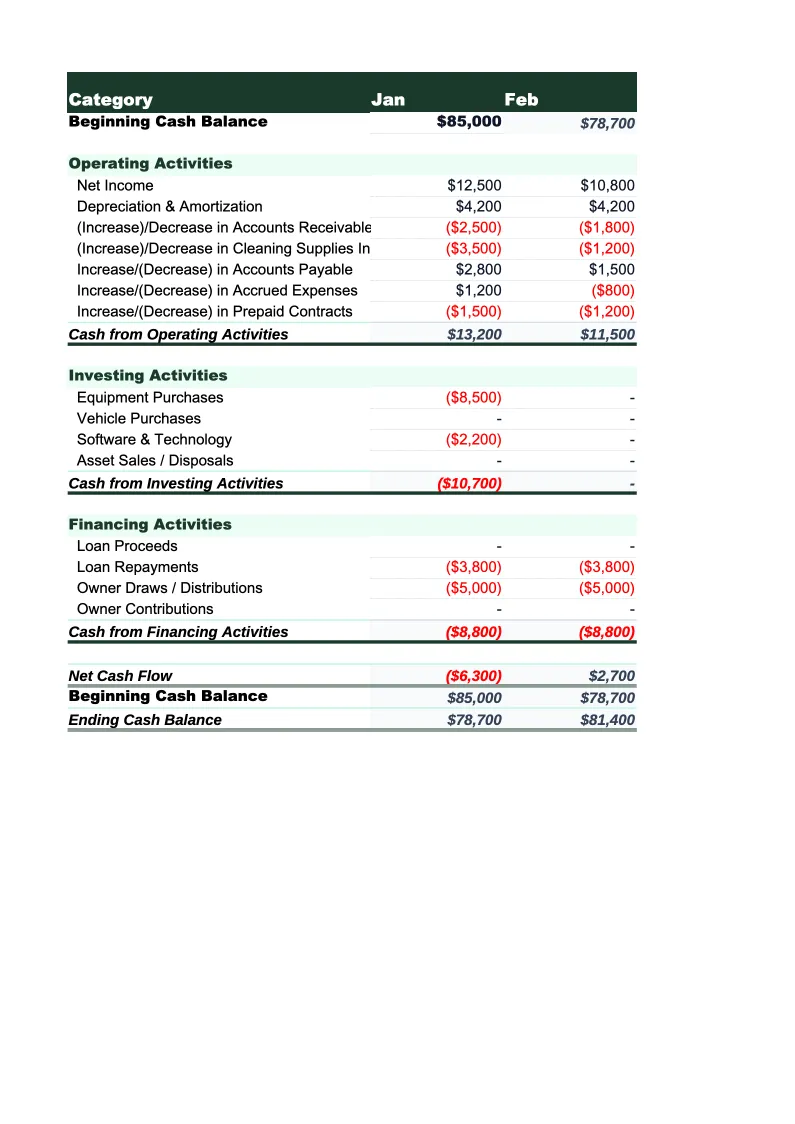
A 12-month indirect-method cash flow statement organized into operating, investing, and financing activities.
Client Contract Tracker
A dedicated sheet for managing your recurring client portfolio — the predictable revenue base that separates a stable cleaning business from one that lives job-to-job.
Annual Summary
A full-year rollup of operating cash flow broken down by revenue type and major expense category.
Dashboard
A visual overview with five pre-built charts: monthly cash inflows versus outflows, ending cash balance trend across 12 months, revenue by type (residential recurring, commercial, one-time, move-in/move-out, post-construction), crew labor cost as a percentage of monthly revenue, and the breakdown of operating expenses by category.
Cleaning Service Cash Flow Template Features
- 13-week cash projection with revenue split by residential contracts, commercial accounts, move-in/move-out, and one-time jobs
- Client Contract Tracker that manages your recurring client portfolio with billing frequency, payment terms, and year-to-date revenue per client
- Accounts receivable timing adjustment for commercial clients paying on 30-day net terms
- Gross margin calculated separately for residential recurring, commercial, and one-time service revenue types
- Labor cost tracked as a percentage of revenue — the primary margin driver in cleaning operations
- Annual cash runway calculation and revenue-type margin split for year-end review and lender conversations
How to Use This Cleaning Service Cash Flow Spreadsheet
Download the .xlsx file and open it in Excel or Google Sheets. Start with the Client Contract Tracker — enter each of your recurring clients, their service frequency, contract value per visit, and how they pay. This is the foundation of your cash projection because recurring billings are predictable and should be entered first before you estimate one-time or special-request revenue. Once your contract base is logged, move to the 13-Week Cash Flow sheet and enter expected one-time jobs, move-in/move-out cleans, and post-construction jobs you have confirmed for the next quarter. Fill in your weekly expense estimates for labor, supplies, vehicle costs, and any equipment purchases, then review the ending cash balance row to see where you stand heading into the next few months.
Use the monthly cycle to stay on top of commercial accounts. If you have clients paying on 30-day net terms, note their payment due dates in the Client Contract Tracker and reflect the timing in the 13-week projection — the revenue and the cash receipt happen in different weeks. Update the 13-week projection each Monday: pull the week's scheduled jobs from your booking system, confirm expected commercial payments against outstanding invoices, and adjust labor costs for any crew schedule changes. Reconcile the Monthly Cash Flow sheet against your bank statement at month-end and check whether commercial accounts receivable is growing or shrinking relative to last month.
15 minutes from download to your first cash flow projection
Download the template, enter your client contracts and weekly job schedule, and see your cleaning business's full cash picture — 13-week projection, client tracker, and monthly statement included.
Why Cleaning Businesses Need a Dedicated Cash Flow Template
Cleaning businesses have a cash flow structure that looks simple from the outside — you clean, you get paid — but creates real planning challenges as the business grows. Labor is the dominant cost at 50–65% of revenue, and it's largely fixed in the short run: you schedule a crew for the week based on booked jobs, and if a client cancels the morning of their appointment, the labor cost is already committed. Revenue, meanwhile, is split between residential clients who pay weekly or bi-weekly on a short cycle and commercial accounts that may pay monthly on 30-day net terms. Running both types of clients without a projection that tracks payment timing separately from service timing is how cleaning companies end up short on payroll even in months when revenue looks fine on paper.
The two dynamics that define cleaning service cash flow are labor cost management and accounts receivable timing. Labor cost as a percentage of revenue is the most important operational metric in the industry — a residential cleaning business running at 50% labor is healthy; one running at 65% is either priced too low, has significant overtime from inefficient scheduling, or is absorbing too many short jobs that don't justify the drive time. Commercial cleaning contracts shift the receivables picture: a commercial client billed $3,000 per month on net-30 terms represents $3,000 sitting in receivables at any given time, which is cash you've earned but can't spend until the check arrives. At five commercial clients, that's $15,000 in working capital tied up in invoices — a real constraint for a business that has to make payroll every two weeks.
Cleaning Service Industry at a Glance
Financial templates built for residential and commercial cleaning businesses — pre-loaded with labor, supplies, and overhead categories, and structured around the recurring contract model most cleaning companies run on.
Revenue Drivers
- Recurring residential contracts
- Commercial cleaning contracts
- One-time deep cleans
- Move-in/move-out cleaning
- Post-construction cleanup
Key Cost Categories
- Labor (wages & payroll taxes)
- Cleaning supplies & chemicals
- Equipment & tools
- Vehicle & transportation
- Liability insurance
- Marketing & advertising
Typical Margins
Gross: 40-55% · Net: 10-20%
Seasonality
Spring (March-April) peaks with spring cleaning demand; back-to-school surge in August-September; summer slightly slower as clients vacation; commercial cleaning demand is relatively steady year-round.
Key Performance Indicators
Cleaning Service Cash Flow Template FAQ
More Cleaning Service Templates
Cleaning Service Balance Sheet Template for Excel
$29
Cleaning Service Budget Template for Excel
$29
Cleaning Service Business Plan Template for Excel
$39
Cleaning Service Expense Tracker Template for Excel
$29
Cleaning Service Financial Model Template for Excel
$29
Cleaning Service Income Statement Template for Excel
$29
Cleaning Service Invoice Template for Excel
$29
Cleaning Service KPI Dashboard Template for Excel
$29
Cleaning Service P&L Template for Excel
$29
Cleaning Service Pro Forma Template for Excel
$29
Cleaning Service Project Budget Template for Excel
$29
Cleaning Service Sales Forecast Template for Excel
$29
Cleaning Service Business Valuation Template for Excel
$29
Cleaning Service Cash Flow Template
$29