Consulting Business Plan Template
A complete business plan template for consultants and consulting firms. Model billable hours and utilization rates, forecast startup costs and staff, and project EBITDA across three years.
What's Inside This Consulting Business Plan Template
This template includes 5 worksheets, each designed for a specific part of your consulting financial workflow:
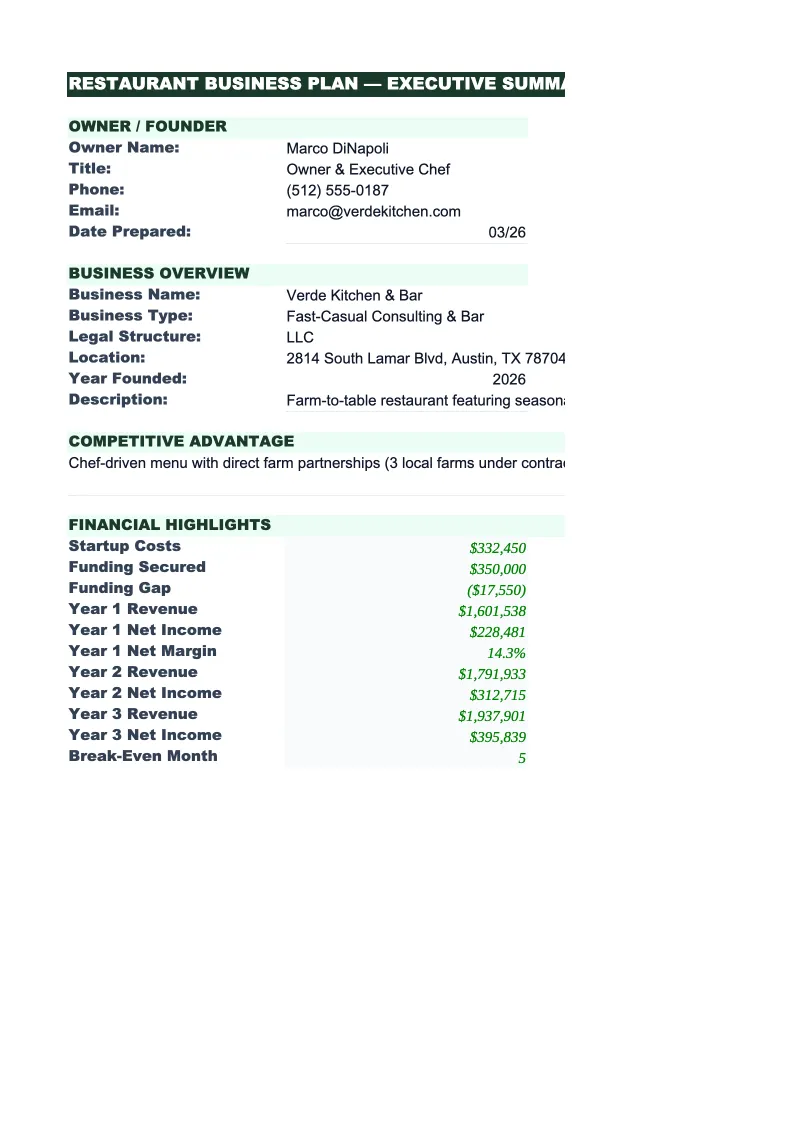
Executive Summary
The one-page snapshot of your consulting business, ideal for SBA lenders and consulting partners.
Startup Costs & Funding
Breaks down the investment required to launch a consulting firm: office space (professional office for client meetings), furniture and equipment (desks, conference table, laptops), technology and software (CRM, project management, accounting, website), licenses and credentials (specialized certifications if required), initial marketing and business development (website, LinkedIn, industry networking), branding and materials (business cards, proposals, website copy), and working capital for staffing and operating expenses during ramp-up.
Revenue Forecast
A 12-month billable hours and revenue forecast.
Projected P&L
Annual projections for years 1, 2, and 3 showing total revenue (billable hours × billing rate), cost of revenue (direct consultant salaries for billable work), gross profit and gross margin %, business development and sales costs (to generate new client work), administrative overhead (office, accounting, HR, finance), and depreciation.
Dashboard
A visual summary of your consulting firm's operational and financial health.
Consulting Business Plan Template Features
- Billable hours model built from consultant utilization rate and average billing rate
- Utilization tracking showing billable vs. non-billable hours and overhead allocation
- Service line modeling with different billing rates and margins for different specialties
- Startup costs for office, staffing, and business development
- 3-year P&L with gross margin %, utilization rate, realization rate, and EBITDA margin
- Dashboard with revenue per consultant, utilization trends, realization rate, and profitability trajectory
How to Use This Consulting Business Plan Spreadsheet
Start with the Executive Summary. Define your consulting specialty (management consulting, IT, HR, finance, marketing, operations) and target client type (Fortune 500, mid-market, SMB, nonprofits). Research billing rates for your specialty and geography: strategy consulting in major markets bills $250–$500+/hour; implementation and operations consulting bills $100–$250/hour; niche specialties vary widely. Then move to the Startup Costs & Funding sheet. Consulting firms have relatively low capital requirements: office space (can be shared or remote—$1,000–$3,000/month lease), laptop and equipment for each consultant, project management tools, website, and business cards. Most consulting startups need $20,000–$100,000 in startup capital.
Next, go to the Revenue Forecast sheet. Enter the number of consultants you'll employ or work with, their billable hourly rate, and expected billable utilization rate. A consultant has roughly 1,800–2,000 available working hours per year (52 weeks × 35–40 hours). Not all of those are billable: some are business development, some are non-billable internal projects, some are training. Realistic billable utilization rates are 50–70% for junior consultants (learning on the job), 70–80% for mid-level, and 80–90%+ for senior consultants (but senior consultants command higher rates). So a mid-level consultant at $200/hour and 70% utilization generates roughly $1,400/month in revenue × 12 = $168,000 annually.
From consultant expertise to lender-ready business plan in under an hour
Enter your billing rate, utilization target, consultant count, and overhead costs. The template builds your 3-year financial projections and profitability path automatically.
Why Consulting Firms Need a Solid Business Plan
A consulting firm business plan is fundamentally about demonstrating that you can win clients, deliver quality work, and achieve sustainable margins. Lenders and investors want to see: a clear value proposition and specialization (generic management consulting is harder to sell than deep expertise in a specific vertical or problem), evidence that you can win clients (existing relationships, pipeline, case studies), realistic utilization rates (not assuming 100% billable time), and sustainable margins after all overhead. A consulting firm that assumes 80% utilization across all staff from day one is being unrealistic—business development and account management take time, especially when you're new.
The three metrics that define consulting financial health are billable utilization rate (% of available hours that are charged to clients), realization rate (% of billable hours that actually get paid—not written off, discounted, or disputed), and gross margin per billable hour (billing rate minus loaded cost of consultant time). A healthy consulting firm has 70%+ billable utilization, 90%+ realization rate, and $100+ gross margin per billable hour. A consulting firm with 50% utilization, 80% realization, and $50 gross margin per hour will struggle to be profitable even with excellent overhead management. Unit economics are critical in services: your profit is determined by how efficiently you convert consultant time into billed revenue.
Consulting Industry at a Glance
Financial templates built for consulting firms and independent consultants. Pre-loaded with billing structures for hourly, retainer, and project-based engagements.
Revenue Drivers
- Hourly billing
- Monthly retainers
- Fixed-fee project work
- Expense reimbursements
Key Cost Categories
- Contractor/subcontractor fees
- Travel and accommodation
- Software and tools
- Professional development
- Marketing and business development
- Office and administrative overhead
Typical Margins
Gross: 50-80% · Net: 20-40%
Seasonality
Q1 tends to be slow as clients finalize budgets; Q4 often sees a surge in project closes. Summer can dip for firms serving corporate clients.
Key Performance Indicators
Consulting Business Plan Template FAQ
More Consulting Templates
Consulting Balance Sheet Template for Excel
$29
Consulting Budget Template for Excel
$29
Consulting Cash Flow Template for Excel
$29
Consulting Expense Tracker Template for Excel
$29
Consulting Financial Model Template for Excel
$29
Consulting Income Statement Template for Excel
$29
Consulting Invoice Template for Excel
$29
Consulting KPI Dashboard Template for Excel
$29
Consulting P&L Template for Excel
$29
Consulting Pro Forma Template for Excel
$29
Consulting Project Budget Template for Excel
$29
Consulting Sales Forecast Template for Excel
$29
Consulting Business Valuation Template for Excel
$29
More Business Plan Templates
Consulting Business Plan Template
$39