Consulting Pro Forma Template
Project revenue, margins, and cash flow for your consulting practice — built around hourly, retainer, and project-based billing structures.
What's Inside This Consulting Pro Forma Template
This template includes 6 worksheets, each designed for a specific part of your consulting financial workflow:
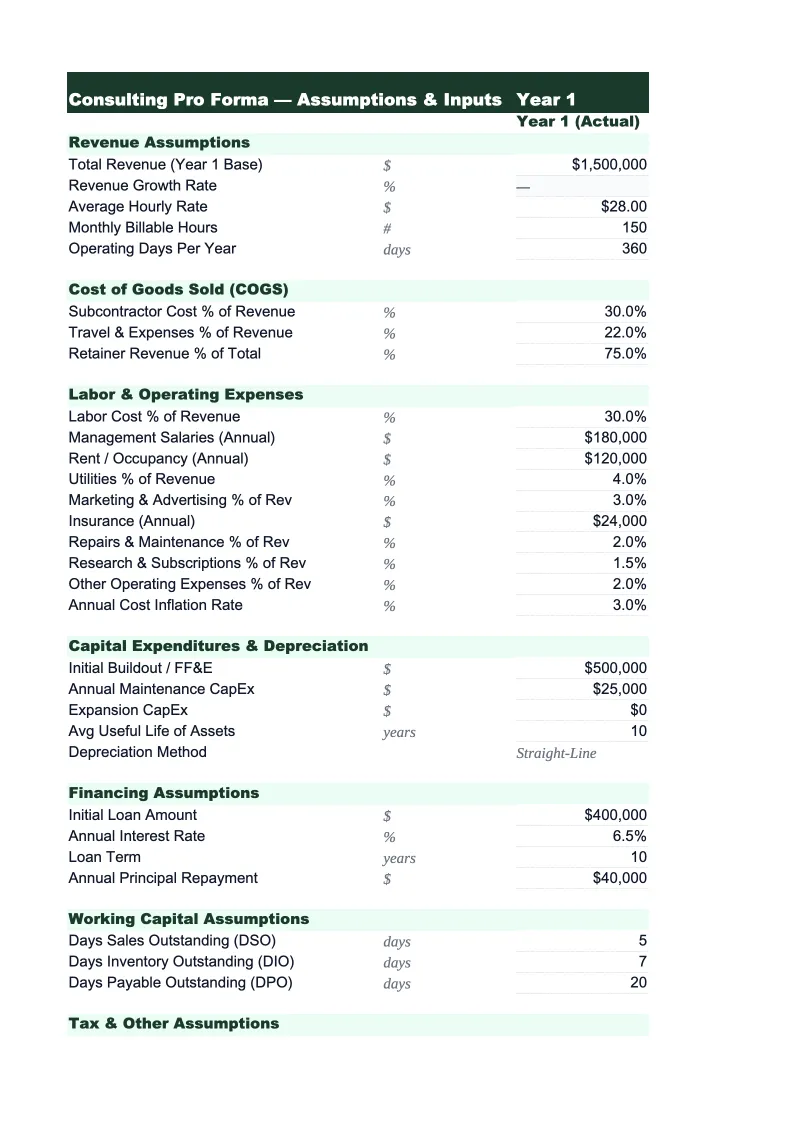
Assumptions
The control panel for your entire pro forma.
Revenue Projections
Projects monthly revenue across your three main engagement types — hourly billing, monthly retainers, and fixed-fee project work — over a 36-month horizon.
Expense Projections
Maps out all cost categories a consulting firm typically incurs: subcontractor and contractor fees (variable with revenue), staff salaries and benefits (semi-fixed), travel and accommodation (project-driven), software and tools, professional development, marketing and business development, and office overhead.
Projected P&L
A full three-year projected income statement that pulls revenue from the Revenue Projections sheet and costs from Expense Projections.
Cash Flow Projection
Projects monthly cash inflows and outflows with a collections lag built in — critical for consulting firms where invoices on net-30 or net-60 terms mean revenue is earned before cash arrives.
Dashboard
A single-page summary designed for presentations to potential partners, investors, or bank lenders.
Consulting Pro Forma Template Features
- Revenue model supporting hourly, retainer, and fixed-fee project billing
- Billable utilization rate calculations by consultant tier
- Subcontractor and direct project cost modeling
- 36-month projected P&L with gross and net margin tracking
- Cash flow projection with configurable collections lag
- Investor-ready summary dashboard with key metrics and charts
How to Use This Consulting Financial Projections Spreadsheet
Start with the Assumptions sheet — this is where you set the foundation for every projection in the model. Fill in your current or projected headcount by role, your target billable hours per week, and billing rates for each tier. If you're a solo consultant, you'll just have one row; if you're projecting a team build-out, add rows for each hire. Spend time here getting the inputs right rather than editing individual cells elsewhere — the whole model will recalculate instantly when you adjust an assumption.
Move to the Revenue Projections sheet and review how the model translates your assumptions into monthly revenue. Check that the utilization rate feels realistic — most solo consultants are fully booked at 60–70% utilization once you account for business development, admin, and downtime between projects. Adjust the retainer count and average retainer value to reflect your current book of business, then set growth rate assumptions for how many new clients you expect to add each quarter. Run both the base case and optimistic scenario to understand your revenue range.
15 minutes from download to your first consulting projection
Download the template, enter your billing rates and utilization targets, and get a complete 3-year financial projection for your consulting practice.
Why Consulting Firms Need a Pro Forma
Consulting firms face a projection challenge that product companies don't: revenue is entirely time-dependent. You can't build inventory during slow periods and sell it later — if your consultants aren't billing, that capacity is gone. A pro forma forces you to model utilization rate explicitly, which is the number most consulting firm owners either don't track at all or track informally. When you see utilization at 55% in a projection and know your break-even is 60%, you have a target. Without that model, you're flying without instruments.
The right consulting pro forma separates direct project costs from overhead, which is the distinction that makes gross margin meaningful. If you're paying subcontractors to deliver client work, that cost should show up as cost of revenue — not as an operating expense — because it moves with revenue. When gross margin is calculated properly, you can see what the business earns before paying for the fixed infrastructure that supports it. Most healthy consulting firms run 50–70% gross margins and 20–35% net margins, depending on whether they're delivery-heavy (using lots of subcontractors) or leverage-heavy (senior partners billing at premium rates with junior staff doing execution).
Consulting Industry at a Glance
Financial templates built for consulting firms and independent consultants. Pre-loaded with billing structures for hourly, retainer, and project-based engagements.
Revenue Drivers
- Hourly billing
- Monthly retainers
- Fixed-fee project work
- Expense reimbursements
Key Cost Categories
- Contractor/subcontractor fees
- Travel and accommodation
- Software and tools
- Professional development
- Marketing and business development
- Office and administrative overhead
Typical Margins
Gross: 50-80% · Net: 20-40%
Seasonality
Q1 tends to be slow as clients finalize budgets; Q4 often sees a surge in project closes. Summer can dip for firms serving corporate clients.
Key Performance Indicators
Consulting Pro Forma Template FAQ
More Consulting Templates
Consulting Balance Sheet Template for Excel
$29
Consulting Budget Template for Excel
$29
Consulting Business Plan Template for Excel
$39
Consulting Cash Flow Template for Excel
$29
Consulting Expense Tracker Template for Excel
$29
Consulting Financial Model Template for Excel
$29
Consulting Income Statement Template for Excel
$29
Consulting Invoice Template for Excel
$29
Consulting KPI Dashboard Template for Excel
$29
Consulting P&L Template for Excel
$29
Consulting Project Budget Template for Excel
$29
Consulting Sales Forecast Template for Excel
$29
Consulting Business Valuation Template for Excel
$29
Consulting Pro Forma Template
$29