Consulting Cash Flow Template
Track and project cash flow for your consulting business — with retainer billing, project milestone payments, AR aging, and a 13-week projection built around the lumpy, invoice-driven cash cycles consulting firms actually manage.
What's Inside This Consulting Cash Flow Template
This template includes 4 worksheets, each designed for a specific part of your consulting financial workflow:
13-Week Cash Flow
A rolling 13-week cash projection covering the most actionable planning window for a consulting business.
Monthly Cash Flow
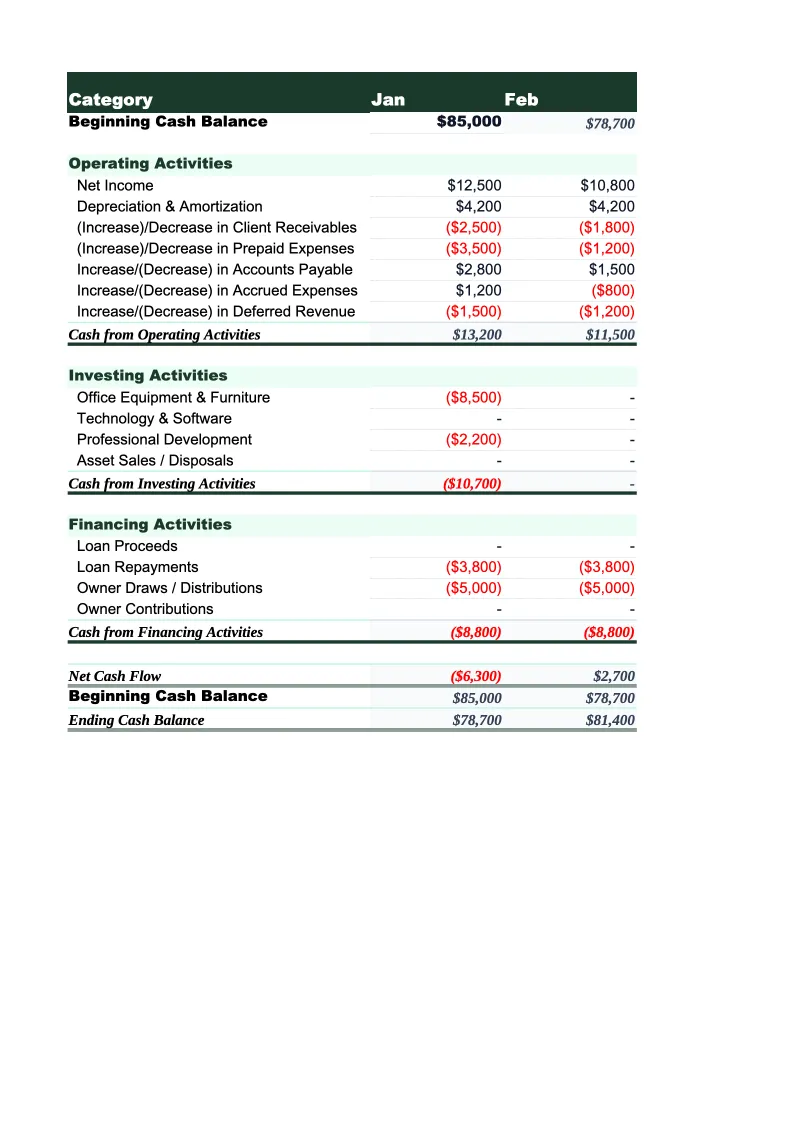
A 12-month indirect-method cash flow statement organized into operating, investing, and financing activities.
Client & AR Tracker
A dedicated sheet for managing every active client relationship, outstanding invoice, and accounts receivable position — the cash flow engine behind the 13-week projection.
Annual Summary
A full-year rollup of revenue by engagement type, operating cash flow, and the KPIs that consulting firm owners, partners, and potential acquirers use to evaluate a professional services business.
Consulting Cash Flow Template Features
- 13-week cash projection with retainer payments, project milestone payments, and hourly billing collections tracked as separate inflows — each arriving on a different schedule relative to when work was delivered
- Client & AR Tracker with automatic aging across 0–30, 31–60, 61–90, and 90+ day buckets, plus revenue concentration flagging when a single client exceeds 30% of total outstanding AR
- Accounts receivable and deferred revenue adjustments in the monthly indirect cash flow — reconciling the gap between when consulting revenue is recognized and when clients actually pay
- Billable utilization rate calculated automatically from the Client & AR Tracker, showing the primary operational driver of consulting cash flow in real time
- Days sales outstanding (DSO) calculation for the full year, measuring AR management effectiveness and identifying whether payment terms are being enforced
- Revenue mix breakdown by engagement type (retainer, hourly, fixed-fee) so you can see how predictable your cash flow is relative to your project completion exposure
How to Use This Consulting Business Cash Flow Spreadsheet
Download the .xlsx file and open it in Excel or Google Sheets. Start with the Client & AR Tracker — enter every active client: the engagement type, billing rate or retainer amount, invoice frequency, and current open invoice balance with the invoice date. For hourly and project clients, also enter the expected payment date based on how that client typically pays (check their last 3–6 invoices to estimate their real payment pattern rather than using the contract terms alone — many clients pay on net-45 regardless of net-30 terms). This step takes 20–30 minutes for most consulting businesses and immediately surfaces your total AR outstanding, your aging breakdown, and your expected cash inflows for the next 30 days. That three-number summary — AR total, aging distribution, and near-term expected receipts — tells you more about your short-term cash position than a bank balance alone, especially for firms where a single client might owe $30,000 in outstanding invoices.
Move to the 13-Week Cash Flow sheet and fill in weekly inflows and outflows. Use the Client & AR Tracker as your source: enter expected retainer payment dates in the retainer row based on when each client's payment is due, enter milestone payment dates for fixed-fee projects based on your contract schedule, and enter hourly billing collection dates based on the expected payment dates from the tracker. For outflows, enter contractor invoices in the week they're due, payroll or owner draws on their scheduled dates, and software subscriptions and other fixed expenses in the weeks they're billed. Travel expenses go in the weeks they're incurred or when reimbursement requests are submitted.
15 minutes from download to your first cash flow projection
Download the template, enter your active clients and outstanding invoices, and see your consulting firm's full cash picture — 13-week projection, AR tracker, and annual utilization summary included.
Why Consulting Firms Need a Dedicated Cash Flow Template
Consulting businesses have a cash flow structure defined by two structural tensions: the gap between when work is delivered and when clients pay, and the difference between the smooth monthly cost base and the lumpy, milestone-driven revenue pattern. A consulting firm delivering $250,000 of work per year on net-30 terms carries roughly $20,000 in outstanding receivables at any given time — and a firm on net-45 terms carries $30,000. That receivables balance isn't optional; it's the direct cost of offering credit to clients. When a single large project completes and the final milestone invoice goes out for $40,000 on net-45, the firm has delivered the work, paid its contractors, and continues to pay overhead — but won't receive the cash for six weeks. Cash flow management in consulting is largely accounts receivable management.
The metric that most directly controls consulting cash flow is billable utilization rate — the percentage of available consultant hours that are billed to clients. A solo consultant with 2,000 available hours per year at $200 per hour has a theoretical revenue ceiling of $400,000, but a realistic ceiling is much lower after non-billable time: business development, proposal writing, project management, and administrative work typically consume 30–50% of a consultant's time. A utilization rate of 60% produces $240,000 in revenue; a rate of 70% produces $280,000. That 10-percentage-point difference is $40,000 in additional revenue at near-zero incremental cost. This is why consulting firm operators track utilization weekly — it's not a lagging financial indicator, it's a leading cash flow signal that tells you whether next month's collections will be strong or weak.
Consulting Industry at a Glance
Financial templates built for consulting firms and independent consultants. Pre-loaded with billing structures for hourly, retainer, and project-based engagements.
Revenue Drivers
- Hourly billing
- Monthly retainers
- Fixed-fee project work
- Expense reimbursements
Key Cost Categories
- Contractor/subcontractor fees
- Travel and accommodation
- Software and tools
- Professional development
- Marketing and business development
- Office and administrative overhead
Typical Margins
Gross: 50-80% · Net: 20-40%
Seasonality
Q1 tends to be slow as clients finalize budgets; Q4 often sees a surge in project closes. Summer can dip for firms serving corporate clients.
Key Performance Indicators
Consulting Business Cash Flow Template FAQ
More Consulting Templates
Consulting Balance Sheet Template for Excel
$29
Consulting Budget Template for Excel
$29
Consulting Business Plan Template for Excel
$39
Consulting Expense Tracker Template for Excel
$29
Consulting Financial Model Template for Excel
$29
Consulting Income Statement Template for Excel
$29
Consulting Invoice Template for Excel
$29
Consulting KPI Dashboard Template for Excel
$29
Consulting P&L Template for Excel
$29
Consulting Pro Forma Template for Excel
$29
Consulting Project Budget Template for Excel
$29
Consulting Sales Forecast Template for Excel
$29
Consulting Business Valuation Template for Excel
$29
Consulting Cash Flow Template
$29