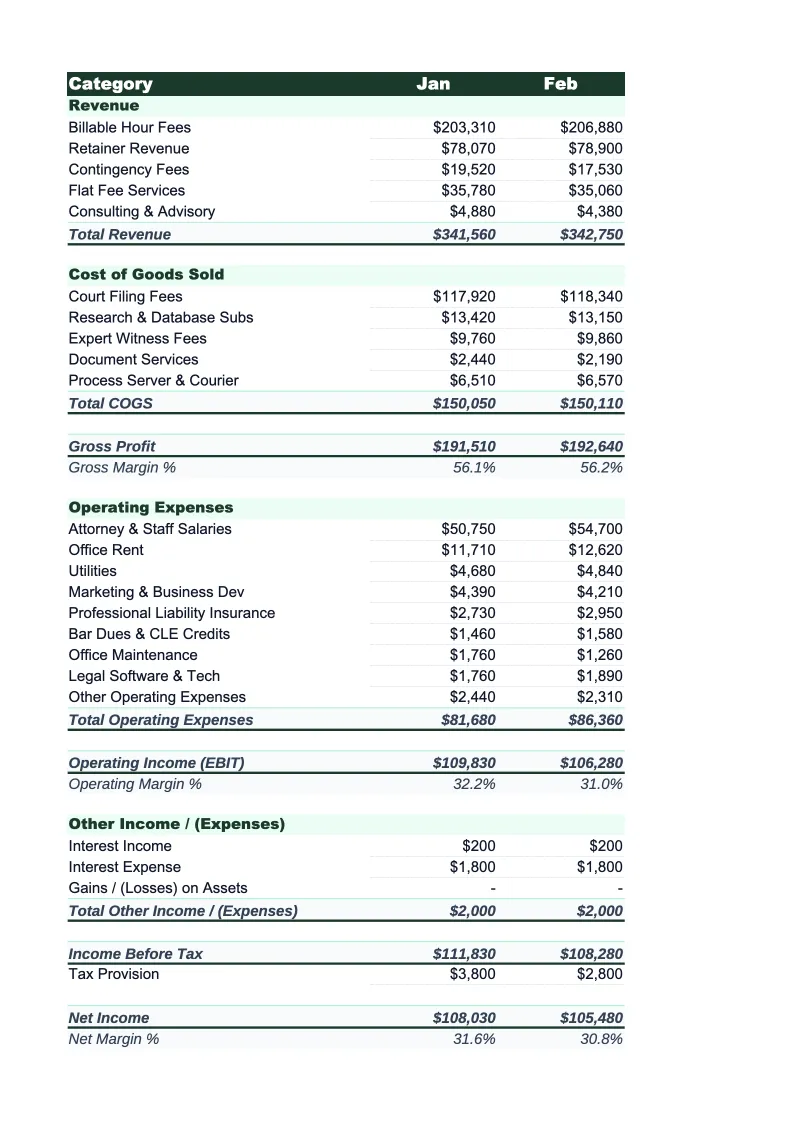
Law Firm Income Statement Template
Track revenue by billing type, practice area profitability, and net income with an income statement built specifically for law firms and legal practices.
What's Inside This Law Firm Income Statement Template
This template includes 5 worksheets, each designed for a specific part of your law firm financial workflow:
Monthly Income Statement
The core worksheet presents your law firm's income statement in standard format — revenue at the top, direct costs below, then operating expenses, and net income at the bottom.
Annual Summary
A 12-month rollup that pulls data from each monthly sheet and displays your firm's full-year financial performance in a single view.
Practice Area P&L
A breakdown of revenue and profitability by practice area — litigation, corporate and transactional, real estate, family law, estate planning, or whatever categories apply to your firm.
Realization & Collection
Tracks the gap between what your attorneys bill and what the firm actually collects — two ratios that determine real profitability in ways that an income statement alone doesn't capture.
Dashboard
A visual summary with pre-built charts tracking revenue by billing type over time, gross and net margin trends, practice area revenue distribution, and key performance indicators — billable hours per attorney, realization rate, and collection rate.
Law Firm Income Statement Template Features
- Revenue split by billing type: hourly, flat fee, retainer, and contingency
- Practice area profitability breakdown with allocated overhead
- Realization rate and collection rate tracking by attorney
- Malpractice insurance, legal research, and bar dues expense lines pre-built
- Gross profit, operating income, EBITDA, and net income calculations
- 12-month annual rollup with margin trend charts
How to Use This Law Firm Income Statement Spreadsheet
Getting started takes about 15 minutes. Download the .xlsx file and open it in Excel or Google Sheets — no macros or plugins required. Start with the Monthly Income Statement sheet: review the pre-loaded revenue and expense categories and adjust them to match your firm's billing structure and chart of accounts. Most firms keep the standard categories and add a few practice-area-specific line items. If your firm uses a different billing mix — for example, all flat fees with no contingency work — simply delete the rows that don't apply.
Once the structure looks right, enter your revenue and expense figures for the current month. If you track billing in practice management software like Clio, MyCase, or PracticePanther, export a monthly summary and use it as your source. For the Realization and Collection sheet, you'll need your billed amounts and collected amounts by attorney — most billing systems can generate this report. The Practice Area P&L works best once you have a few months of data, so it can show you meaningful margin differences across your practice groups.
15 minutes from download to your first income statement
Download the template, enter your billing and expense data, and see your law firm's full financial picture — monthly income, practice area margins, and attorney productivity in one place.
Why Every Law Firm Needs a Structured Income Statement
Law firms generate revenue in ways most income statement templates don't anticipate. Hourly billing, flat fees, monthly retainers, and contingency recoveries each have different timing, predictability, and margin profiles. A generic income statement lumps all of this into a single revenue line, which makes it impossible to see which billing model is actually driving profitability. For most small and mid-size firms, retainer revenue is the most stable, flat fee matters vary widely by complexity, and contingency fees are lumpy — large when they hit, absent in slow litigation years. Breaking these out separately gives you a more accurate picture of where income is coming from and how predictable next quarter looks.
On the cost side, law firms operate with a two-tier structure that matters for income statement analysis. Direct costs — attorney time and paralegal work attributable to client matters — scale with revenue and show up in gross profit. Operating expenses — malpractice insurance, Westlaw and LexisNexis subscriptions, office rent, bar dues, CLE, and administrative staff — are relatively fixed and compress net margins when revenue dips. Well-run firms target gross margins of 40–60% and net margins of 15–35%, but those numbers vary significantly by firm size, practice area mix, and whether partners draw salary or distributions. Tracking both gross and net margin separately is the only way to see which cost tier is causing margin pressure.
Law Firm Industry at a Glance
Financial templates built for law firms and legal practices — from solo practitioners to mid-size firms. Pre-loaded with billing rate structures, matter tracking, and trust account categories.
Revenue Drivers
- Billable hours (hourly engagements)
- Flat fee matters
- Retainer agreements
- Contingency fee recoveries
Key Cost Categories
- Attorney compensation & draws
- Paralegal & staff salaries
- Malpractice insurance
- Legal research subscriptions (Westlaw, LexisNexis)
- Office rent & overhead
- Bar dues, CLE & licensing
Typical Margins
Gross: 40-60% · Net: 15-35%
Seasonality
Q4 typically busiest for transactional and corporate practices (year-end deals); litigation practices are more event-driven. January is slower across most practice areas.
Key Performance Indicators
Law Firm Income Statement Template FAQ
More Law Firm Templates
Law Firm Balance Sheet Template for Excel
$29
Law Firm Budget Template for Excel
$29
Law Firm Business Plan Template for Excel
$39
Law Firm Cash Flow Template for Excel
$29
Law Firm Expense Tracker Template for Excel
$29
Law Firm Financial Model Template for Excel
$29
Law Firm Invoice Template for Excel
$29
Law Firm KPI Dashboard Template for Excel
$29
Law Firm P&L Template for Excel
$29
Law Firm Pro Forma Template for Excel
$29
Law Firm Project Budget Template for Excel
$29
Law Firm Sales Forecast Template for Excel
$29
Law Firm Valuation Template for Excel
$29
More Income Statement Templates
Accounting Firm Income Statement Template for Excel
$29
Auto Repair Income Statement Template for Excel
$29
Car Wash Income Statement Template for Excel
$29
Church Income Statement Template for Excel
$29
Cleaning Service Income Statement Template for Excel
$29
Coffee Shop Income Statement Template for Excel
$29
Law Firm Income Statement Template
$29