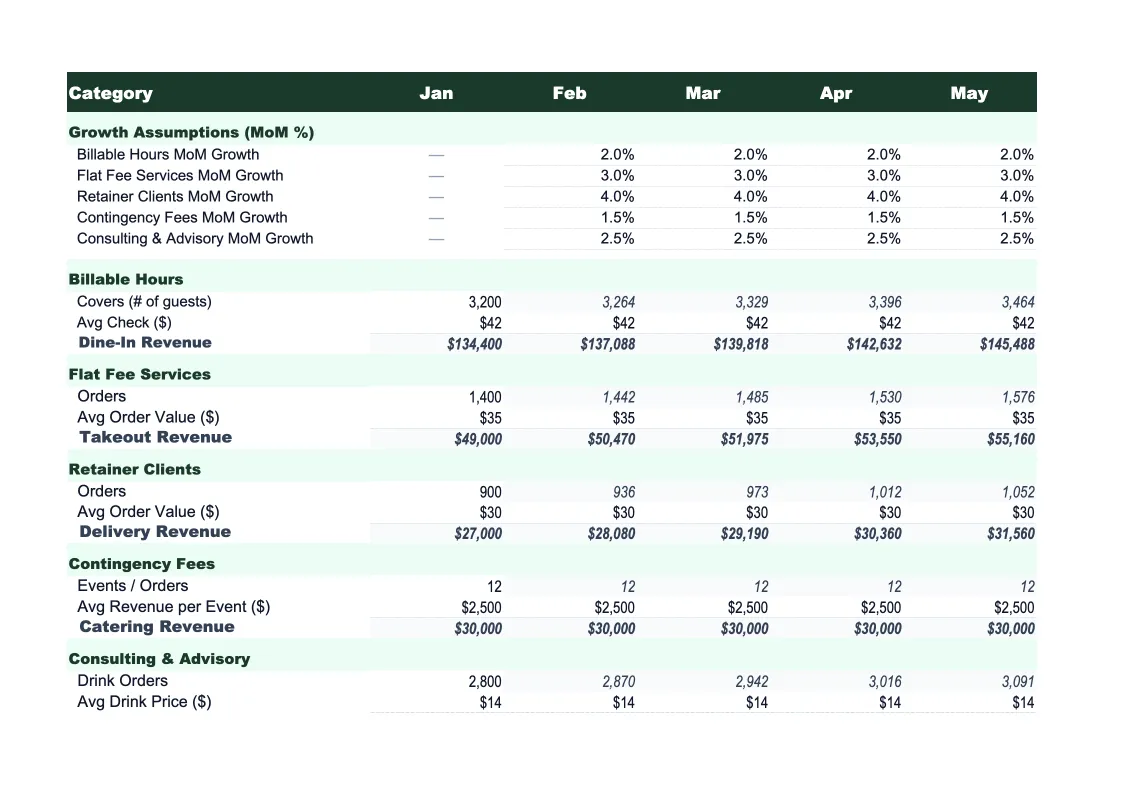
Law Firm Sales Forecast Template
Forecast law firm revenue by matter pipeline, billable hours capacity, and practice area — built for solo practitioners and small to mid-size firms managing hourly, flat fee, retainer, and contingency work.
What's Inside This Law Firm Sales Forecast Template
This template includes 7 worksheets, each designed for a specific part of your law firm financial workflow:
Assumptions
The central input sheet where you set up the inputs that drive the entire forecast.
Matter Pipeline
A matter-by-matter view of your active engagements and new business prospects.
Revenue Forecast
The monthly revenue build that models four billing streams independently: hourly billing (calculated from billable hours, billing rate, and realization rate), flat fee matters (based on expected matter closings from the pipeline), retainer revenue (recurring monthly fees from clients on retainer), and contingency fees (estimated settlement or verdict proceeds adjusted for expected timing and probability).
Capacity & Utilization
Billable hours analysis by attorney or by role tier.
Actuals vs Forecast
Month-by-month tracking of actual billed and collected revenue against the forecast, broken down by revenue stream.
Scenario Planner
Three parallel revenue scenarios — base case, upside, and downside — with independent assumption sets for each.
Dashboard
Visual summary of the law firm revenue forecast with pre-built charts: monthly revenue by billing type (hourly vs flat fee vs retainer vs contingency), pipeline coverage ratio relative to monthly revenue target, billable hours utilization trend by role, realization and collection rate tracking, and year-over-year revenue comparison if you have prior-year actuals.
Law Firm Sales Forecast Template Features
- Matter pipeline tracker with probability-weighted revenue calculations by practice area
- Four-stream revenue model: hourly billing, flat fee, retainer, and contingency
- Realization and collection rate adjustments built into every revenue calculation
- Capacity analysis by attorney role to validate forecast against billable hours
- Three-scenario planner: base, upside, and downside with independent assumptions
- Actuals vs forecast variance tracker with color-coded alerts by billing type
How to Use This Law Firm Sales Forecast Spreadsheet
Start with the Assumptions sheet. Download the file and open it in Excel or upload it to Google Sheets. Enter your attorney headcount by role, billing rates, target billable hours per month, and your expected realization and collection rates. If you're a solo practitioner, this takes ten minutes — enter your own rate, your working hours, and the retainer revenue you already have under agreement. If you run a small firm, enter each role tier separately. Take your time with realization and collection rates: if you're not sure, 88–92% for realization and 93–97% for collection are reasonable starting points for most general practice and transactional firms. These two inputs have an outsized effect on the forecast.
Next, populate the Matter Pipeline sheet with every active matter and prospective engagement. Include matters already in progress (probability 100%), engagement letters pending (80–90%), and referrals or consultations you're actively pursuing (30–60%). The weighted pipeline total is your most important leading indicator — if it's less than three months of target revenue, the forecast downstream will be soft. Then review the Revenue Forecast sheet to see how the model builds monthly revenue from your billing stream mix, and check the Capacity sheet to confirm the implied billable hours are achievable. Adjust assumptions until the forecast reflects what you genuinely believe is achievable, not what you're hoping for.
15 minutes from download to your first law firm forecast
Download the template, enter your billing rates, headcount, and matter pipeline, and get a complete revenue forecast with capacity analysis and scenario planning ready to use.
Why Law Firms Need a Purpose-Built Revenue Forecast
Law firm revenue forecasting is more complex than most service businesses because of the gap between hours worked and dollars collected. A firm might work 200 billable hours in a month, bill 180 of them (a 90% realization rate), and collect payment on 165 billed hours (a 92% collection rate) — meaning 17.5% of the work performed that month never becomes cash. Without a structured forecast that models both adjustments, revenue projections are systematically overstated, cash flow planning is unreliable, and decisions about hiring and expansion are made on numbers that won't materialize. This is the core reason law firms need a purpose-built forecast, not a generic sales spreadsheet.
Practice area mix adds another layer of complexity. Hourly billing in a litigation practice generates predictable monthly revenue tied directly to attorney activity, but it's capped by capacity and vulnerable to trial continuances and scheduling delays. Flat fee work in transactional practices generates lumpy revenue that depends on deal closings outside your control. Retainer arrangements from corporate clients provide a recurring revenue base that grows slowly but churns suddenly when clients go in-house or change relationships. And contingency matters are financially invisible until they settle — sometimes for years — and then produce large, irregular receipts. A single revenue line can't capture any of this, and neither can a standard pipeline tool built for product sales.
Law Firm Industry at a Glance
Financial templates built for law firms and legal practices — from solo practitioners to mid-size firms. Pre-loaded with billing rate structures, matter tracking, and trust account categories.
Revenue Drivers
- Billable hours (hourly engagements)
- Flat fee matters
- Retainer agreements
- Contingency fee recoveries
Key Cost Categories
- Attorney compensation & draws
- Paralegal & staff salaries
- Malpractice insurance
- Legal research subscriptions (Westlaw, LexisNexis)
- Office rent & overhead
- Bar dues, CLE & licensing
Typical Margins
Gross: 40-60% · Net: 15-35%
Seasonality
Q4 typically busiest for transactional and corporate practices (year-end deals); litigation practices are more event-driven. January is slower across most practice areas.
Key Performance Indicators
Law Firm Sales Forecast Template FAQ
More Law Firm Templates
Law Firm Balance Sheet Template for Excel
$29
Law Firm Budget Template for Excel
$29
Law Firm Business Plan Template for Excel
$39
Law Firm Cash Flow Template for Excel
$29
Law Firm Expense Tracker Template for Excel
$29
Law Firm Financial Model Template for Excel
$29
Law Firm Income Statement Template for Excel
$29
Law Firm Invoice Template for Excel
$29
Law Firm KPI Dashboard Template for Excel
$29
Law Firm P&L Template for Excel
$29
Law Firm Pro Forma Template for Excel
$29
Law Firm Project Budget Template for Excel
$29
Law Firm Valuation Template for Excel
$29
More Sales Forecast Templates
Law Firm Sales Forecast Template
$29