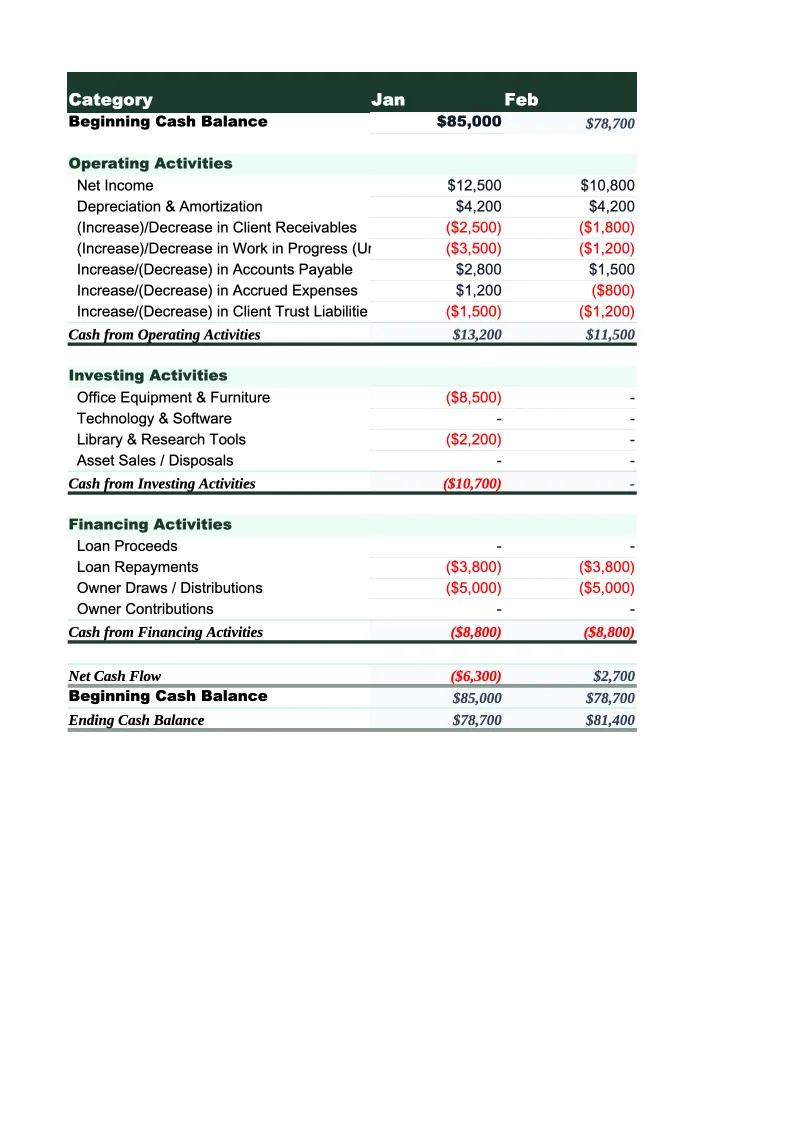
Law Firm Cash Flow Template
Track your law firm's cash flow from billing through collection — with sheets for WIP, accounts receivable aging, and 12-month projections built around how legal practices actually get paid.
What's Inside This Law Firm Cash Flow Template
This template includes 5 worksheets, each designed for a specific part of your law firm financial workflow:
Monthly Cash Flow
The core statement tracking all cash in and out for the month, organized into operating, investing, and financing activities.
Accounts Receivable Aging
A receivables tracker that categorizes every outstanding invoice by how long it has been unpaid — current, 30 days, 60 days, 90 days, and 90+ days overdue.
WIP & Billing Pipeline
Work in progress tracking for unbilled time and the pipeline from hours worked to invoice to payment.
12-Month Projection
A forward-looking cash flow model that projects inflows and outflows for the next 12 months based on current billings, known expenses, and expected collection timing.
Dashboard
A single-screen summary of your firm's key cash flow metrics: cash on hand, monthly collections, receivables aging distribution, WIP balance, collection rate, and realization rate.
Law Firm Cash Flow Template Features
- Accounts receivable aging with automatic 30/60/90/90+ day buckets
- WIP tracker converting unbilled hours to projected cash receipts
- Collection rate and realization rate auto-calculated from actuals
- 12-month cash flow projection with adjustable collection lag
- Retainer, hourly, flat fee, and contingency revenue line items
- Partner draw and compensation planning section
How to Use This Law Firm Cash Flow Spreadsheet
Getting started takes about 15 minutes. Download the .xlsx file and open it in Excel or Google Sheets. Begin with the Accounts Receivable Aging sheet — enter your current outstanding invoices with client name, invoice date, and amount. The sheet will automatically sort them into aging buckets. Then move to the Monthly Cash Flow sheet and enter last month's actual collections and expenses as your baseline. This gives you a real starting point rather than projections built on guesswork.
Once baseline data is in, open the WIP & Billing Pipeline sheet and log your current unbilled time by timekeeper and matter. This is the step most firms skip — and why they're caught off guard by cash crunches. The sheet converts your WIP to a projected billing schedule based on your typical billing cycle. From there, use the 12-Month Projection sheet to set assumptions for the months ahead: expected new billings, your average collection lag (usually 45–75 days for well-run firms), and any planned changes to headcount or overhead.
15 minutes from download to your first cash flow statement
Download the template, enter your current receivables and WIP, and see exactly where your firm's cash stands — and what the next 90 days look like.
Why Every Law Firm Needs a Cash Flow Template
Law firm cash flow is fundamentally different from most businesses because of the lag between work performed and cash received. An attorney bills 100 hours in January, sends the invoice in February, and collects in March or April — sometimes later. During that window, payroll runs every two weeks, rent is due on the first, and malpractice insurance doesn't care about your receivables balance. This timing gap is the single biggest source of financial stress for small and mid-size firms, and it's almost entirely invisible without a structured cash flow process.
The metrics that matter most in legal cash flow are the ones most firms track least consistently. Collection rate — the percentage of billed fees you actually collect — should ideally land between 90–95% for healthy firms. Anything below 85% signals a problem with billing practices, client selection, or collections follow-up. Realization rate — the percentage of worked hours that actually get billed — is the upstream indicator: if attorneys are writing off 20–30% of their time before the invoice even goes out, no collection process can fix the underlying revenue leak. This template tracks both automatically, so you can see where in the pipeline cash is being lost.
Law Firm Industry at a Glance
Financial templates built for law firms and legal practices — from solo practitioners to mid-size firms. Pre-loaded with billing rate structures, matter tracking, and trust account categories.
Revenue Drivers
- Billable hours (hourly engagements)
- Flat fee matters
- Retainer agreements
- Contingency fee recoveries
Key Cost Categories
- Attorney compensation & draws
- Paralegal & staff salaries
- Malpractice insurance
- Legal research subscriptions (Westlaw, LexisNexis)
- Office rent & overhead
- Bar dues, CLE & licensing
Typical Margins
Gross: 40-60% · Net: 15-35%
Seasonality
Q4 typically busiest for transactional and corporate practices (year-end deals); litigation practices are more event-driven. January is slower across most practice areas.
Key Performance Indicators
Law Firm Cash Flow Template FAQ
More Law Firm Templates
Law Firm Balance Sheet Template for Excel
$29
Law Firm Budget Template for Excel
$29
Law Firm Business Plan Template for Excel
$39
Law Firm Expense Tracker Template for Excel
$29
Law Firm Financial Model Template for Excel
$29
Law Firm Income Statement Template for Excel
$29
Law Firm Invoice Template for Excel
$29
Law Firm KPI Dashboard Template for Excel
$29
Law Firm P&L Template for Excel
$29
Law Firm Pro Forma Template for Excel
$29
Law Firm Project Budget Template for Excel
$29
Law Firm Sales Forecast Template for Excel
$29
Law Firm Valuation Template for Excel
$29
Law Firm Cash Flow Template
$29