Law Firm Pro Forma Template
Project your law firm's revenue, headcount, and profitability across a 3-year horizon — with pre-built billing rate models, collection rate assumptions, and matter-type breakdowns.
What's Inside This Law Firm Pro Forma Template
This template includes 6 worksheets, each designed for a specific part of your law firm financial workflow:
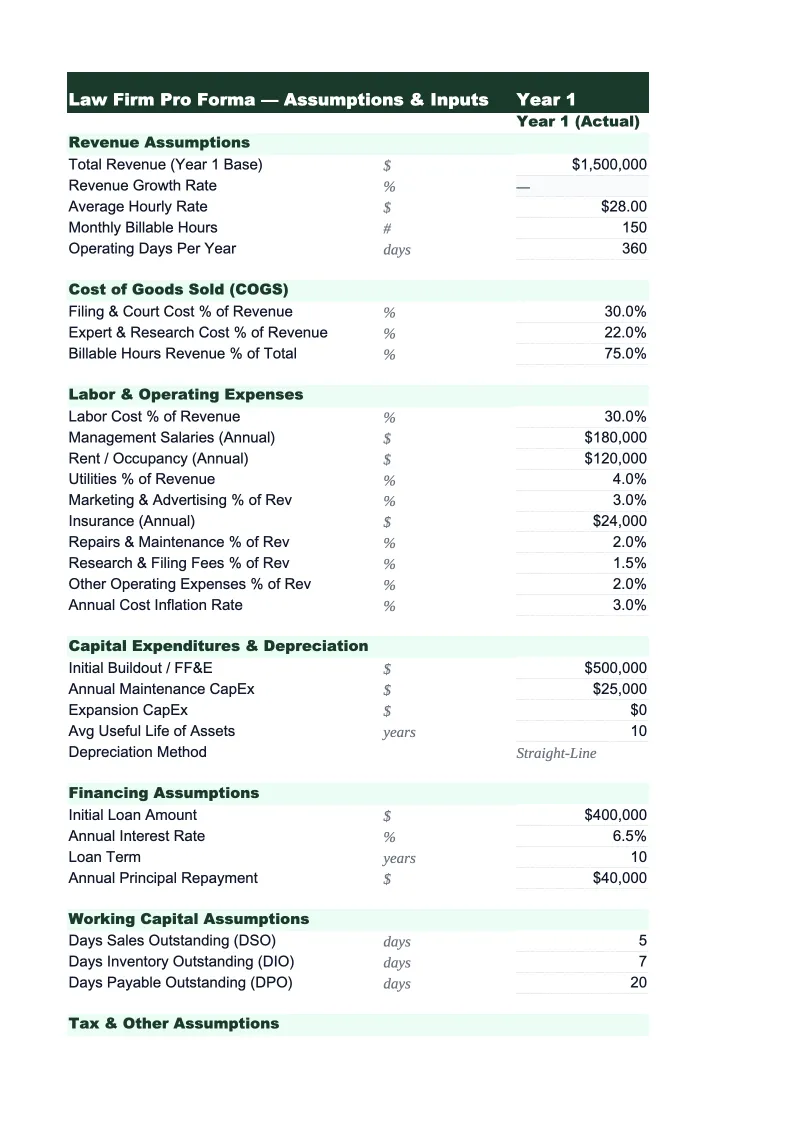
Assumptions
The control panel for the entire model.
Revenue Projections
A year-by-year revenue build broken out by billing type (hourly, flat fee, retainer, contingency) and practice area.
Expense Projections
Covers all operating costs over the three-year projection period, organized into the cost categories law firms actually use: attorney compensation and draws, paralegal and staff salaries, malpractice insurance, legal research subscriptions (Westlaw, LexisNexis), office rent and occupancy, marketing and business development, bar dues and CLE, and technology (practice management software, e-discovery tools).
Income Projection
The three-year pro forma income statement — gross revenue, less operating expenses, to arrive at net income and profit margin by year.
Cash Flow Projection
A monthly cash flow schedule covering the first 24 months of operations.
Dashboard
A one-page summary pulling the key outputs from across the model: three-year revenue trajectory, expense breakdown, net income by year, revenue per attorney, collection rate trend, and break-even analysis.
Law Firm Pro Forma Template Features
- Billing rate model by attorney level — partner, associate, of counsel, paralegal
- Realization and collection rate assumptions with downstream revenue impact
- Revenue breakdown by matter type: hourly, flat fee, retainer, contingency
- Monthly cash flow projection showing billing-to-collection lag
- 3-year income projection with revenue per attorney and partner draw calculations
- Investor-ready dashboard with practice-area revenue breakdowns and growth charts
How to Use This Law Firm Pro Forma Spreadsheet
Start on the Assumptions sheet — it drives the entire model. Enter your billing rates by attorney level, target billable hours, realization rate, and collection rate. If you're projecting a new practice, use conservative benchmarks for Year 1 (70–75% realization, 85% collection) and build toward industry norms by Year 3. If you're modeling an established firm or a lateral expansion, pull actual numbers from your current financials. Getting these inputs right takes 20–30 minutes, but it's what makes the rest of the model credible.
With assumptions set, move to the Revenue Projections sheet and fill in your expected matter volume and average matter value by billing type and practice area. Be specific: a litigation group projecting 40 matters per year at an average $15,000 flat fee is a very different model than an hourly practice billing 1,800 hours per attorney. Once revenue is in, review the Expense Projections sheet and adjust compensation, overhead, and headcount ramp for each year. The model will flag if your expense growth outpaces revenue growth.
15 minutes from download to your first law firm projection
Download the template, plug in your billing rates and headcount assumptions, and see your practice's three-year financial picture — with monthly cash flow and partner draw calculations included.
Why Law Firms Need a Pro Forma Financial Projection
A law firm pro forma is a specific kind of financial projection — one that has to account for how legal practices actually generate and collect revenue. Unlike a retail business where a sale is a sale, law firms bill for time or matters, apply a realization rate (the percentage of billed time actually invoiced), and then collect a percentage of invoiced amounts, typically 60–120 days later. A pro forma that ignores this sequence will show profitability that doesn't materialize as cash, which is the single most common financial surprise for attorneys starting or expanding a practice.
The numbers that matter most in a law firm pro forma are billable hours per attorney, realization rate, and collection rate — in that order. An attorney billing 1,800 hours at a $400 rate looks like $720,000 in gross production. At a 90% realization rate and 95% collection, that becomes $615,600 in collected revenue. Add a second attorney and you're modeling $1.2 million — subtract compensation, malpractice insurance, overhead, and technology costs, and you have a realistic picture of what the practice can generate. Most lenders and potential partners will build exactly this model; having it ready in your first conversation signals credibility.
Law Firm Industry at a Glance
Financial templates built for law firms and legal practices — from solo practitioners to mid-size firms. Pre-loaded with billing rate structures, matter tracking, and trust account categories.
Revenue Drivers
- Billable hours (hourly engagements)
- Flat fee matters
- Retainer agreements
- Contingency fee recoveries
Key Cost Categories
- Attorney compensation & draws
- Paralegal & staff salaries
- Malpractice insurance
- Legal research subscriptions (Westlaw, LexisNexis)
- Office rent & overhead
- Bar dues, CLE & licensing
Typical Margins
Gross: 40-60% · Net: 15-35%
Seasonality
Q4 typically busiest for transactional and corporate practices (year-end deals); litigation practices are more event-driven. January is slower across most practice areas.
Key Performance Indicators
Law Firm Pro Forma Template FAQ
More Law Firm Templates
Law Firm Balance Sheet Template for Excel
$29
Law Firm Budget Template for Excel
$29
Law Firm Business Plan Template for Excel
$39
Law Firm Cash Flow Template for Excel
$29
Law Firm Expense Tracker Template for Excel
$29
Law Firm Financial Model Template for Excel
$29
Law Firm Income Statement Template for Excel
$29
Law Firm Invoice Template for Excel
$29
Law Firm KPI Dashboard Template for Excel
$29
Law Firm P&L Template for Excel
$29
Law Firm Project Budget Template for Excel
$29
Law Firm Sales Forecast Template for Excel
$29
Law Firm Valuation Template for Excel
$29
Law Firm Pro Forma Template
$29