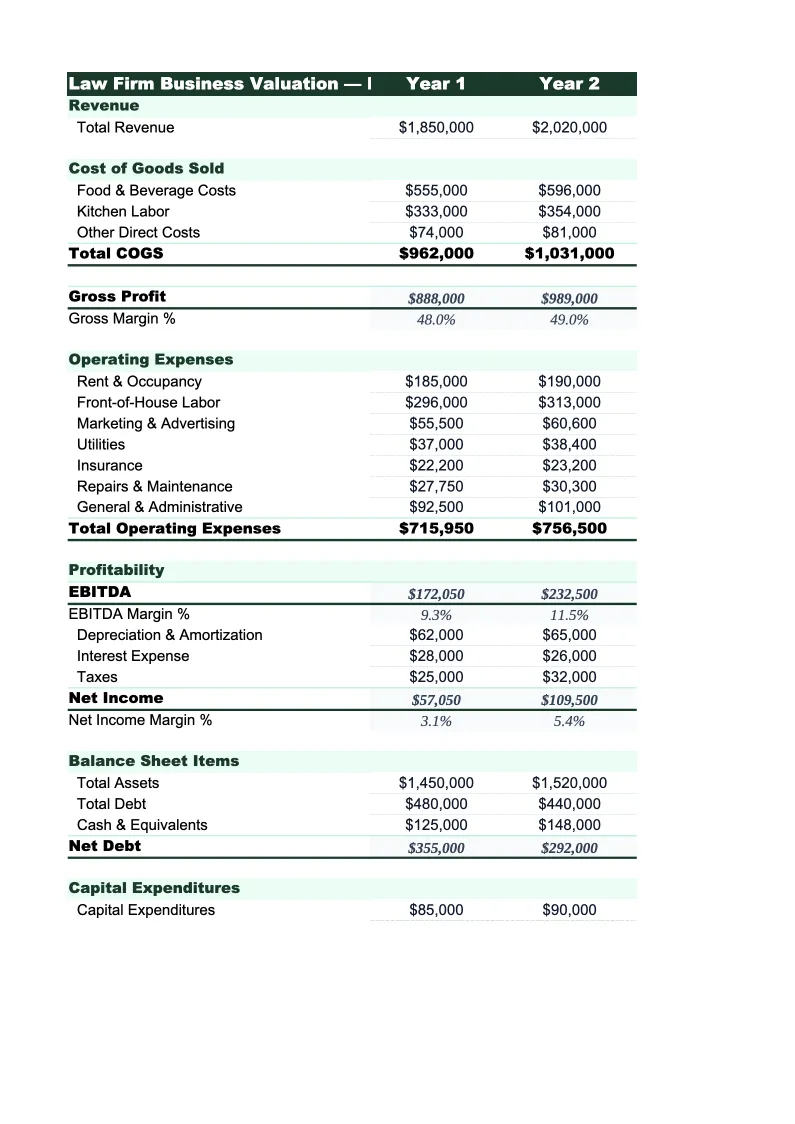
Law Firm Valuation Template
Value your law firm using seller's discretionary earnings multiples, a revenue approach, book of business portability analysis, and an attorney dependency scorecard — built around how legal practices actually change hands.
What's Inside This Law Firm Valuation Template
This template includes 6 worksheets, each designed for a specific part of your law firm financial workflow:
Business Inputs
The data entry foundation for every calculation in the model. Enter trailing twelve-month gross revenue split by fee structure: hourly billing, flat fee matters, monthly retainer agreements, and contingency fee recoveries. The expense section captures attorney compensation and draws (entered separately from staff for SDE normalization), paralegal and legal assistant salaries, malpractice insurance premiums, legal research subscriptions (Westlaw, LexisNexis, Clio, or practice management software), office rent and utilities, bar dues and CLE requirements, and professional services including the firm's own accountant and outside legal counsel for firm matters. Operational data fields include total billable hours in the trailing twelve months by attorney, effective hourly rate (total revenue divided by total billed hours), realization rate (billed hours as a percentage of worked hours), collection rate (collected revenue as a percentage of billed revenue), active matter count, number of recurring retainer clients, matter count by practice area, and total headcount of attorneys beyond the principal. All downstream sheets pull from these inputs without requiring additional data entry.
Revenue Multiple Approach
A top-down valuation method that establishes a broad value range using trailing twelve-month gross revenue. Small and mid-size law firms selling as going concerns typically transact at 0.5–1.5x gross revenue in private practice sales, with the multiple driven primarily by how portable the book of business is under new ownership and the structure of the fee arrangements. Firms whose revenue comes from institutionalized clients — companies and organizations that retain the firm for ongoing legal work regardless of which attorney handles the matter — command the upper end of the range. Practices where clients chose the firm because of one principal attorney's specific expertise, relationships, or courtroom reputation typically transact at 0.5–0.8x revenue because buyers face significant client attrition risk after the attorney of record departs. The sheet adjusts the baseline multiple for four factors: revenue type (retainer and institutional client revenue command a premium over contingency and personal referral-driven work), staff attorney capacity (associates and of-counsel attorneys who carry client relationships independently reduce principal dependency), matter concentration (heavy concentration in one practice area or a single corporate client compresses the range), and proprietary assets including documented intake processes, case management systems, and recurring legal work with established clients. A per-matter implied value is calculated alongside the revenue multiple as a cross-check for practices with stable matter volumes.
SDE Multiple Approach
Seller's Discretionary Earnings is the primary income-based valuation method for solo practices and small law firms with a dominant principal. SDE normalizes net income by adding back the principal attorney's total compensation — salary, draws, and any personal expenses run through the practice — along with depreciation and amortization on equipment and software, interest on business debt, and one-time or non-recurring expenditures such as a major practice management software implementation or non-recurring expert witness fees. The resulting SDE figure represents the full economic benefit the practice generates for one full-time owner-attorney. Solo and small law firm practices typically sell at 1.5–3.5x trailing twelve-month SDE in private transactions, with the multiple driven by the same portability and dependency factors that govern the revenue multiple approach. Larger firms with multiple equity partners are more commonly valued on an EBITDA or adjusted profit basis rather than SDE, and the sheet includes an EBITDA normalization track for practices with multiple attorneys whose compensation is above-market relative to what a replacement attorney would cost. The multiple selection matrix maps specific practice attributes — client portability, retainer revenue percentage, associate depth, practice area concentration, and documented intake and case management processes — to the appropriate SDE multiple range so you can see exactly where your practice falls.
Book of Business Analysis
The central risk assessment for any law firm transaction. This sheet quantifies the portability of client relationships — the factor that buyers, brokers, and acquirers evaluate most carefully in any legal practice sale. Enter your top fifteen clients and matters by trailing twelve-month billings — the sheet calculates each client's percentage of total revenue, cumulative concentration across your top one, three, five, and ten clients, and a portability risk score based on standard thresholds used in legal practice acquisitions. A single client representing more than 20% of revenue is classified as high concentration; a client above 35% of billings creates a material acquisition risk that most buyers will address with earnout provisions or price adjustments. The sheet also breaks down revenue by fee type for each major client — hourly matters, flat fee engagements, and retainers — because recurring retainer arrangements with institutional clients are substantially more transferable than contingency or personal-referral-driven hourly work. A relationship structure section documents whether each major client relationship is governed by a formal engagement letter with the firm entity, whether it is a personal referral relationship with the principal attorney, and the length of the engagement history. Buyers rely on this data to estimate post-acquisition retention and to determine whether an earnout is necessary to manage transition risk. Ethics compliance notes are included to flag ABA Model Rule 1.17 considerations for your state, since law practice sales have specific notification and client consent requirements that affect transaction timing.
Attorney Dependency Scorecard
A structured scoring model for evaluating how much of the practice's revenue and client goodwill is transferable independent of the selling attorney. Attorney dependency is the defining risk in legal practice valuations: in most solo and small firm contexts, clients choose the practice because of the principal attorney's specific expertise, bar credentials, courtroom reputation, or personal referral network — none of which transfer with the sale of the firm's business assets. The scorecard evaluates eight dimensions: client loyalty to the firm versus the principal attorney (do clients reference the firm brand or the attorney by name?); associate and of-counsel attorney depth (can employed attorneys handle client matters independently from intake through resolution without the principal's involvement?); documented case management and intake processes (are the firm's service delivery workflows documented so a new owner can operate them?); digital and brand assets (is the firm's website, Google Business Profile, and online presence tied to the business entity or to the principal's personal profile and bar directory listings?); retainer versus contingency and project revenue (what portion of annual billings comes from clients under ongoing retainer arrangements?); referral network portability (are the firm's referral relationships personal to the principal attorney or institutional to the firm?); practice area specialization (does the firm serve a highly specialized niche where the principal's specific credentials are the primary value, or a broader practice area where an incoming attorney could serve clients with equivalent expertise?); and documented workflows and standard operating procedures (are intake processes, deadline management systems, and client communication protocols documented for a new owner?). Each factor is scored 1–5, and the composite score maps to an SDE multiple adjustment within the 1.5–3.5x range.
Valuation Summary
A single-page output consolidating the revenue multiple approach and the SDE multiple approach into one view across conservative, base, and optimistic scenarios. The summary shows the revenue multiple range and the SDE multiple range side by side, with client and matter goodwill isolated from staff goodwill and documented systems goodwill so buyers and sellers can see what fraction of the purchase price reflects different categories of transferable value. A transition scenario comparison shows how the same billings and SDE produce different valuations depending on the sale structure: an asset purchase covering client files, case management software and data, the firm name and web presence, and ongoing matters with client consent and court approval; an earnout-supported transition where the purchase price includes a variable component tied to client billings retention over 12–24 months post-close; and a full going-concern sale with employed associates who carry client portfolios independently and a documented intake and case management process in place. The sensitivity table shows how the SDE valuation shifts as the multiple moves in 0.25x increments from 1.25x to 4.0x, giving both parties a clear view of the full negotiation band. Solo practices typically sell in the $75,000–$350,000 range; small firms with multiple attorneys, recurring retainer revenue, and strong institutional client relationships can reach $400,000–$1,200,000 or above depending on practice area and client portability.
Law Firm Valuation Template Features
- Revenue multiple calculation benchmarked to law firm and legal practice transactions with retainer, hourly, and contingency revenue adjustments
- SDE normalization with full principal attorney compensation add-back, realization and collection rate adjustments, and a multiple selection matrix for legal practice value drivers
- Book of business portability analysis tracking top-15 client revenue share, engagement letter structure, and ABA Rule 1.17 compliance notes
- Attorney dependency scorecard scoring eight transferability factors including client loyalty, associate depth, referral network portability, and documented workflows
- Transition scenario comparison showing asset purchase, earnout structure, and full going-concern scenarios with client consent considerations
- Three-scenario valuation output with SDE sensitivity table showing the full negotiation band from 1.25x to 4.0x
How to Use This Law Firm Valuation Spreadsheet
Start with the Business Inputs sheet. Pull trailing twelve-month revenue from your practice management software or accounting system — most firms track hourly, flat fee, retainer, and contingency revenue in separate billing categories, and keeping them separate matters for valuation because each type commands a different multiple. Break out the principal attorney's total compensation completely: salary or guaranteed draws, any profit distributions, and personal expenses run through the firm (professional liability insurance for personal matters, personal vehicle, personal travel). You'll also need operational data: total billable hours per attorney in the trailing twelve months, your practice's blended realization rate (billed versus worked hours — typically 85–95% for efficient practices), and collection rate (collected versus billed — typically 90–98% for healthy practices). Active matter count, percentage of revenue from retainer clients, and headcount of associates or of-counsel attorneys who carry client matters independently all go into this sheet as well.
Work through the Revenue Multiple and SDE Multiple sheets, then complete the Book of Business Analysis and Attorney Dependency Scorecard. The book of business section is where most solo and small firm attorneys encounter the core tension in legal practice sales: nearly all of their billing relationships are with clients who came to them personally — through referrals, bar associations, previous firm relationships, or reputation in a specific practice area — and who may or may not continue with a new owner. Document each major client relationship honestly: whether it's governed by an engagement letter with the firm entity, whether the relationship would realistically follow the selling attorney to retirement or a successor practice, and the length of the engagement. The Attorney Dependency Scorecard then scores the factors a buyer or practice broker will walk through during diligence. Understanding your score in advance identifies the specific improvements — converting informal client relationships to formal firm retainers, helping associates develop independent client relationships, or documenting intake and case management workflows — that would increase the achievable multiple before going to market.
Review the Valuation Summary before any conversation with a law practice broker, bar association transition program, or prospective acquirer. Pay close attention to the transition scenario comparison: the structure of a law practice sale — which must comply with ABA Model Rule 1.17 or its state equivalent, including notification to active clients and their right to choose new counsel — significantly affects both the achievable price and the transaction timeline. The earnout structure is common in legal practice acquisitions precisely because client retention is uncertain and often takes 12–24 months to fully stabilize. The sensitivity table shows what specific changes to the practice — adding an associate who can independently carry client matters, converting three hourly clients to monthly retainers, or building a documented intake and deadline management process — would do to the SDE multiple, helping you decide whether those investments make sense before initiating a sale.
Know what your law practice is worth before you sell
Enter your billings, SDE, book of business data, and operational metrics — and get a defensible valuation range with the SDE approach, portability analysis, and attorney dependency scorecard that buyers will use to make their offer.
How Law Firms Are Valued When They Sell
Law firm valuations share the owner-dependency problem with consulting practices but add a layer of complexity unique to legal services: the professional relationship between an attorney and a client is not automatically transferable, and selling an active law practice requires compliance with state-specific ethics rules governing practice sales — most of which derive from ABA Model Rule 1.17. Clients of a selling attorney have the right to choose new counsel, to take their files, and to be notified of any change in the attorney who holds their matter. This means that even when a buyer purchases a practice's book of business, they are effectively purchasing the opportunity to be introduced to the clients — not a guaranteed revenue stream. Solo and small firm practices where clients chose the practice specifically for the principal attorney's expertise, courtroom reputation, or personal referral network face the most acute version of this risk, and it is the single largest factor that drives legal practice sale prices below what the firm's revenue figures might imply.
The factors that push a law firm valuation toward the higher end of the range reflect one underlying principle: revenue that doesn't depend on the selling attorney being present. Institutional clients — corporations, nonprofits, government agencies, and organizations that retain the firm for ongoing legal work under a master engagement agreement with the firm entity — represent the most transferable revenue because the relationship is with the firm, not with a specific attorney. Associates and of-counsel attorneys who carry their own matters independently, maintain direct client communication, and have established direct relationships with clients before the sale significantly reduce the dependency risk because the client's relationship with the firm is broader than the principal alone. Retainer agreements in practice areas where the legal service itself is relatively standardized — business formation, lease review, HR compliance, estate planning maintenance — are more transferable than contingency fee personal injury matters or complex commercial litigation where the principal's specific courtroom judgment is the product. And a documented case management system — documented intake processes, deadline tracking protocols, client communication standards — demonstrates to a buyer that the practice can be operated by someone other than the current principal.
The practical path to a higher law firm valuation typically requires several years of deliberate practice development rather than pre-sale optimization. Converting informal client relationships into formal firm engagement letters — where the client relationship is documented as belonging to the firm entity, not just to the principal attorney's bar number — takes relational groundwork and, in some cases, explicit client conversations. Developing associates into relationship-holding attorneys who clients identify with as their primary contact requires time, supervised independence, and a client-introduction strategy. The practices that achieve the highest multiples in legal practice sales are almost always those where the principal attorney has spent several years making themselves less operationally essential before marketing the firm — not because the work became less demanding, but because the business no longer required the principal to be present in every matter to maintain client satisfaction and revenue continuity.
Law Firm Industry at a Glance
Financial templates built for law firms and legal practices — from solo practitioners to mid-size firms. Pre-loaded with billing rate structures, matter tracking, and trust account categories.
Revenue Drivers
- Billable hours (hourly engagements)
- Flat fee matters
- Retainer agreements
- Contingency fee recoveries
Key Cost Categories
- Attorney compensation & draws
- Paralegal & staff salaries
- Malpractice insurance
- Legal research subscriptions (Westlaw, LexisNexis)
- Office rent & overhead
- Bar dues, CLE & licensing
Typical Margins
Gross: 40-60% · Net: 15-35%
Seasonality
Q4 typically busiest for transactional and corporate practices (year-end deals); litigation practices are more event-driven. January is slower across most practice areas.
Key Performance Indicators
Law Firm Valuation FAQ
More Law Firm Templates
Law Firm Balance Sheet Template for Excel
$29
Law Firm Budget Template for Excel
$29
Law Firm Cash Flow Template for Excel
$29
Law Firm Financial Model Template for Excel
$29
Law Firm Income Statement Template for Excel
$29
Law Firm Invoice Template for Excel
$29
Law Firm KPI Dashboard Template for Excel
$29
Law Firm P&L Template for Excel
$29
Law Firm Pro Forma Template for Excel
$29
Law Firm Project Budget Template for Excel
$29
Law Firm Sales Forecast Template for Excel
$29
Law Firm Valuation Template
$29