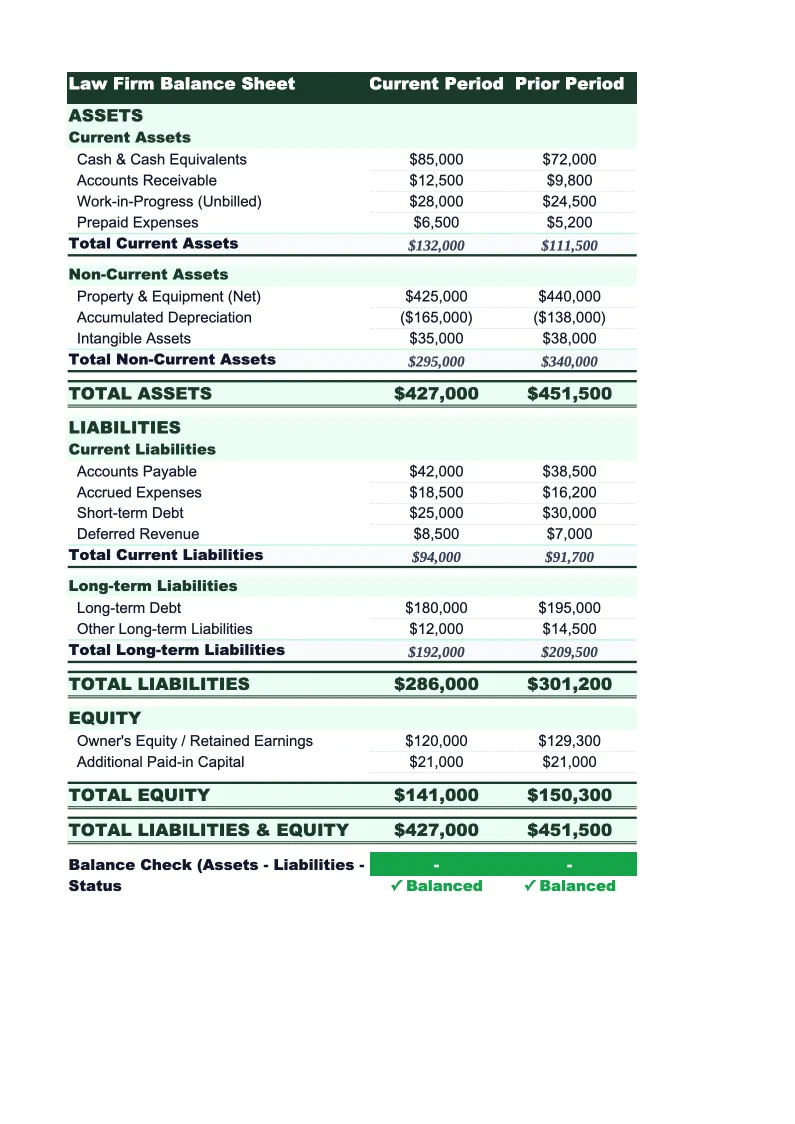
Law Firm Balance Sheet Template
A balance sheet template built for law firms — with trust account handling, work-in-progress assets, and partner equity sections that match how legal practices actually operate.
What's Inside This Law Firm Balance Sheet Template
This template includes 4 worksheets, each designed for a specific part of your law firm financial workflow:
Balance Sheet
The core statement showing your firm's financial position at a specific date.
Trust Account Reconciliation
A dedicated worksheet for reconciling your IOLTA (Interest on Lawyer Trust Accounts) balance — one of the most compliance-sensitive numbers on any law firm balance sheet.
Period Comparison
A side-by-side view of two balance sheet periods — current versus prior year (or any two dates you choose).
Dashboard
A visual summary of key balance sheet metrics — current ratio, debt-to-equity, WIP as a percentage of total receivables, and trust account utilization.
Law Firm Balance Sheet Template Features
- Trust account (IOLTA) handled as offsetting asset and liability
- Work-in-progress section under current assets
- Partner capital accounts and draws in equity section
- Trust account reconciliation worksheet for bar compliance
- Current ratio and debt-to-equity auto-calculated
- Side-by-side period comparison with variance tracking
How to Use This Law Firm Balance Sheet Spreadsheet
Download the .xlsx file and open it in Excel or Google Sheets — no macros or plugins required. Start with the Balance Sheet sheet and review the pre-loaded line items. Most of the asset and liability categories will match your firm's chart of accounts with minimal changes. The main adjustments are usually in the equity section: update the partner capital account names to match your actual partner structure, and if your firm tracks draws separately from capital, the template handles both formats.
Enter your current figures starting from cash and working down through the asset section. The trust account balance should match your IOLTA reconciliation — use the Trust Account Reconciliation sheet to confirm the figure before entering it. Work-in-progress should reflect unbilled time valued at your standard billing rates. On the liabilities side, the trust account liability line must equal your trust asset balance; the template links these cells automatically so they stay in sync. Once you've entered all figures, the balance check cell at the bottom confirms your statement is in balance.
15 minutes from download to your first balance sheet
Download the template, enter your figures, and get a complete picture of your firm's financial position — assets, trust account, WIP, and partner equity all in one place.
Why Every Law Firm Needs a Balance Sheet Template
Law firm balance sheets have structural features that generic templates handle badly. The most significant is the trust account: client funds held in escrow or retainer must appear on the balance sheet as both a current asset (the cash your firm is holding) and an equal current liability (the obligation to disburse those funds). Most accounting templates treat the trust account as just a bank account, which understates both assets and liabilities and creates reconciliation headaches. For firms with active transactional or family law practices, the trust balance can represent a substantial portion of total assets — and it must be reconcilable to the client ledger at all times.
Work-in-progress is another line item that distinguishes legal practices from most businesses. WIP represents time your attorneys have worked but not yet billed. For firms on a cash basis, WIP doesn't appear on the balance sheet at all — but for accrual-basis firms (which most mid-size practices use), WIP is a current asset valued at billing rates. Tracking it separately from accounts receivable is important because it has different collection risk. Billed and unpaid invoices are receivables; unbilled time is WIP. The ratio of WIP to total outstanding billings tells you whether your billing cadence is keeping pace with work being done. Firms that let WIP accumulate for more than 30–60 days typically collect less of it.
Law Firm Industry at a Glance
Financial templates built for law firms and legal practices — from solo practitioners to mid-size firms. Pre-loaded with billing rate structures, matter tracking, and trust account categories.
Revenue Drivers
- Billable hours (hourly engagements)
- Flat fee matters
- Retainer agreements
- Contingency fee recoveries
Key Cost Categories
- Attorney compensation & draws
- Paralegal & staff salaries
- Malpractice insurance
- Legal research subscriptions (Westlaw, LexisNexis)
- Office rent & overhead
- Bar dues, CLE & licensing
Typical Margins
Gross: 40-60% · Net: 15-35%
Seasonality
Q4 typically busiest for transactional and corporate practices (year-end deals); litigation practices are more event-driven. January is slower across most practice areas.
Key Performance Indicators
Law Firm Balance Sheet Template FAQ
More Law Firm Templates
Law Firm Budget Template for Excel
$29
Law Firm Business Plan Template for Excel
$39
Law Firm Cash Flow Template for Excel
$29
Law Firm Expense Tracker Template for Excel
$29
Law Firm Financial Model Template for Excel
$29
Law Firm Income Statement Template for Excel
$29
Law Firm Invoice Template for Excel
$29
Law Firm KPI Dashboard Template for Excel
$29
Law Firm P&L Template for Excel
$29
Law Firm Pro Forma Template for Excel
$29
Law Firm Project Budget Template for Excel
$29
Law Firm Sales Forecast Template for Excel
$29
Law Firm Valuation Template for Excel
$29
More Balance Sheet Templates
Law Firm Balance Sheet Template
$29