Car Wash Pro Forma Template
Project three years of wash volume, membership revenue, and cash flow — built around cars per day, wash package mix, membership conversion rate, and the equipment costs that define car wash startup economics.
What's Inside This Car Wash Pro Forma Template
This template includes 6 worksheets, each designed for a specific part of your car wash financial workflow:
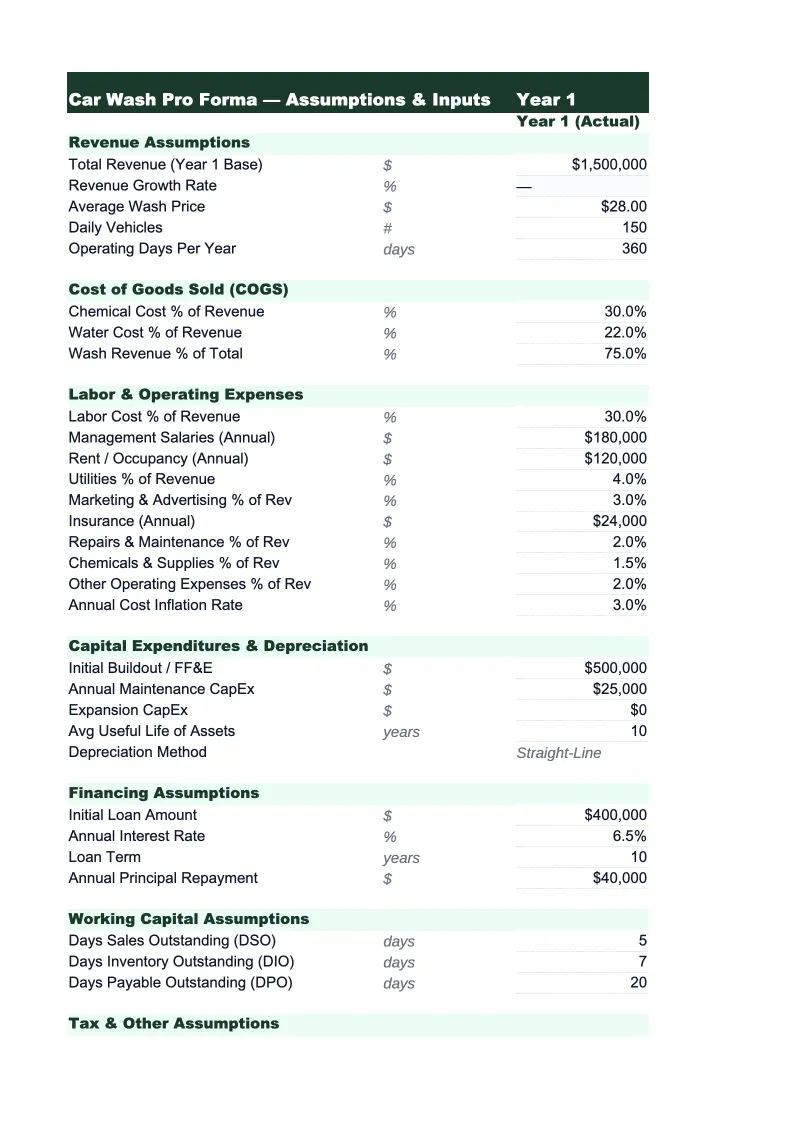
Assumptions
The central input sheet that drives every projection in the model.
Revenue Projections
Projects monthly revenue across all car wash revenue streams over a 36-month horizon.
Operating Costs
Projects the variable and semi-fixed costs that move with wash volume.
Projected P&L
A complete three-year projected income statement organized in the standard car wash format: gross revenue broken out by retail washes (by package tier), membership revenue (MRR), detail services, and other revenue; chemical and supply cost; water and sewer cost; gross profit and gross margin percentage; direct labor cost; occupancy (rent, CAM charges, property taxes); equipment lease or depreciation; equipment maintenance and repairs; utilities (electricity, gas); insurance (general liability, property, workers comp); marketing and advertising; point-of-sale and software fees; credit card processing; and other overhead.
Cash Flow Projection
Maps your projected cash position month by month from startup or expansion through 36 months of operations.
Dashboard
A one-page visual summary pulling the key car wash performance metrics from the underlying model.
Car Wash Pro Forma Template Features
- Bottom-up revenue model built from daily car count, wash package mix, and membership conversion rate
- Membership MRR tracked separately from retail wash volume with monthly churn and growth modeling
- Startup costs section covering equipment, site build-out, utility connections, and working capital
- 36-month projected P&L with chemical cost, water cost, and labor modeled per car
- Cash flow projection with minimum balance alert and ramp-up period visibility
- Lender-ready dashboard with cost per car, membership percentage, and occupancy ratio KPIs
How to Use This Car Wash Financial Projections Spreadsheet
Start on the Assumptions sheet and work through it from top to bottom. The most important inputs are your wash format, average daily car count, wash package pricing, and membership tier pricing. If you have an existing site, pull car count from your POS system and calculate your current package mix — what percentage of customers choose basic, mid-tier, and premium washes. For a new site, research car counts at comparable sites in similar markets; many express exterior tunnels target 200–300 cars per day at maturity, while in-bay automatics typically run 40–80 cars per day per bay. Set your membership pricing carefully — membership programs typically price at 2–3x the cost of a single mid-tier wash per month, and the conversion rate from retail customer to member (commonly 5–15% of retail transactions in the first year) will heavily influence your long-term revenue trajectory.
Once the Assumptions sheet is set, fill in the startup costs section of the Cash Flow sheet. Equipment is the largest variable — a new in-bay automatic runs $80,000–$180,000 installed, while a new express exterior tunnel system runs $300,000–$1,000,000 depending on length and feature set. Site work (concrete, drainage, utility connections) is often underestimated and can add $100,000–$400,000 for greenfield builds. Add your equipment down payment or first lease payment, initial chemical supply order, signage, POS system setup, and a working capital reserve of at least 3 months of projected operating expenses. Review the Revenue Projections and Operating Costs sheets to confirm that outputs look realistic — your cost per car should land in the $2.50–$5.00 range for a well-run tunnel, and your chemical cost per car should run $0.50–$1.50 depending on your product mix and supplier pricing.
15 minutes from download to your first car wash projection
Download the template, enter your daily car count, wash package pricing, and membership assumptions, and get a complete 3-year financial projection for your car wash.
Why Car Wash Operators Need a Pro Forma Template
Car wash economics have changed significantly over the past decade, driven almost entirely by the shift to membership-based pricing. Express exterior tunnels that once generated unpredictable retail revenue now build a recurring membership base that covers fixed costs before a single retail customer pulls in. A site with 1,000 active members at $30 per month generates $30,000 in recurring revenue every month — enough to cover rent, minimum staffing, and equipment payments at many locations regardless of weather or seasonal traffic. For a new or expanding operator, building a pro forma that separates retail wash revenue from membership MRR is essential for understanding how quickly the business reaches financial stability, and that's a distinction a generic financial model won't handle correctly.
The capital requirements for car wash development are higher than most small-business categories, which makes accurate upfront projections more important. A new express exterior tunnel requires $500,000–$1,500,000 in total project cost across land or lease, site work, equipment, and working capital — before collecting a dollar of revenue. Equipment leases run $8,000–$20,000 per month for a modern tunnel system. This means that break-even analysis isn't just a planning exercise: it's the document that determines whether an SBA loan, equipment finance package, or investor commitment gets approved. Lenders evaluate car wash pro formas on three things — realistic car count assumptions backed by traffic counts or comparable site data, a clear path to break-even that accounts for the ramp-up period (most new sites build car count over 12–24 months), and enough working capital to stay solvent through that ramp.
Car Wash Industry at a Glance
Financial templates built for car wash businesses — from self-service bays and in-bay automatics to full-service tunnels and mobile detailing operations.
Revenue Drivers
- Retail wash sales
- Membership/subscription plans
- Fleet account billing
- Detailing & add-on services
Key Cost Categories
- Labor
- Chemicals & supplies
- Water & utilities
- Equipment maintenance & repairs
- Rent & occupancy
- Credit card processing fees
Typical Margins
Gross: 75-85% · Net: 15-45%
Seasonality
Spring and fall typically peak — customers wash after winter salt and before summer heat; slowest in deep winter in cold climates and during rainy stretches.
Key Performance Indicators
Car Wash Pro Forma Template FAQ
More Car Wash Templates
Car Wash Balance Sheet Template for Excel
$29
Car Wash Budget Template for Excel
$29
Car Wash Business Plan Template for Excel
$39
Car Wash Cash Flow Template for Excel
$29
Car Wash Expense Tracker Template for Excel
$29
Car Wash Financial Model Template for Excel
$29
Car Wash Income Statement Template for Excel
$29
Car Wash Invoice Template for Excel
$29
Car Wash KPI Dashboard Template for Excel
$29
Car Wash P&L Template for Excel
$29
Car Wash Project Budget Template for Excel
$29
Car Wash Sales Forecast Template for Excel
$29
Car Wash Valuation Template for Excel
$29
Car Wash Pro Forma Template
$29