Church Pro Forma Template
Project your church's giving income, ministry expenses, and capital needs over 3–5 years — built for building campaigns, new campus launches, and annual ministry planning.
What's Inside This Church Pro Forma Template
This template includes 6 worksheets, each designed for a specific part of your church financial workflow:
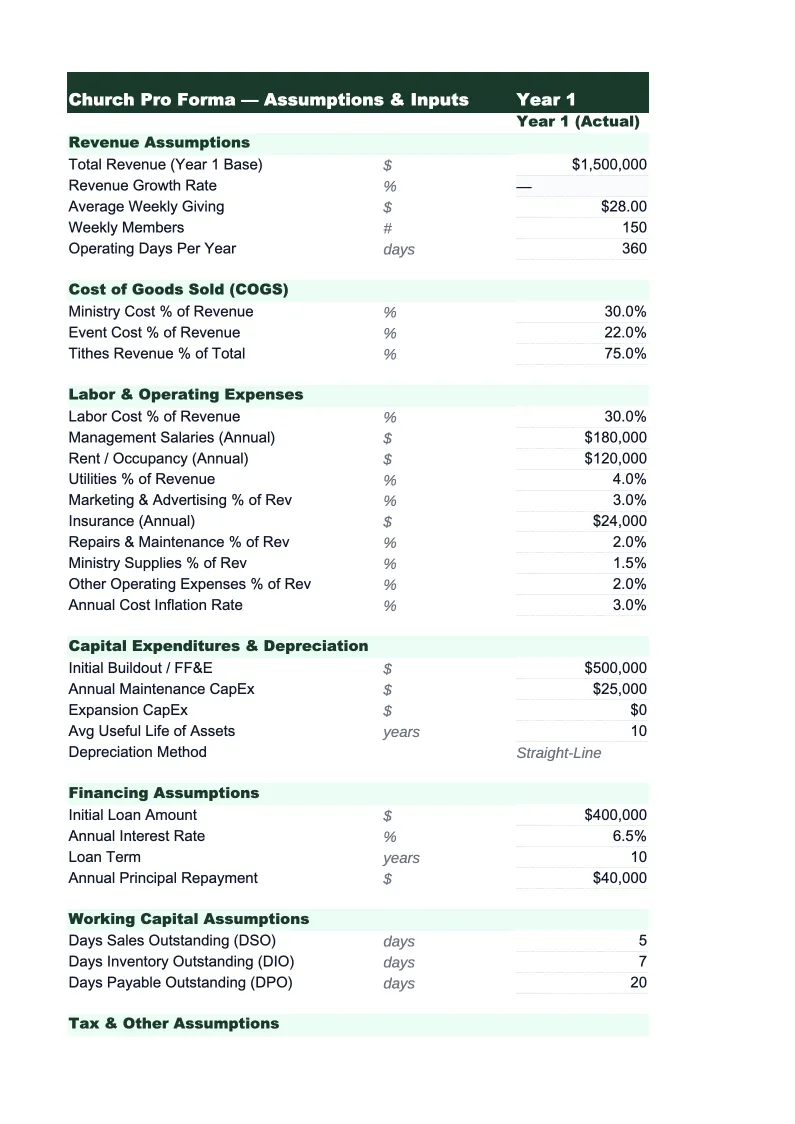
Assumptions
The control panel for your entire projection.
Revenue Projections
A 5-year forward projection of all church income sources.
Expense Projections
A structured 5-year expense forecast organized around the categories that matter most to church finance teams.
Capital Campaign Plan
A dedicated worksheet for churches planning a building project, major renovation, or campus expansion.
Cash Flow Projection
A monthly cash flow statement spanning the full 5-year horizon.
Summary Dashboard
A one-page executive overview designed to be printed or exported for board presentations, elder meetings, or lender packages.
Church Pro Forma Template Features
- 5-year giving projections with attendance and per-attender giving assumptions
- Capital campaign cash flow model with pledge fulfillment and draw schedule
- Monthly cash balance tracking with low-balance alerts
- Personnel cost modeling with annual increase assumptions
- Seasonal giving adjustments for Christmas, Easter, and summer
- Lender-ready summary dashboard for building loan presentations
How to Use This Church Pro Forma Spreadsheet
Start in the Assumptions sheet. Enter your current weekly attendance, average weekly giving per attender, and the annual growth rate you're planning toward. If you're modeling a capital campaign, add your pledge goal and expected fulfillment rate. These inputs drive every projection in the template, so spend 15–20 minutes getting them right — use your last 12 months of actual giving data as a baseline rather than guessing. Most finance committees find it helpful to set up three versions: a 0% growth conservative case, a 3–5% growth moderate case, and a campaign-fueled optimistic case.
Once your assumptions are in, review the Revenue and Expense Projections sheets together. The revenue sheet will show you whether projected giving keeps pace with expense growth — and if not, which year the gap starts to open. Pay particular attention to the personnel cost row: churches that hire ahead of giving growth often hit cash flow trouble in year 2 or 3. The Capital Campaign sheet is where you model the construction timeline and loan draw schedule if you're planning a building project. Enter your contractor's draw schedule by month and the sheet calculates exactly when you need cash and how much debt you'll carry.
15 minutes from download to your first projection
Download the template, enter your giving and attendance assumptions, and see your church's 5-year financial picture — capital campaign model and cash flow included.
Why Every Growing Church Needs a Pro Forma
A church pro forma is most commonly needed in two situations: when a congregation is considering a capital campaign or building project, and when a new campus or church plant needs to present financial projections to denominational leadership or a lender. In both cases, the core challenge is the same — giving income is driven by people and habits, not contracts, which makes projecting it harder than forecasting revenue for a business. A realistic pro forma acknowledges that variability and builds in conservative assumptions rather than straight-line growth.
Churches that approach a building loan without a multi-year cash flow projection often discover the debt service problem after they've committed to a construction budget. A well-built pro forma shows you the answer before you're in the room with a banker: given your current giving levels, growth assumptions, and expense structure, can you service the debt while maintaining ministry programs? Personnel costs are usually the biggest variable — churches that staff up during a campaign period sometimes find that giving-per-attender doesn't grow fast enough to sustain the payroll once the campaign excitement fades. The projection makes that risk visible so leadership can make an informed decision.
Church Industry at a Glance
Financial templates built for churches and religious organizations — facility rentals, ceremony fees, staff payroll, and ministry budgets.
Revenue Drivers
- Tithes and weekly offerings
- Facility rental income
- Special offerings (Christmas, Easter)
- School and childcare tuition
- Cemetery and memorial service fees
Key Cost Categories
- Personnel and housing allowance
- Facilities and occupancy
- Worship and ministry programs
- Missions and benevolence
- Administration and software
- Debt service
Typical Margins
Gross: N/A · Net: 0-5% operating surplus
Seasonality
Giving peaks at Christmas and Easter; summer typically sees 10-20% attendance and giving decline. Year-end giving surge in December is common for tax purposes.
Key Performance Indicators
Church Pro Forma Template FAQ
More Church Templates
Church Balance Sheet Template for Excel
$29
Church Budget Template for Excel
$29
Church Budget & Financial Plan Template for Excel
$39
Church Cash Flow Template for Excel
$29
Church Expense Tracker Template for Excel
$29
Church Financial Model Template for Excel
$29
Church Income Statement Template for Excel
$29
Church Invoice Template for Excel
$29
Church KPI Dashboard Template for Excel
$29
Church P&L Template for Excel
$29
Church Project Budget Template for Excel
$29
Church Revenue Forecast Template for Excel
$29
Church Valuation Template for Excel
$29
Church Pro Forma Template
$29