Coffee Shop Pro Forma Template
Project three years of revenue, costs, and cash flow for your coffee shop — built around daily transaction volume, average ticket, and beverage-first economics.
What's Inside This Coffee Shop Pro Forma Template
This template includes 6 worksheets, each designed for a specific part of your coffee shop financial workflow:
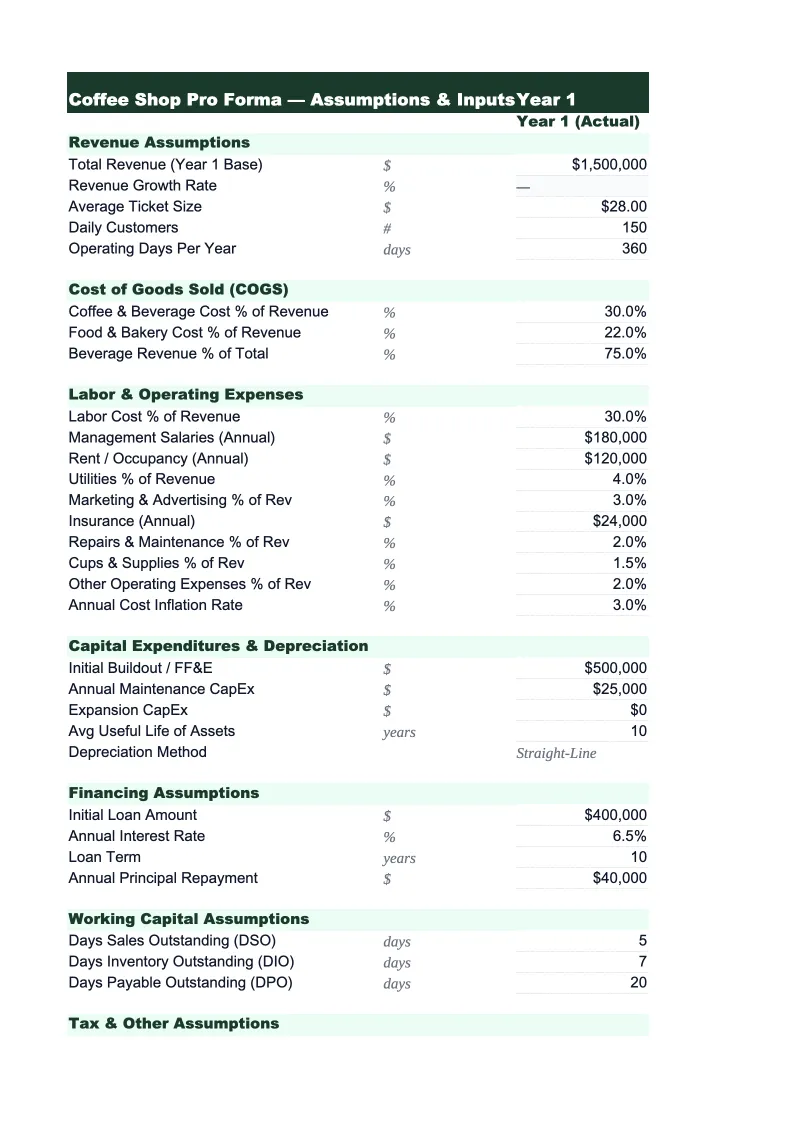
Assumptions
The central input sheet that drives every projection in the model.
Revenue Projections
Projects monthly revenue across all coffee shop revenue streams over a 36-month horizon.
COGS & Labor
Projects the two largest variable cost categories for a coffee shop: cost of goods sold and labor.
Projected P&L
A complete three-year projected income statement organized in the standard coffee shop format: gross revenue by stream, total COGS, gross profit and gross margin percentage, labor, occupancy (rent, utilities, property insurance), equipment maintenance, marketing and loyalty program costs, packaging and supplies, point-of-sale and technology fees, and other general overhead.
Cash Flow Projection
Maps your projected cash position month by month, accounting for the timing gap between when revenue is earned and when major expenses — rent, payroll, equipment lease payments, and inventory orders — are paid.
Dashboard
A one-page visual summary pulling key metrics from the underlying sheets.
Coffee Shop Pro Forma Template Features
- Bottom-up revenue model built from daily transactions and average ticket size
- Beverage COGS, food COGS, and labor modeled as separate percentage-based inputs
- Startup costs section for buildout, equipment, and working capital (new locations)
- 36-month projected P&L with monthly year-one detail and quarterly years two and three
- Cash flow projection with minimum balance alert for loan repayment planning
- Investor- and lender-ready dashboard with beverage cost and labor percentage KPIs
How to Use This Coffee Shop Financial Projections Spreadsheet
Start on the Assumptions sheet and work through it top to bottom. The most important inputs are average daily transactions and average ticket size — if you have an existing location, pull these from your POS system. If you're projecting a new location, use 100–150 transactions per day as a conservative starting point for a neighborhood cafe, and $7–8 as your average ticket. Set your beverage-to-food revenue split (most cafes run 70–80% beverage) and your monthly transaction growth rate. Everything else in the model flows from these numbers, so getting them right upfront saves you time later.
Once the Assumptions sheet is set, review the Revenue Projections and COGS & Labor sheets to confirm the outputs look realistic. Check that your projected beverage cost percentage lands in the 25–35% range and that your labor percentage is in the 35–40% range — if either is significantly off, adjust the corresponding assumption rather than editing individual cells. If you're projecting a new location, fill in the startup costs section of the Cash Flow sheet: buildout, equipment, initial inventory (roughly 2–3 weeks of COGS), security deposits, and a working capital reserve of at least 3 months of operating expenses.
15 minutes from download to your first coffee shop projection
Download the template, enter your transaction volume and ticket size, and get a complete 3-year financial projection for your cafe.
Why Coffee Shops Need a Pro Forma Template
Coffee shops are one of the most financially complex small businesses to open — they look simple from the outside but operate on thin margins with high fixed costs. Rent alone can sink a location if transaction volume doesn't ramp fast enough. A pro forma forces you to work through the math before you sign a lease: at 150 transactions per day with a $7.50 average ticket, you're generating $1,125 in daily revenue. With a six-day week, that's roughly $288,000 per year. Once you subtract COGS (30%), labor (38%), and rent ($3,500/month), you may realize you need 200 daily transactions to be profitable — which completely changes your site selection criteria.
The beverage-first economics of coffee are what make the category interesting. A well-run cafe runs 60–70% gross margins on drinks — one of the highest gross margins in food service — because a $5.50 latte costs less than $2 to produce. The margin compression happens at the net level: labor is high because coffee service is labor-intensive during rush periods, and equipment costs are significant. The pro forma helps you stress-test these dynamics: what happens to net margin if milk prices rise 15%? What if you add a second barista during the morning rush? What does the business look like in year two when training costs drop and the team is more efficient?
Coffee Shop Industry at a Glance
Financial templates built for coffee shops and cafes — from single-location espresso bars to multi-location roasters. Pre-loaded with beverage cost categories, wholesale account structures, and industry KPIs.
Revenue Drivers
- Espresso & specialty drinks
- Drip coffee & batch brew
- Food & pastry sales
- Wholesale bean sales
- Office coffee service accounts
- Catering & event service
Key Cost Categories
- Coffee beans & specialty ingredients (COGS)
- Dairy & alternative milks
- Food/pastry COGS
- Labor
- Rent & occupancy
- Equipment maintenance & repair
- Packaging & supplies
- Marketing
Typical Margins
Gross: 60-70% · Net: 5-15%
Seasonality
Strongest in fall and winter when hot drink demand peaks; slower in summer unless cold brew and iced drink sales are high. Morning rush (6–10am) drives the majority of daily revenue.
Key Performance Indicators
Coffee Shop Pro Forma Template FAQ
More Coffee Shop Templates
Coffee Shop Balance Sheet Template for Excel
$29
Coffee Shop Budget Template for Excel
$29
Coffee Shop Business Plan Template for Excel
$39
Coffee Shop Cash Flow Template for Excel
$29
Coffee Shop Expense Tracker Template for Excel
$29
Coffee Shop Financial Model Template for Excel
$29
Coffee Shop Income Statement Template for Excel
$29
Coffee Shop Invoice Template for Excel
$29
Coffee Shop KPI Dashboard Template for Excel
$29
Coffee Shop P&L Template for Excel
$29
Coffee Shop Project Budget Template for Excel
$29
Coffee Shop Sales Forecast Template for Excel
$29
Coffee Shop Valuation Template for Excel
$29
Coffee Shop Pro Forma Template
$29