Accounting Firm Pro Forma Template
Project revenue, staffing capacity, and profitability for your accounting firm — built around billable hours, realization rates, and service line mix.
What's Inside This Accounting Firm Pro Forma Template
This template includes 6 worksheets, each designed for a specific part of your accounting firm financial workflow:
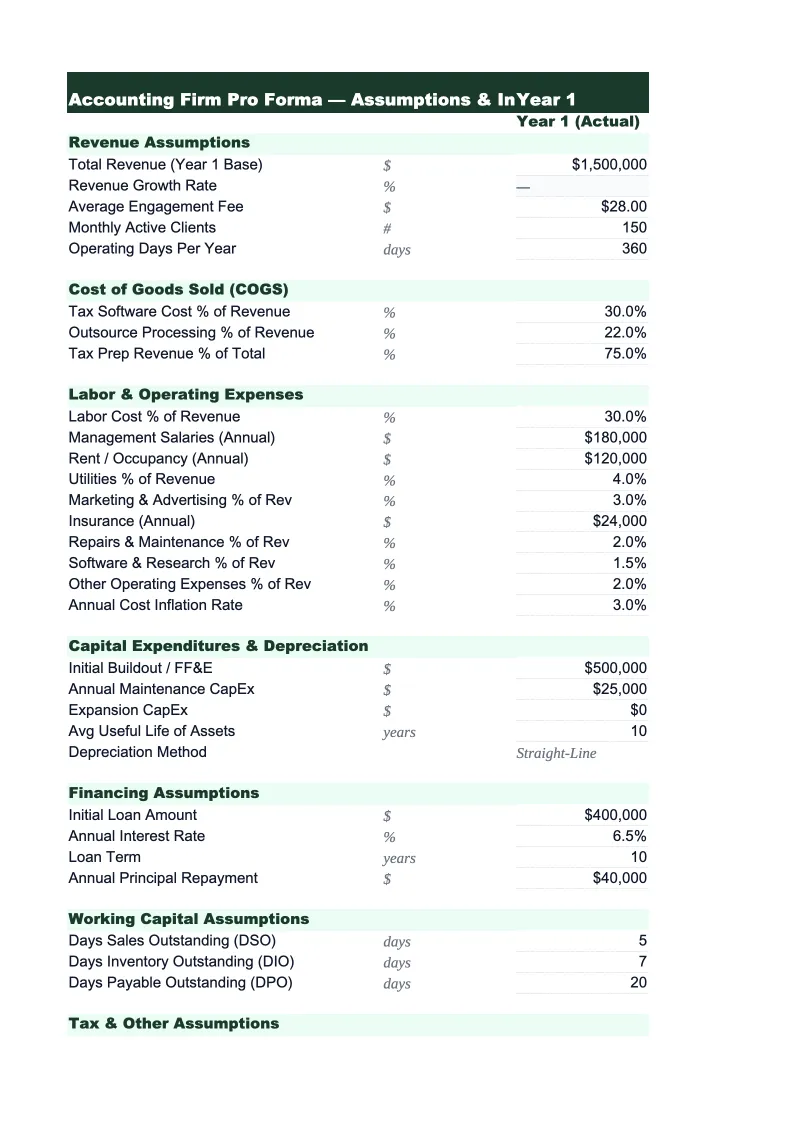
Assumptions
The control panel for the entire model.
Staffing & Capacity
Models headcount by level across a three-year horizon and translates it into billable hour capacity.
Revenue Projections
Projects revenue for each of the five primary accounting firm service lines — tax preparation and planning, audit and assurance, bookkeeping and client accounting services (CAS), advisory and fractional CFO, and payroll processing.
Expense Projections
Projects operating expenses across all major cost categories for the firm: professional staff compensation and benefits by level (driven by headcount from the Staffing sheet), administrative staff, occupancy and rent, technology and software (tax, practice management, cloud tools), malpractice and E&O insurance, marketing and business development, CPE and professional development, and subcontractors or offshore staff.
Pro Forma P&L
A three-year forward-looking income statement that pulls revenue from the Revenue Projections sheet and expenses from the Expense Projections sheet.
KPI Dashboard
Tracks the five metrics that accounting firm partners actually use to run their practices: utilization rate (billable hours as a percentage of total hours), realization rate (billed revenue as a percentage of standard rate value), collection rate (cash collected as a percentage of billed revenue), revenue per FTE, and days sales outstanding.
Accounting Firm Pro Forma Template Features
- Headcount-driven revenue model built around billable hours and utilization rates
- Five accounting service lines: tax, audit, CAS, advisory, and payroll
- Three-year staffing plan with per-level billing rate and capacity tracking
- Realization and collection rate assumptions that flow through the full model
- Pro Forma P&L showing gross margin and net income by year
- KPI dashboard tracking utilization, realization, revenue per FTE, and DSO
How to Use This Accounting Firm Pro Forma Spreadsheet
Start with the Assumptions sheet — it's the foundation the entire model builds on. Enter your current staffing mix (number of partners, managers, seniors, and staff accountants), the standard billing rates for each level, and your target utilization and realization rates. If you're projecting a new practice or expansion, enter your expected headcount for each year. Most firms use historical utilization and realization as a starting point — if you don't have those numbers, the sheet includes industry benchmarks you can use until you gather your own.
Once assumptions are set, move to Revenue Projections and review the output by service line. Check that the mix between tax, audit, CAS, advisory, and payroll reflects how your firm actually earns revenue — and adjust the growth rates for each line based on your business development pipeline and strategic plan. If you're planning to launch a new service like fractional CFO work, set the year-one revenue conservatively (80% of capacity) to account for ramp-up time. The staffing capacity check on the Staffing sheet will tell you if your projected revenue targets are achievable given your current team.
15 minutes from download to your first projection
Download the template, enter your staffing mix and billing rates, and see your firm's three-year financial picture — capacity, revenue, margins, and KPIs included.
Why Accounting Firms Need a Pro Forma
Accounting firms have a fundamentally different financial structure than most businesses. Revenue is bounded by the number of hours a team can bill, not by inventory, production capacity, or marketing spend. That makes headcount planning and utilization the central drivers of the financial model — and it's why generic pro forma templates don't work well for CPA firms. A model built for a restaurant or retail business doesn't account for billable capacity ceilings, realization haircuts, or the practice-specific relationship between staff level and rate.
The metrics that determine a firm's profitability are layered. First, how many available hours does your team have? That depends on headcount and the typical number of working hours (firms commonly assume 1,800–2,000 available hours per year per person). Second, what percentage of those hours are billable — your utilization rate? Well-run firms target 60–75% for most staff levels; partners typically run lower due to business development and management time. Third, how much of the standard rate value actually gets billed? Realization rates at healthy firms run 85–95%. Finally, how much of what's billed actually gets collected? Collection rates below 95% indicate write-off problems that compound over time. The pro forma models all four layers simultaneously.
Accounting Firm Industry at a Glance
Financial templates built for accounting firms and CPA practices — from solo practitioners to multi-partner firms. Pre-loaded with billable hour tracking, realization rate calculations, and service categories that reflect how accounting firms actually bill.
Revenue Drivers
- Tax preparation and planning
- Audit and assurance
- Bookkeeping and client accounting services (CAS)
- Advisory and fractional CFO services
- Payroll processing
Key Cost Categories
- Professional staff salaries and benefits
- Administrative staff
- Occupancy and rent
- Technology and software (tax, practice management)
- Malpractice (E&O) insurance
- Marketing and business development
- CPE and professional development
- Subcontractors and offshore staff
Typical Margins
Gross: 50-65% · Net: 20-35%
Seasonality
Heavy busy season January through April 15; secondary crunch in September through October 15 for extensions. Slowest months are July and August.
Key Performance Indicators
Accounting Firm Pro Forma Template FAQ
More Accounting Firm Templates
Accounting Firm Balance Sheet Template for Excel
$29
Accounting Firm Budget Template for Excel
$29
Accounting Firm Business Plan Template for Excel
$39
Accounting Firm Cash Flow Template for Excel
$29
Accounting Firm Expense Tracker Template for Excel
$29
Accounting Firm Financial Model Template for Excel
$29
Accounting Firm Income Statement Template for Excel
$29
Accounting Firm Invoice Template for Excel
$29
Accounting Firm KPI Dashboard Template for Excel
$29
Accounting Firm P&L Template for Excel
$29
Accounting Firm Project Budget Template for Excel
$29
Accounting Firm Sales Forecast Template for Excel
$29
Accounting Firm Valuation Template for Excel
$29
Accounting Firm Pro Forma Template
$29