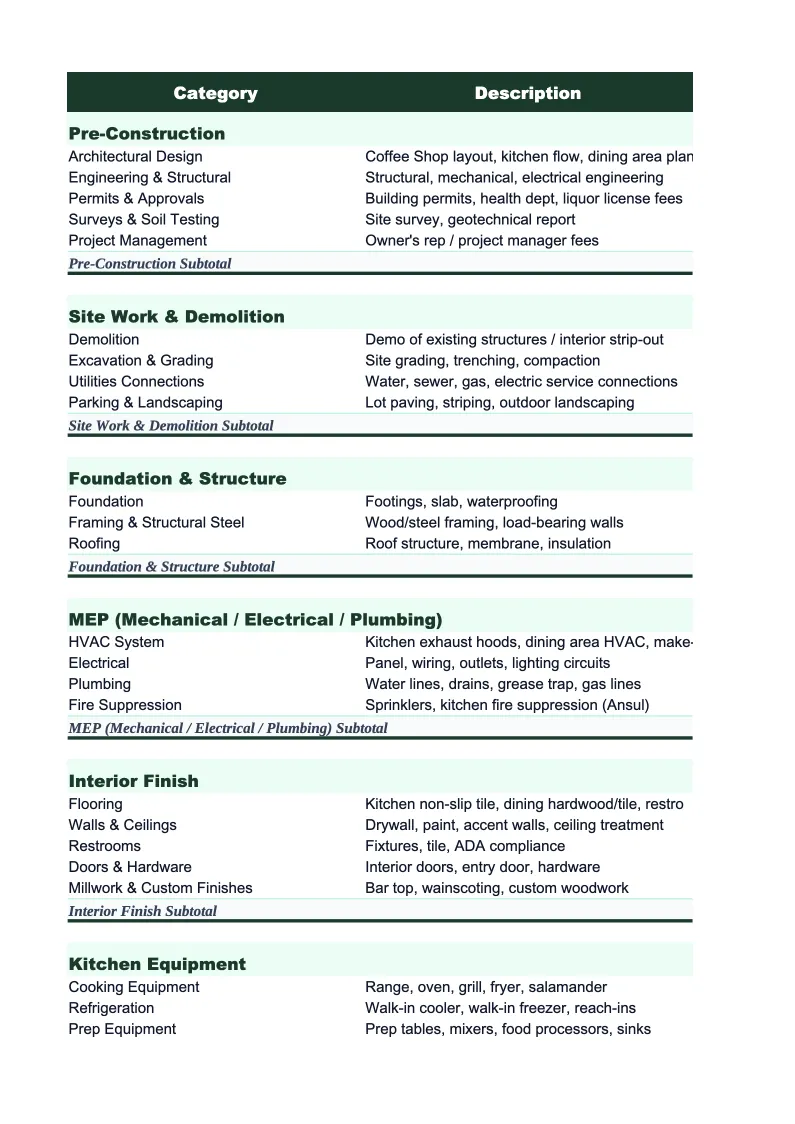
Coffee Shop Project Budget Template
Budget and track every dollar of a coffee shop opening or renovation — from espresso equipment and buildout to permits, initial inventory, and working capital.
What's Inside This Coffee Shop Project Budget Template
This template includes 6 worksheets, each designed for a specific part of your coffee shop financial workflow:
Project Setup
Enter your coffee shop's project details first: concept name, location, square footage, target opening date, total projected budget, and financing breakdown (personal equity, SBA loan, investor capital, or other sources).
Construction & Buildout
A line-item budget for all leasehold improvements and construction work specific to a coffee shop: plumbing rough-in and under-counter water lines for espresso equipment, electrical panel upgrades and dedicated circuits for high-draw equipment, millwork and custom cabinetry for the bar and service counter, HVAC, flooring, wall finishes, lighting, and signage infrastructure.
Equipment & FF&E
Separate budget tracker for all coffee shop equipment, furniture, fixtures, and technology.
Pre-Opening Costs
Covers all the one-time soft costs required to open the doors: business license, health department permit, building and fire inspection fees, food handler certifications for staff, architect and design fees, legal fees for lease review and entity formation, liability and property insurance deposits, initial coffee bean and supply inventory, packaging and cups (first order), staff uniforms, pre-opening marketing and social media setup, and training costs (including barista training programs if applicable).
Budget vs Actual
Side-by-side comparison of your original budget against actual costs incurred to date, organized by the same categories as the other sheets.
Dashboard
A one-page project summary with pre-built charts showing total budget versus actual spend by category, percentage of budget committed, and projected final cost.
Coffee Shop Project Budget Template Features
- Pre-built coffee shop buildout categories — plumbing, electrical, millwork, bar infrastructure, and HVAC
- Equipment budget broken out by station — espresso bar, batch brewing, refrigeration, blending, and smallwares
- Committed-not-yet-paid column to track equipment orders and signed contracts before invoices arrive
- Cost per square foot calculation benchmarked against typical coffee shop buildout ranges
- Pre-opening soft cost tracker covering permits, health certifications, initial inventory, and training
- Visual dashboard with budget vs actual by category and projected final cost
How to Use This Coffee Shop Project Budget Spreadsheet
Start with the Project Setup sheet. Enter your concept name, address, square footage, target opening date, and the total capital you have available — including how it's funded (personal savings, SBA 7(a) loan, investor capital). The setup sheet gives you a summary view of your four main cost buckets before you get into line items. Use it to check whether your total projected cost fits within your available capital, including a working capital reserve, before you sign a lease or authorize a contractor to start demo. Then open the Construction & Buildout sheet and adjust the pre-loaded categories to match your specific build — a buildout in a second-generation coffee shop space will look very different from a raw retail shell.
As contractor bids and equipment quotes come in, enter them in the relevant sheets alongside your original estimates. The Budget vs Actual sheet shows variance as soon as a category has both a budget number and an actual or committed amount. Log equipment orders in the committed column as soon as you place them — commercial espresso machines often have 4–8 week lead times, and you need to track that spend even though it may not be invoiced for weeks. Most coffee shop owners find it useful to update the tracker weekly, timed to when they're reviewing contractor invoices or coordinating equipment delivery schedules.
15 minutes from download to your first project budget
Download the template, enter your buildout budget and equipment quotes, and see your full coffee shop opening cost — construction, espresso equipment, soft costs, and working capital — in one place.
Why Coffee Shop Openings Need a Dedicated Project Budget
Opening a coffee shop typically costs between $80,000 and $350,000 depending on whether you're taking over an existing cafe (second-generation space) or building out a raw retail shell. The variation isn't just market-dependent — it hinges heavily on two cost categories that coffee shops carry that most retail businesses don't: bar infrastructure and commercial espresso equipment. A proper espresso bar requires dedicated plumbing with water filtration, drainage in the floor, high-amperage electrical circuits, and custom millwork for the bar top. The espresso machine and grinder combination alone can run $8,000–$25,000 for commercial-grade equipment. Operators who don't account for these categories specifically end up with contractor change orders and equipment surprises that push them over budget before the build is half done.
A coffee shop project budget needs to separate three cost pools that behave differently. Construction costs are bid-based and roughly predictable, but coffee shop builds almost always carry plumbing and electrical change orders once work starts — budget a 10–15% contingency above contractor quotes. Equipment costs are quote-driven and vary widely by brand, condition (new vs. refurbished), and lead time. A refurbished La Marzocca Linea or Synesso can save $5,000–$10,000 versus new but requires sourcing time and certification. Pre-opening soft costs — health permits, food handler certifications, initial bean and supply inventory, training, and signage — are the most commonly underestimated category, not because any one item is large but because there are 20 of them. Budgeting each line item explicitly in the Pre-Opening sheet before you start spending is the most reliable way to avoid running short on cash in the final week before opening.
Coffee Shop Industry at a Glance
Financial templates built for coffee shops and cafes — from single-location espresso bars to multi-location roasters. Pre-loaded with beverage cost categories, wholesale account structures, and industry KPIs.
Revenue Drivers
- Espresso & specialty drinks
- Drip coffee & batch brew
- Food & pastry sales
- Wholesale bean sales
- Office coffee service accounts
- Catering & event service
Key Cost Categories
- Coffee beans & specialty ingredients (COGS)
- Dairy & alternative milks
- Food/pastry COGS
- Labor
- Rent & occupancy
- Equipment maintenance & repair
- Packaging & supplies
- Marketing
Typical Margins
Gross: 60-70% · Net: 5-15%
Seasonality
Strongest in fall and winter when hot drink demand peaks; slower in summer unless cold brew and iced drink sales are high. Morning rush (6–10am) drives the majority of daily revenue.
Key Performance Indicators
Coffee Shop Project Budget Template FAQ
More Coffee Shop Templates
Coffee Shop Balance Sheet Template for Excel
$29
Coffee Shop Budget Template for Excel
$29
Coffee Shop Business Plan Template for Excel
$39
Coffee Shop Cash Flow Template for Excel
$29
Coffee Shop Expense Tracker Template for Excel
$29
Coffee Shop Financial Model Template for Excel
$29
Coffee Shop Income Statement Template for Excel
$29
Coffee Shop Invoice Template for Excel
$29
Coffee Shop KPI Dashboard Template for Excel
$29
Coffee Shop P&L Template for Excel
$29
Coffee Shop Pro Forma Template for Excel
$29
Coffee Shop Sales Forecast Template for Excel
$29
Coffee Shop Valuation Template for Excel
$29
More Project Budget Templates
Coffee Shop Project Budget Template
$29