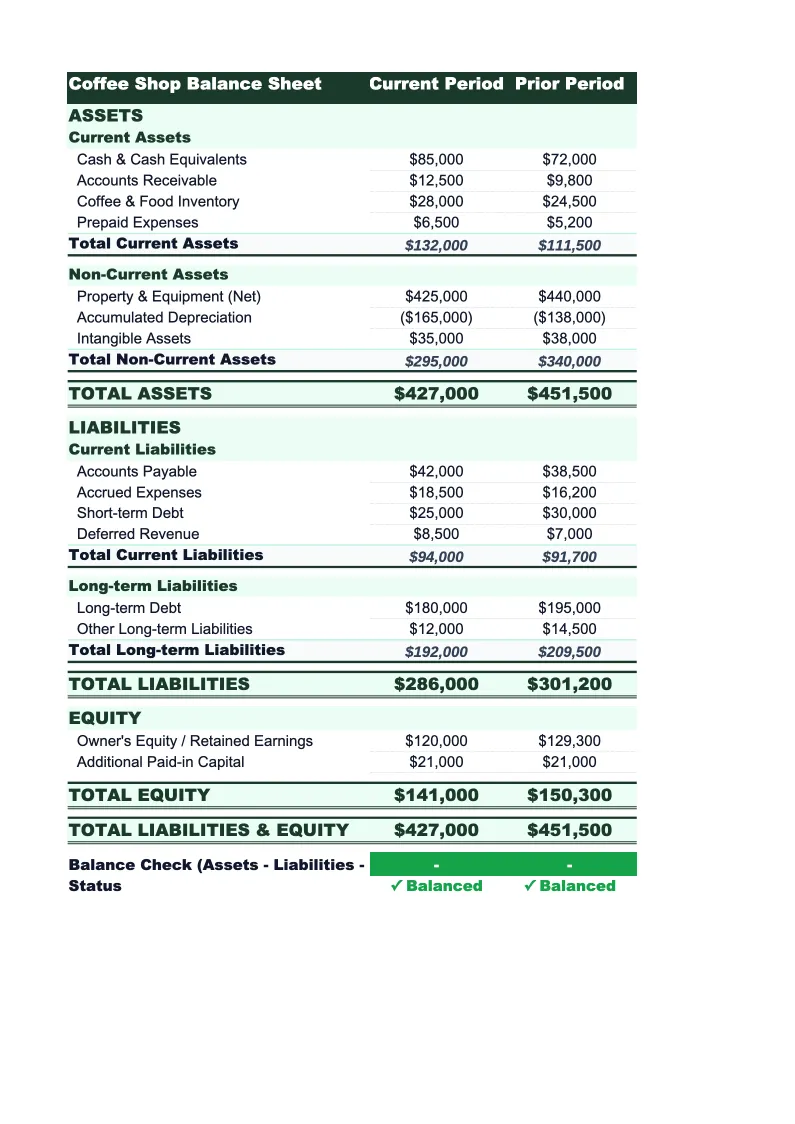
Coffee Shop Balance Sheet Template
See exactly what your coffee shop owns, owes, and is worth — a balance sheet built for cafes with bean and supply inventory, espresso equipment schedules, café card liabilities, and wholesale account receivables.
What's Inside This Coffee Shop Balance Sheet Template
This template includes 4 worksheets, each designed for a specific part of your coffee shop financial workflow:
Balance Sheet
The core financial statement organized around the coffee shop chart of accounts.
Inventory Tracker
A period-end inventory count sheet that feeds coffee bean, supply, and retail merchandise values into the balance sheet.
Fixed Assets
A fixed-asset register tracking every major piece of equipment, furniture, technology, and leasehold improvement the coffee shop owns or has invested in.
Period Comparison
A side-by-side view of two balance sheet dates — typically the current period-end against the prior year-end, or the same quarter from the prior year.
Coffee Shop Balance Sheet Template Features
- Bean and supply inventory split into coffee, dairy, syrups, food, packaging, and retail merchandise categories with cost-per-unit calculations
- Café gift card and loyalty card liability tracked as separate current liability line items
- Fixed asset register with depreciation schedules for espresso machines, grinders, refrigeration, and leasehold improvements
- Accounts receivable section for wholesale bean accounts and office coffee service contracts
- Accounting equation check — automatically flags any imbalance between assets and liabilities plus equity
- Period-over-period comparison for lender reporting, SBA renewals, and second-location planning
How to Use This Coffee Shop Balance Sheet Spreadsheet
Start with the Fixed Assets sheet before entering anything else. Pull your depreciation schedule from last year's tax return or your accountant's records and list every major asset: espresso machines, grinders, refrigeration units, furniture, POS system, and leasehold improvements. Enter the original cost, purchase date, and useful life for each item, and the sheet handles depreciation calculations and produces category totals that flow into the balance sheet automatically. Espresso equipment is often the largest single asset line — make sure you record the full purchase cost and not the financed amount, since the loan appears separately on the liabilities side.
Next, complete the Inventory Tracker with a physical count of your coffee beans, dairy, syrups, food items, packaging supplies, and retail merchandise at the end of the period. Pull current purchase costs from your most recent roaster and supplier invoices and enter them alongside the unit counts. The sheet calculates ending inventory value by category and feeds the totals into the balance sheet's current assets section. Then fill in the rest of the balance sheet: pull cash from your bank statement, accounts receivable from any outstanding wholesale or office coffee contracts, accounts payable from your vendor aging report, and gift card liability from your POS system's loyalty and gift card ledger.
15 minutes from download to your first coffee shop balance sheet
Download the template, enter your equipment, inventory, and accounts, and see your café's full financial position — assets, liabilities, gift card obligations, and owner's equity included.
Why Every Coffee Shop Needs a Balance Sheet Template
Most coffee shop owners watch their daily sales and labor percentages closely but rarely look at a balance sheet. The P&L shows whether last month was profitable; the balance sheet shows what the business is actually worth and whether it can absorb a slow week or a broken espresso machine. Coffee shops face real balance sheet complexity: significant equipment investment subject to wear and replacement, a commodity input (coffee beans) whose cost can shift meaningfully quarter to quarter, and loyalty and gift card programs that generate upfront cash representing future drink obligations. None of that shows up properly on a P&L alone.
Three items on a coffee shop balance sheet are frequently missing or understated. The first is equipment: a quality commercial espresso setup — machine, grinder, knock box, water filtration — can represent $20,000 or more in capitalized assets, and that investment needs to be tracked through depreciation to reflect its declining book value and plan for eventual replacement. The second is café card and gift card liability: when a customer loads $50 onto a loyalty card, you've collected real cash for drinks not yet served — that's deferred revenue and a genuine liability until the balance is drawn down. For shops with active loyalty programs, this balance can be substantial. The third is bean and supply inventory: physical stock on hand is a current asset, and estimating it rather than counting it leads to misstated COGS and an inaccurate picture of working capital.
Coffee Shop Industry at a Glance
Financial templates built for coffee shops and cafes — from single-location espresso bars to multi-location roasters. Pre-loaded with beverage cost categories, wholesale account structures, and industry KPIs.
Revenue Drivers
- Espresso & specialty drinks
- Drip coffee & batch brew
- Food & pastry sales
- Wholesale bean sales
- Office coffee service accounts
- Catering & event service
Key Cost Categories
- Coffee beans & specialty ingredients (COGS)
- Dairy & alternative milks
- Food/pastry COGS
- Labor
- Rent & occupancy
- Equipment maintenance & repair
- Packaging & supplies
- Marketing
Typical Margins
Gross: 60-70% · Net: 5-15%
Seasonality
Strongest in fall and winter when hot drink demand peaks; slower in summer unless cold brew and iced drink sales are high. Morning rush (6–10am) drives the majority of daily revenue.
Key Performance Indicators
Coffee Shop Balance Sheet Template FAQ
More Coffee Shop Templates
Coffee Shop Budget Template for Excel
$29
Coffee Shop Business Plan Template for Excel
$39
Coffee Shop Cash Flow Template for Excel
$29
Coffee Shop Expense Tracker Template for Excel
$29
Coffee Shop Financial Model Template for Excel
$29
Coffee Shop Income Statement Template for Excel
$29
Coffee Shop Invoice Template for Excel
$29
Coffee Shop KPI Dashboard Template for Excel
$29
Coffee Shop P&L Template for Excel
$29
Coffee Shop Pro Forma Template for Excel
$29
Coffee Shop Project Budget Template for Excel
$29
Coffee Shop Sales Forecast Template for Excel
$29
Coffee Shop Valuation Template for Excel
$29
More Balance Sheet Templates
Coffee Shop Balance Sheet Template
$29