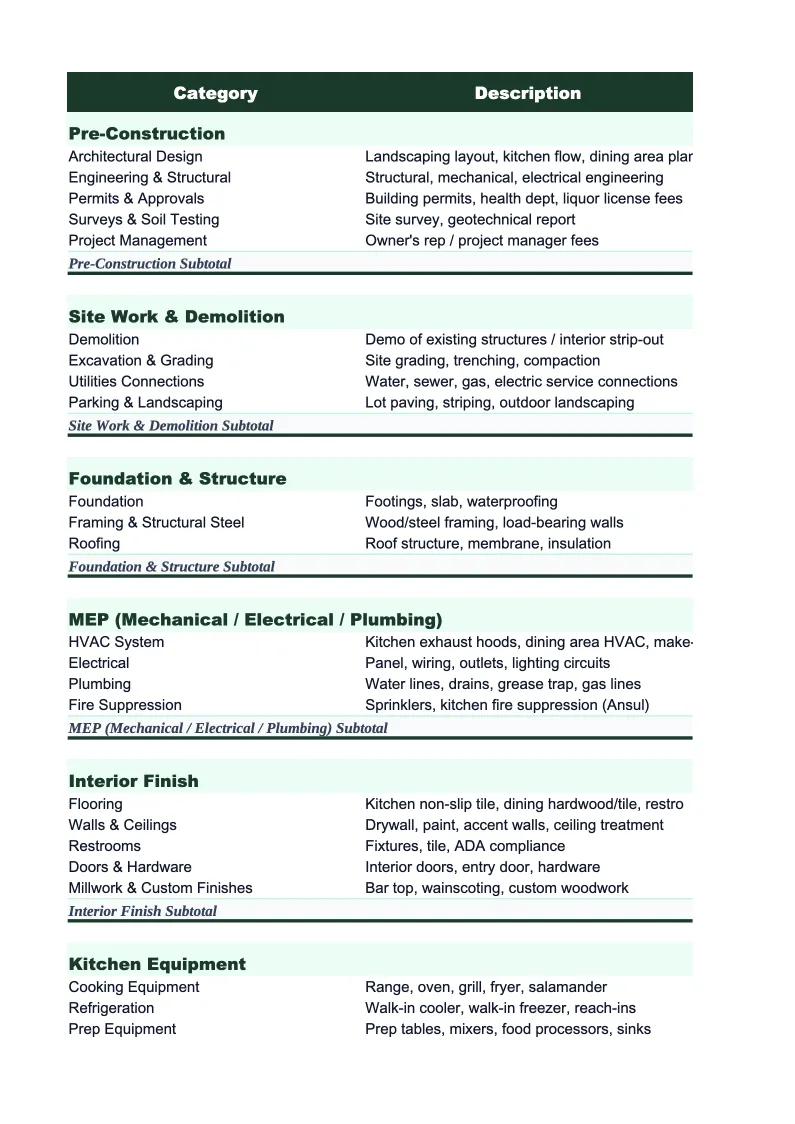
Landscaping Project Budget Template
Budget and track every cost of a landscaping installation or renovation project — from materials and crew labor to equipment rental, subcontractors, and client change orders.
What's Inside This Landscaping Project Budget Template
This template includes 7 worksheets, each designed for a specific part of your landscaping financial workflow:
Project Setup
Enter your project details first: client name, property address, project type (new installation, renovation, hardscape, or mixed), contract amount, target start and completion dates, and your margin target.
Plants & Materials
A line-item budget for all plants, hardscape materials, and landscape supplies for the project.
Labor
Tracks estimated and actual crew hours and labor cost by phase and task.
Equipment & Rentals
Budget tracker for all equipment used on the project, whether owned fleet or rented.
Subcontractors
Tracks any trade work that's subcontracted to outside firms rather than done with your own crew.
Budget vs Actual
Side-by-side comparison of your estimated cost versus actual costs incurred, organized by the four main categories: plants and materials, labor, equipment, and subcontractors.
Change Orders
Tracks all client-requested changes to the original project scope that affect cost, contract value, or schedule.
Landscaping Project Budget Template Features
- Pre-built landscaping cost categories covering plants, hardscape materials, crew labor, equipment, and subcontractors
- Labor tracker organized by project phase — site prep, irrigation, hardscape, planting, mulch, and cleanup
- Equipment cost tracker for both owned fleet (internal rate recovery) and rented equipment (day/week rates)
- Subcontractor log with quote, contract status, deposit paid, and markup tracking by trade
- Change order sheet with running CO log, client billing, and revised contract value totals
- Budget vs Actual comparison with committed-not-yet-invoiced column and automatic variance calculation
How to Use This Landscaping Project Budget Spreadsheet
Start with the Project Setup sheet. Enter the client name, job address, project type, contract amount, and your margin target before anything else. The setup sheet gives you a summary of your four cost buckets — materials, labor, equipment, and subs — so you can see at a glance whether your target margin is realistic given what you know about the job. Then open the Plants & Materials sheet and work through the line items that apply to your project. You won't use every row on every job — delete or hide the categories that don't apply, and add rows for specialty items (a specific stone variety, an unusual plant species your supplier quotes separately) as needed.
As the job progresses, log actual costs in the relevant sheets as invoices arrive and labor hours are tracked. The best time to update the template is at the end of each work week: enter hours from your crew's time sheets into the Labor sheet, log any material deliveries received, and mark subcontractor invoices paid. The Budget vs Actual sheet will show variance by category automatically. If you're seeing your materials overspend early — say, plant substitutions required due to availability, or more base material needed than estimated — you can catch it before it compounds across the rest of the project. On larger multi-week jobs, review the Dashboard weekly with your foreman.
15 minutes from download to your first project budget
Download the template, enter your materials quotes and labor estimates, and see your full landscaping project cost — plants, labor, equipment, and subs — in one place.
Why Every Landscaping Contractor Needs a Project Budget Template
Landscaping installation projects are harder to estimate accurately than almost any other trade. Materials pricing fluctuates with plant availability and stone supply, crew hours vary with site conditions and soil quality, and equipment needs change as the scope evolves on the ground. Most landscape contractors who've been in business for more than a few years can tell you about a project that came in 20–30% over their original estimate because they were tracking costs loosely — through supplier invoices, mental accounting, and rough payroll numbers — rather than against a structured project budget. The gap between good estimating and good job costing is that estimating gets you to a contract price, and job costing tells you whether that price was right.
A well-structured landscaping project budget tracks costs across four categories that behave differently and need to be managed separately. Materials are largely predictable once you have supplier quotes, but plant substitutions and add-on materials requested by clients mid-project frequently erode your margin if they're not tracked as change orders. Labor is the category with the highest variance — a phase that was estimated at 40 hours routinely runs 50–55 hours when site conditions (rocky soil, grading challenges, tight access) slow the crew down. Equipment costs are easy to undercount when you're using your own fleet without an internal rate, and rental costs get scattered across multiple invoices. Subcontractor costs are the most predictable if you have signed quotes, but informal verbal agreements can create disputes at billing time.
Landscaping Industry at a Glance
Financial templates built for landscaping companies — from lawn maintenance crews to full-service landscape design and installation firms. Pre-loaded with service categories, material line items, and project billing structures.
Revenue Drivers
- Recurring maintenance contracts
- Landscape installation projects
- Hardscaping (patios, walls, walkways)
- Tree services and irrigation
- Snow and ice removal
Key Cost Categories
- Plants and nursery materials
- Hardscape materials (pavers, stone, block)
- Crew labor (direct field wages)
- Equipment and vehicle fleet
- Payroll taxes and insurance
- Subcontractors
Typical Margins
Gross: 40-55% · Net: 8-15%
Seasonality
Strongly seasonal in northern markets — peak April through October, near-zero outdoor work in January and February. Year-round operations in southern and Pacific markets.
Key Performance Indicators
Landscaping Project Budget Template FAQ
More Landscaping Templates
Landscaping Balance Sheet Template for Excel
$29
Landscaping Budget Template for Excel
$29
Landscaping Business Plan Template for Excel
$39
Landscaping Cash Flow Template for Excel
$29
Landscaping Expense Tracker Template for Excel
$29
Landscaping Financial Model Template for Excel
$29
Landscaping Income Statement Template for Excel
$29
Landscaping Invoice Template for Excel
$29
Landscaping KPI Dashboard Template for Excel
$29
Landscaping P&L Template for Excel
$29
Landscaping Pro Forma Template for Excel
$29
Landscaping Sales Forecast Template for Excel
$29
Landscaping Business Valuation Template for Excel
$29
More Project Budget Templates
Landscaping Project Budget Template
$29