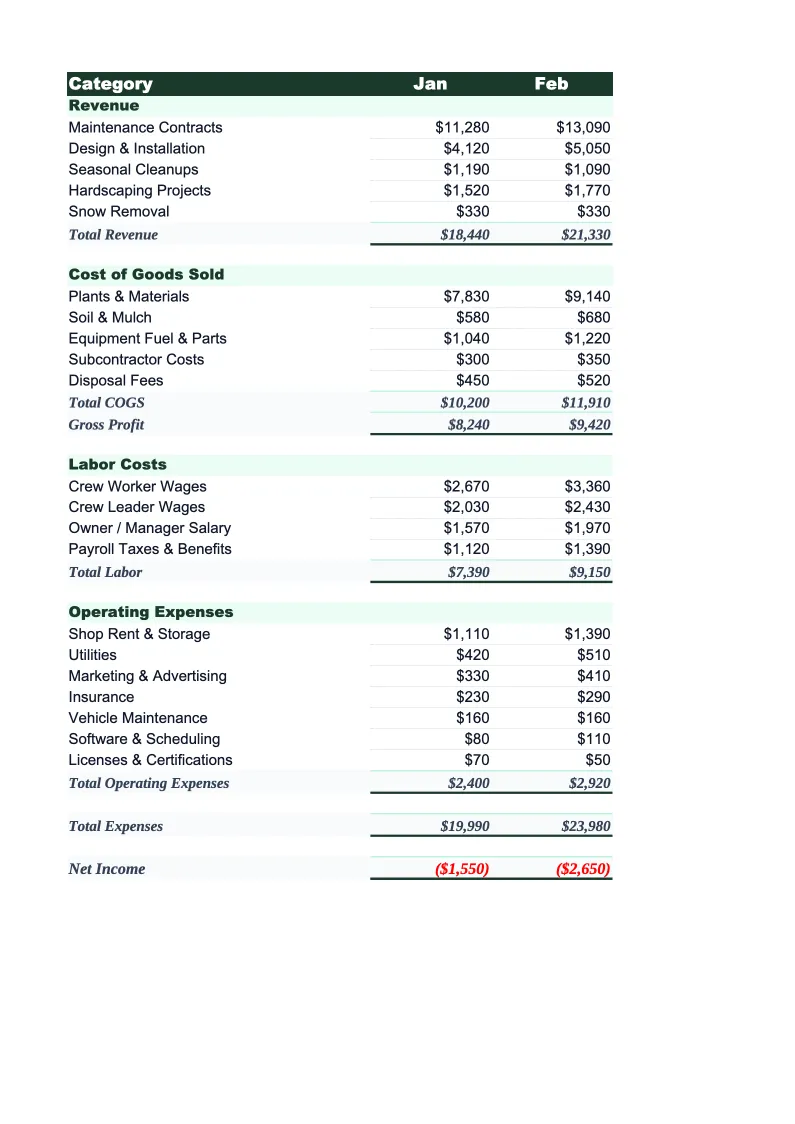
Landscaping Budget Template
Plan and track your landscaping company's finances with a budget template built for the field — pre-loaded with crew labor, materials, equipment, and maintenance contract categories.
What's Inside This Landscaping Budget Template
This template includes 4 worksheets, each designed for a specific part of your landscaping financial workflow:
Monthly Budget
The main planning worksheet where you set revenue and expense targets for each month.
Annual Summary
A 12-month rollup that pulls from all monthly sheets automatically, giving you a full-year view of revenue, expenses, and net profit across every category.
Budget vs Actual
Enter actual figures alongside your budget each month to see dollar and percentage variance for every line item.
Dashboard
A one-page visual summary with pre-built charts covering revenue mix by service type, labor cost as a percentage of revenue, material costs as a percentage of revenue, and monthly profit trend.
Landscaping Budget Template Features
- Revenue split by service type: maintenance, installation, hardscaping, tree services, snow removal
- Crew labor tracking separate from subcontractor costs
- Materials split: plants/nursery vs. hardscape materials (pavers, stone, block)
- Monthly budget with 12-month annual rollup for seasonal planning
- Budget vs actual variance tracking with color-coded flagging
- Visual dashboard with labor %, materials %, and revenue mix charts
How to Use This Landscaping Budget Spreadsheet
Download the .xlsx file and open it in Excel or Google Sheets — no macros, no plugins. Start with the Monthly Budget sheet and review the pre-loaded categories. Most landscaping companies find that 75–80% of the line items already match their chart of accounts. Adjust the revenue rows to reflect your specific service mix (not every company does snow removal or tree services), and rename any expense categories that don't match how you track costs. This setup takes about 15 minutes.
Once the categories look right, enter your projected revenue and expenses for the current month. If you're starting mid-year, use last season's actuals from your accounting software as a starting point. Copy the monthly structure forward for remaining months and adjust for seasonality — boost your installation and maintenance revenue rows in spring and summer, scale back in the fall, and reflect snow removal in winter if that applies to your market. The Annual Summary and Dashboard update automatically as you work.
15 minutes from download to your first landscaping budget
Download the template, plug in your numbers, and see your landscaping company's full financial picture — monthly budget, annual rollup, and variance tracking included.
Why Every Landscaping Company Needs a Budget Template
Landscaping companies face a budgeting challenge that most industries don't: most of the revenue and almost all of the field costs happen in a six-month window, but many fixed expenses (equipment loans, insurance, office staff, facility rent) run twelve months a year. Without a structured budget, it's common to spend the fall and winter thinking the business is profitable because revenue was strong in summer — then hit February with a slow cash position and no clear picture of what it costs just to keep the doors open. A landscaping budget that maps the full twelve months, including the quiet months, is what gives you control over that cycle.
The cost categories that drive landscaping profitability are different from most service businesses. Labor is the largest variable cost, but it needs to be tracked separately from subcontractors — you own the risk on your crew's hours even when jobs run long, while subcontractor costs should be tied directly to the jobs that use them. Materials split into two very different buckets: plants and nursery materials, which are perishable and highly seasonal, and hardscape materials (pavers, gravel, stone, block), which are heavier and often purchased per-project. Gross margins on maintenance contracts typically run 40–55%, while installation projects — especially hardscaping — can vary significantly based on material costs and job complexity. Tracking these separately in your budget lets you see which service type is actually driving your profitability.
Landscaping Industry at a Glance
Financial templates built for landscaping companies — from lawn maintenance crews to full-service landscape design and installation firms. Pre-loaded with service categories, material line items, and project billing structures.
Revenue Drivers
- Recurring maintenance contracts
- Landscape installation projects
- Hardscaping (patios, walls, walkways)
- Tree services and irrigation
- Snow and ice removal
Key Cost Categories
- Plants and nursery materials
- Hardscape materials (pavers, stone, block)
- Crew labor (direct field wages)
- Equipment and vehicle fleet
- Payroll taxes and insurance
- Subcontractors
Typical Margins
Gross: 40-55% · Net: 8-15%
Seasonality
Strongly seasonal in northern markets — peak April through October, near-zero outdoor work in January and February. Year-round operations in southern and Pacific markets.
Key Performance Indicators
Landscaping Budget Template FAQ
More Landscaping Templates
Landscaping Balance Sheet Template for Excel
$29
Landscaping Business Plan Template for Excel
$39
Landscaping Cash Flow Template for Excel
$29
Landscaping Expense Tracker Template for Excel
$29
Landscaping Financial Model Template for Excel
$29
Landscaping Income Statement Template for Excel
$29
Landscaping Invoice Template for Excel
$29
Landscaping KPI Dashboard Template for Excel
$29
Landscaping P&L Template for Excel
$29
Landscaping Pro Forma Template for Excel
$29
Landscaping Project Budget Template for Excel
$29
Landscaping Sales Forecast Template for Excel
$29
Landscaping Business Valuation Template for Excel
$29
Landscaping Budget Template
$29