Landscaping Financial Model Template
A complete financial model for landscaping companies — project revenue by service type, track job costs, plan for seasonal cash gaps, and see your full P&L and cash flow in one connected workbook.
What's Inside This Landscaping Financial Model Template
This template includes 7 worksheets, each designed for a specific part of your landscaping financial workflow:
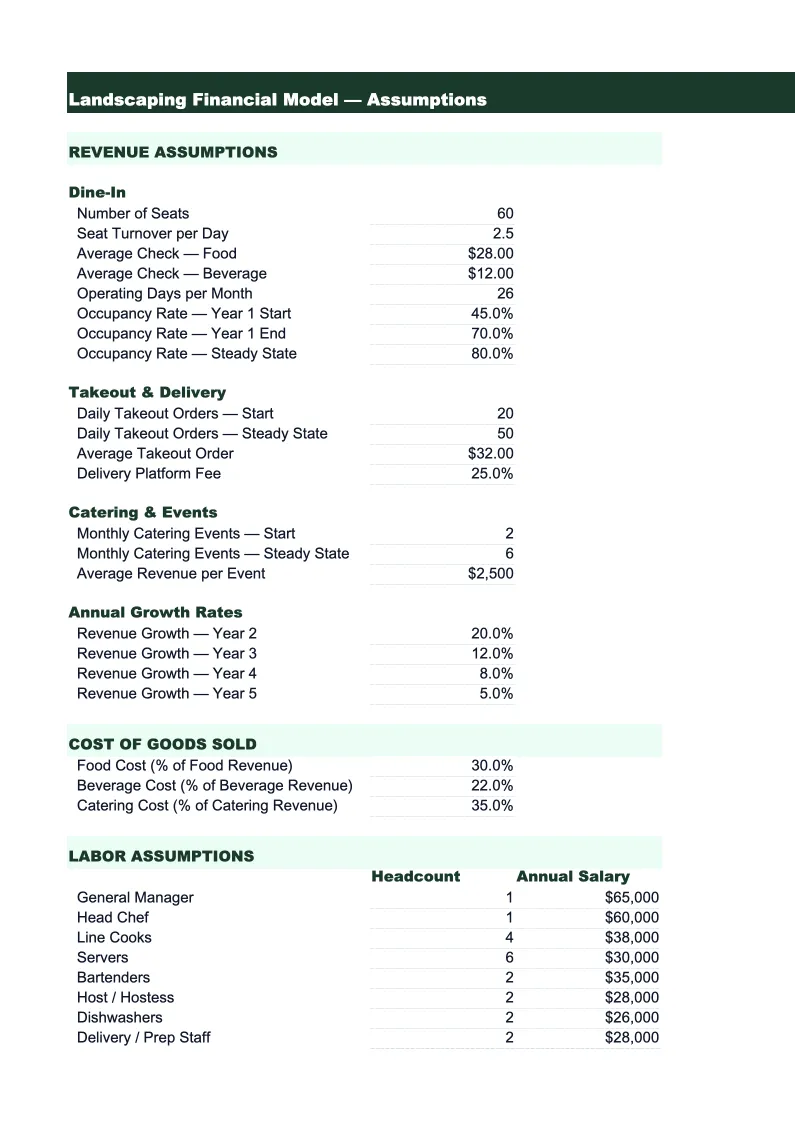
Assumptions
The central inputs sheet where you define all the drivers that flow through the rest of the model.
Revenue Projections
A 12-month revenue forecast broken down by service line: recurring maintenance contracts, landscape installation projects, hardscaping (patios, walls, walkways), tree services and irrigation, and snow and ice removal.
Job Costing
Tracks the estimated versus actual cost structure for each service type.
P&L
A monthly income statement covering the full 12-month projection period.
Cash Flow
A monthly cash flow statement that accounts for the timing differences that define the landscaping business.
Balance Sheet
A projected balance sheet that updates monthly based on the P&L and cash flow outputs.
KPI Dashboard
A visual summary of the metrics that matter most for a landscaping operation.
Landscaping Financial Model Template Features
- Revenue model split across 5 service lines: maintenance, installation, hardscaping, tree services, and snow removal
- Seasonal revenue adjustments built into monthly projections — peak and off-season months modeled correctly
- Job costing sheet compares estimated vs. target gross margin by service type
- Full 3-statement model: P&L, cash flow statement, and projected balance sheet
- Monthly cash balance forecast that shows seasonal shortfalls before they happen
- KPI dashboard with revenue per man-hour, labor cost %, and gross margin by service line
How to Use This Landscaping Financial Model Spreadsheet
Start with the Assumptions sheet — this is where you define your business. Enter your current crew count, hourly billing rates for each service type, average maintenance contract value, and the seasonality pattern for your market (a northern operation running April through October looks very different from a southern one running year-round). If you're modeling a future state, enter your target numbers here and see what they produce downstream. The whole model updates from these inputs, so spend 20 minutes getting them right before touching anything else.
Once your assumptions are in place, review the Revenue Projections sheet to make sure the monthly pattern looks realistic. Cross-check the Installation and Hardscaping rows against your actual pipeline or historical project close rates — those service lines tend to be lumpy, and the model lets you adjust volume month-by-month if you have jobs already scheduled. Then open the Job Costing sheet and verify that the material and labor cost percentages match what you actually see on your jobs. If your hardscaping margins are lower than the defaults, update them here and the P&L will reflect it immediately.
15 minutes from download to your first landscaping projection
Download the template, enter your crew count and billing rates, and see your full-year revenue, cash flow, and profit in one connected workbook.
Why Every Landscaping Company Needs a Financial Model
Landscaping companies face a financial planning challenge that most small business owners don't: the work is seasonal but the overhead isn't. Equipment loans, insurance, vehicle payments, and key staff wages continue through the winter even when revenue drops to near zero in northern markets. Without a financial model that explicitly forecasts monthly cash, the typical outcome is drawing down a line of credit each winter and hoping spring contracts close fast enough to cover it — which is reactive planning at best.
A landscaping financial model needs to reflect how the business actually generates money. Maintenance contracts are the foundation — they provide recurring, predictable revenue that you can build a crew schedule around. Installation and hardscaping projects carry higher average job values but require upfront material purchasing and subcontractor commitments before the invoice is sent. Snow removal is high-margin but weather-dependent. Modeling each service line separately lets you see which parts of the business are carrying the others, and where growth investment produces the most return per dollar spent.
Landscaping Industry at a Glance
Financial templates built for landscaping companies — from lawn maintenance crews to full-service landscape design and installation firms. Pre-loaded with service categories, material line items, and project billing structures.
Revenue Drivers
- Recurring maintenance contracts
- Landscape installation projects
- Hardscaping (patios, walls, walkways)
- Tree services and irrigation
- Snow and ice removal
Key Cost Categories
- Plants and nursery materials
- Hardscape materials (pavers, stone, block)
- Crew labor (direct field wages)
- Equipment and vehicle fleet
- Payroll taxes and insurance
- Subcontractors
Typical Margins
Gross: 40-55% · Net: 8-15%
Seasonality
Strongly seasonal in northern markets — peak April through October, near-zero outdoor work in January and February. Year-round operations in southern and Pacific markets.
Key Performance Indicators
Landscaping Financial Model Template FAQ
More Landscaping Templates
Landscaping Balance Sheet Template for Excel
$29
Landscaping Budget Template for Excel
$29
Landscaping Business Plan Template for Excel
$39
Landscaping Cash Flow Template for Excel
$29
Landscaping Expense Tracker Template for Excel
$29
Landscaping Income Statement Template for Excel
$29
Landscaping Invoice Template for Excel
$29
Landscaping KPI Dashboard Template for Excel
$29
Landscaping P&L Template for Excel
$29
Landscaping Pro Forma Template for Excel
$29
Landscaping Project Budget Template for Excel
$29
Landscaping Sales Forecast Template for Excel
$29
Landscaping Business Valuation Template for Excel
$29
More Financial Model Templates
Landscaping Financial Model Template
$29