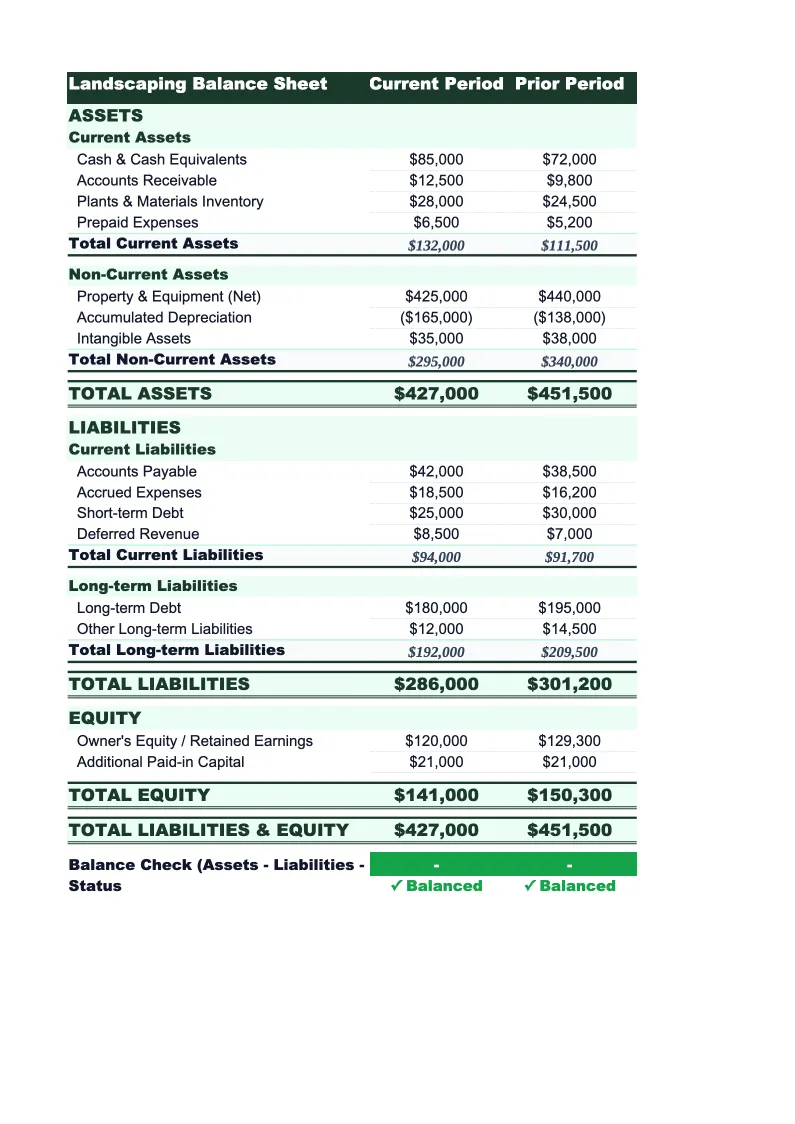
Landscaping Balance Sheet Template
See exactly what your landscaping company owns, owes, and is worth — a balance sheet built for lawn care and landscape contractors with equipment depreciation schedules, materials inventory, and vehicle fleet tracking.
What's Inside This Landscaping Balance Sheet Template
This template includes 4 worksheets, each designed for a specific part of your landscaping financial workflow:
Balance Sheet
The core financial statement organized around the landscaping chart of accounts.
Equipment Register
A fixed-asset register tracking every major piece of landscaping equipment, vehicle, and tool the company owns.
Materials Inventory
A period-end inventory sheet that calculates the value of materials on hand at your yard or job sites and feeds the figure into the balance sheet's current assets section.
Period Comparison
A side-by-side view of two balance sheet dates — typically the current period against the prior year-end, or end of the busy season versus start of the next.
Landscaping Balance Sheet Template Features
- Equipment register with depreciation schedules for mowers, trucks, trailers, and heavy equipment by category
- Materials inventory tracker for plants, bulk materials, seed, chemicals, and irrigation components
- Accounts receivable split between recurring maintenance contracts and installation project billing
- Seasonal line-of-credit tracking as a current or long-term liability depending on repayment terms
- Accounting equation check — automatically flags any imbalance between assets and liabilities plus equity
- Period-over-period comparison for equipment financing applications and year-over-year equity growth tracking
How to Use This Landscaping Balance Sheet Spreadsheet
Start with the Equipment Register before entering anything else. Pull your current depreciation schedule from last year's tax return or ask your accountant for the fixed-asset listing. Enter every major asset — mowers, trucks, trailers, skid steer, irrigation equipment — with its original cost, purchase date, and useful life. The sheet calculates accumulated depreciation and net book value for each item and produces category totals that flow automatically into the balance sheet. If you're doing this for the first time and don't have a depreciation schedule, use the original purchase price and subtract a reasonable accumulated depreciation estimate based on age and expected life. Your accountant can refine it at tax time.
Next, complete the Materials Inventory sheet with a count of plants, bulk materials, and supplies currently at your yard or job sites. Pull unit costs from your most recent supplier invoices and enter quantities on hand. The sheet calculates total materials inventory value and feeds it into current assets. Then complete the rest of the balance sheet: pull cash from your bank statement, accounts receivable from your open invoice report, accounts payable from what you owe to nurseries and supply houses, and any equipment loan or vehicle loan balances from the financing statements. Accrued wages are any pay earned but not yet paid as of the balance sheet date.
15 minutes from download to your first landscaping balance sheet
Download the template, enter your equipment, inventory, and accounts, and see your landscaping company's full financial position — assets, liabilities, and owner's equity included.
Why Every Landscaping Company Needs a Balance Sheet Template
Most landscaping contractors track revenue and job costs closely but rarely look at a balance sheet. The income statement tells you whether last season was profitable; the balance sheet tells you what the business is actually worth and whether it can handle a bad winter or finance a new crew truck without straining the operation. Landscaping companies have two large asset categories that make their balance sheets structurally different from most service businesses: equipment and vehicle fleets that depreciate rapidly, and materials inventory that turns over constantly through the busy season. Getting both of these right on the balance sheet produces a financial picture that's both accurate and useful.
Equipment is the defining asset on a landscaping balance sheet. A mid-size operation might carry $150,000 to $500,000 in trucks, mowers, trailers, and heavy equipment — and the difference between the original purchase cost and the depreciated book value tells a critical story. A company where all equipment is nearly fully depreciated is facing a capital replacement cycle that will strain cash flow. A company that has recently invested in new equipment shows asset value but also carries the corresponding loan liabilities. Lenders and buyers evaluate both sides. Materials inventory — plants, mulch, aggregate, and chemical inputs sitting in the yard or staged on job sites — is a real current asset that contractors frequently leave off the balance sheet, understating their working capital position.
Landscaping Industry at a Glance
Financial templates built for landscaping companies — from lawn maintenance crews to full-service landscape design and installation firms. Pre-loaded with service categories, material line items, and project billing structures.
Revenue Drivers
- Recurring maintenance contracts
- Landscape installation projects
- Hardscaping (patios, walls, walkways)
- Tree services and irrigation
- Snow and ice removal
Key Cost Categories
- Plants and nursery materials
- Hardscape materials (pavers, stone, block)
- Crew labor (direct field wages)
- Equipment and vehicle fleet
- Payroll taxes and insurance
- Subcontractors
Typical Margins
Gross: 40-55% · Net: 8-15%
Seasonality
Strongly seasonal in northern markets — peak April through October, near-zero outdoor work in January and February. Year-round operations in southern and Pacific markets.
Key Performance Indicators
Landscaping Balance Sheet Template FAQ
More Landscaping Templates
Landscaping Budget Template for Excel
$29
Landscaping Business Plan Template for Excel
$39
Landscaping Cash Flow Template for Excel
$29
Landscaping Expense Tracker Template for Excel
$29
Landscaping Financial Model Template for Excel
$29
Landscaping Income Statement Template for Excel
$29
Landscaping Invoice Template for Excel
$29
Landscaping KPI Dashboard Template for Excel
$29
Landscaping P&L Template for Excel
$29
Landscaping Pro Forma Template for Excel
$29
Landscaping Project Budget Template for Excel
$29
Landscaping Sales Forecast Template for Excel
$29
Landscaping Business Valuation Template for Excel
$29
More Balance Sheet Templates
Landscaping Balance Sheet Template
$29