Landscaping Cash Flow Template
Track and project cash flow for your landscaping business — with revenue split by maintenance contracts, installation projects, and hardscaping, seasonal planning across the full year, and a 13-week view built around how landscape contractors actually collect and spend money.
What's Inside This Landscaping Cash Flow Template
This template includes 6 worksheets, each designed for a specific part of your landscaping financial workflow:
13-Week Cash Flow
A rolling 13-week cash projection covering the most operationally useful planning window for a landscaping business.
Monthly Cash Flow
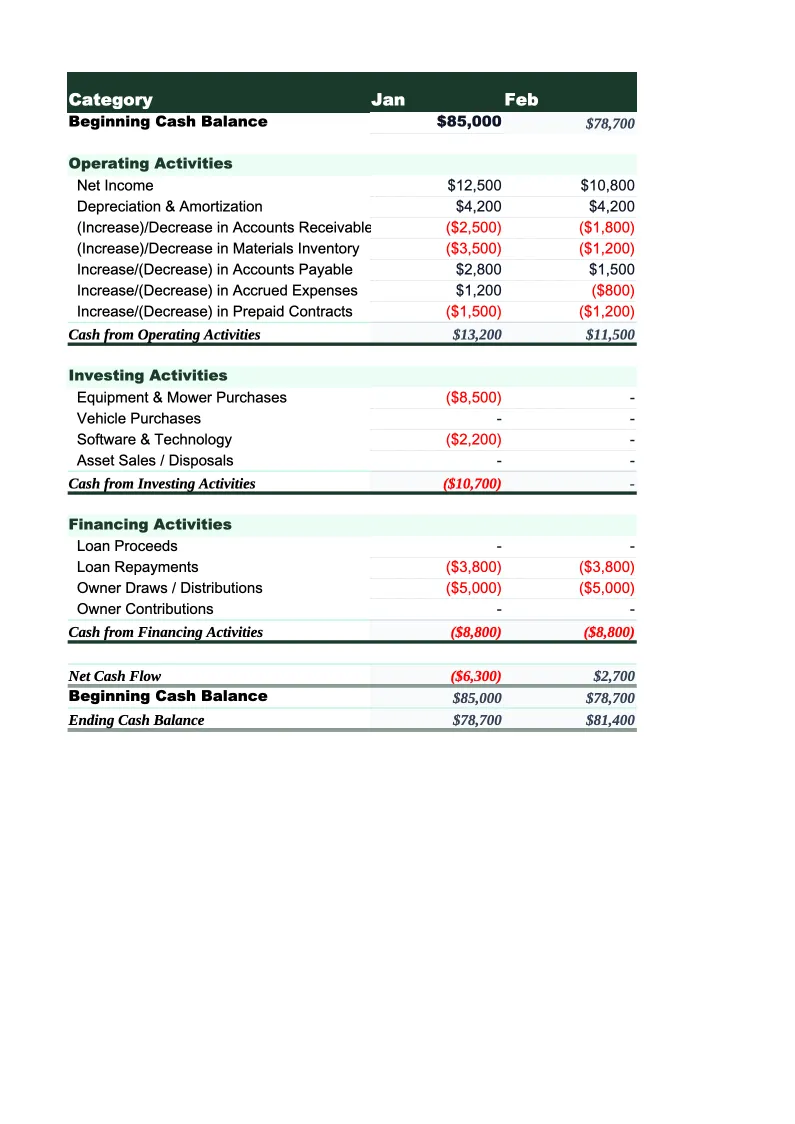
A 12-month indirect-method cash flow statement organized into operating, investing, and financing activities.
Contract Revenue Tracker
A dedicated sheet for managing your recurring maintenance contract portfolio — the financial backbone of a stable landscaping operation.
Seasonal Planning
A full-year view of cash flow broken down by month, with a color band highlighting your seasonal revenue window.
Annual Summary
A full-year rollup of operating cash flow broken down by revenue type and major expense category.
Dashboard
A visual overview with five pre-built charts: monthly cash inflows versus outflows, ending cash balance trend across 12 months, revenue by type (maintenance vs.
Landscaping Cash Flow Template Features
- 13-week cash projection with revenue split by maintenance contracts, installation, hardscaping, and snow removal
- Contract Revenue Tracker that manages your recurring maintenance portfolio and monthly billings by client
- Seasonal Planning sheet with conservative, typical, and strong scenarios across the full operating year
- Gross margin calculated separately for maintenance versus installation versus hardscaping revenue types
- Labor cost and materials cost tracked as a percentage of revenue — the two primary margin drivers in landscaping
- Annual cash runway calculation and revenue-type margin split for year-end review and lender conversations
How to Use This Landscaping Cash Flow Spreadsheet
Download the .xlsx file and open it in Excel or Google Sheets. Start with the Contract Revenue Tracker — enter each of your active maintenance contracts, the monthly billing amount, and the billing schedule. This is the foundation of your cash projection because maintenance billings are predictable and should be entered first before you estimate any project or one-time revenue. Once your contracts are logged, move to the 13-Week Cash Flow sheet and enter your expected project billings and collection dates for the next quarter. Fill in your weekly expense estimates for materials, crew labor, equipment, and any subcontractors, then review the ending cash balance row to see where you stand heading into the next few months.
Use the Seasonal Planning sheet before each season opens to model your full-year cash position. Enter your fixed monthly costs — insurance, equipment loans, storage, administrative overhead — and your projected active-season revenue by type. Run the conservative scenario first: assume average weather, 15% bid losses, and modest growth over last year. Then run the strong scenario. The gap between those two outcomes tells you how much cash reserve you need heading into winter to comfortably cover a slow start to spring. Update the 13-week projection weekly as project timelines shift and new contracts come in, and reconcile the Monthly Cash Flow sheet against your bank statement at the end of each month.
15 minutes from download to your first cash flow projection
Download the template, enter your maintenance contracts and project pipeline, and see your landscaping business's full cash picture — 13-week projection, seasonal model, and monthly statement included.
Why Landscaping Businesses Need a Dedicated Cash Flow Template
Landscaping businesses face a cash flow challenge that most industries don't: revenue is deeply seasonal, but overhead and labor costs are only partially seasonal. A crew that works from April through October still costs money in November and December — truck payments, insurance, equipment storage, and often a core of year-round employees who handle sales, admin, and light maintenance work. Contractors who don't model this structure in advance often reach February with a clear sense of how busy last summer was but no cash to cover March payroll and the spring plant order that needs to go out before the season opens.
The two dynamics that define landscaping cash flow are the maintenance contract base and the project billing cycle. Recurring maintenance contracts create predictable monthly billings — typically 30–50% of a mature landscaping operation's revenue — and they're what stabilizes cash through the active season. Installation and hardscaping projects bring larger dollar amounts but unpredictable collection timing: a patio project might require a 30% deposit at signing, a 30% draw at rough grade, and the balance on completion, with each milestone dependent on weather, subcontractor schedules, and the client's own timeline. Managing those two revenue streams as one undifferentiated number makes it nearly impossible to plan crew hours, materials purchases, or equipment financing accurately.
Landscaping Industry at a Glance
Financial templates built for landscaping companies — from lawn maintenance crews to full-service landscape design and installation firms. Pre-loaded with service categories, material line items, and project billing structures.
Revenue Drivers
- Recurring maintenance contracts
- Landscape installation projects
- Hardscaping (patios, walls, walkways)
- Tree services and irrigation
- Snow and ice removal
Key Cost Categories
- Plants and nursery materials
- Hardscape materials (pavers, stone, block)
- Crew labor (direct field wages)
- Equipment and vehicle fleet
- Payroll taxes and insurance
- Subcontractors
Typical Margins
Gross: 40-55% · Net: 8-15%
Seasonality
Strongly seasonal in northern markets — peak April through October, near-zero outdoor work in January and February. Year-round operations in southern and Pacific markets.
Key Performance Indicators
Landscaping Cash Flow Template FAQ
More Landscaping Templates
Landscaping Balance Sheet Template for Excel
$29
Landscaping Budget Template for Excel
$29
Landscaping Business Plan Template for Excel
$39
Landscaping Expense Tracker Template for Excel
$29
Landscaping Financial Model Template for Excel
$29
Landscaping Income Statement Template for Excel
$29
Landscaping Invoice Template for Excel
$29
Landscaping KPI Dashboard Template for Excel
$29
Landscaping P&L Template for Excel
$29
Landscaping Pro Forma Template for Excel
$29
Landscaping Project Budget Template for Excel
$29
Landscaping Sales Forecast Template for Excel
$29
Landscaping Business Valuation Template for Excel
$29
Landscaping Cash Flow Template
$29