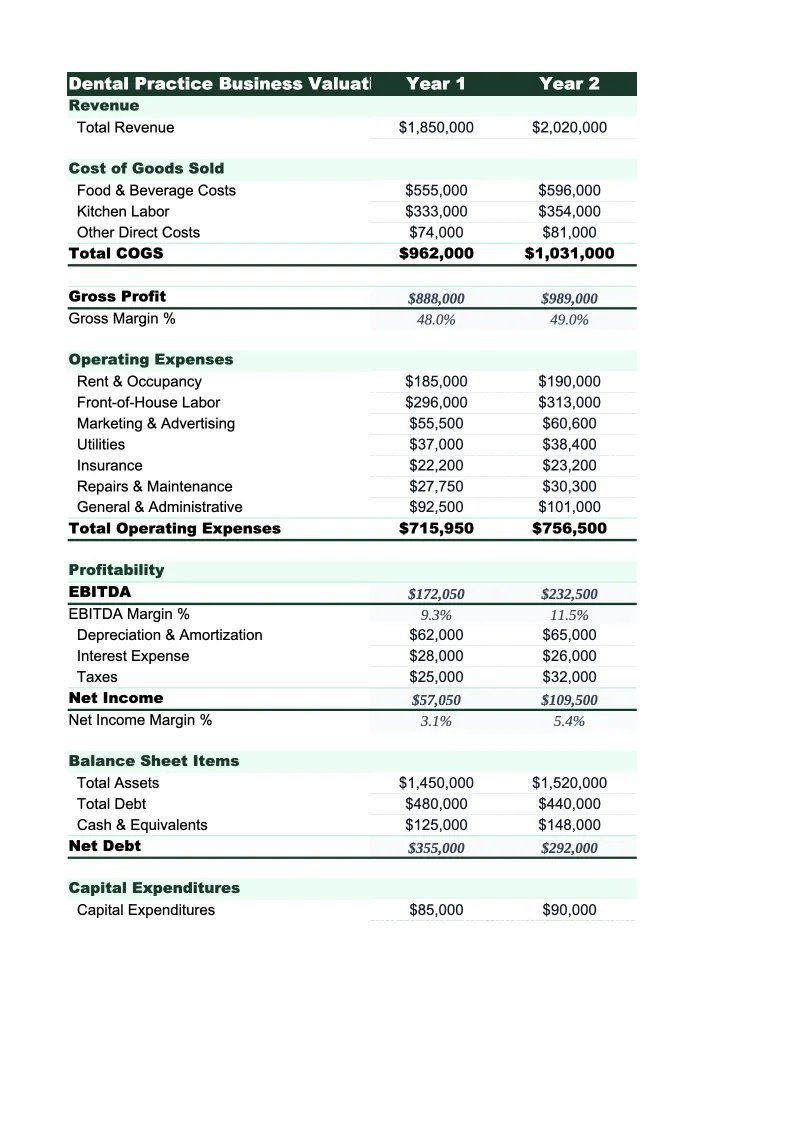
Dental Practice Valuation Template
Value your dental practice using collections-based multiples, an EBITDA approach, and a goodwill and value drivers scorecard — with benchmarks built around how dental practices actually sell to private buyers and DSOs.
What's Inside This Dental Practice Valuation Template
This template includes 6 worksheets, each designed for a specific part of your dental practice financial workflow:
Practice Inputs
The data foundation for the entire model. Enter your trailing twelve-month gross production, adjustments (write-offs and PPO contractual discounts), and net collections broken out by provider (dentist and hygienists). The sheet also captures the full expense structure: staff compensation for front desk, dental assistants, and hygienists; lab fees for outsourced crowns, dentures, and implant components; dental supplies at chairside; rent or facility cost; equipment lease payments and depreciation; practice management software and billing systems; marketing and patient acquisition; and professional services including your CPA and any consultants. Doctor compensation — both the salary drawn and any personal expenses run through the practice — is entered separately for the EBITDA and SDE normalizations. On the operational side, enter total active patients (seen within 24 months), new patients per month, hygiene recall rate, case acceptance rate, payer mix by category (fee-for-service, PPO in-network, Medicaid/CHIP), number of operatories, equipment age by major item, and years the practice has been at its current location. All downstream sheets pull from these inputs.
Collections Multiple Approach
The most commonly cited method for dental practice valuations in the U.S. market. This sheet calculates your trailing twelve-month net collections and applies the typical range for a solo general dentistry practice: 60–80% of gross collections for practices selling to individual dentist-buyers, and 70–90% of gross collections for DSO acquisitions in competitive markets. The range within each category is determined by payer mix (fee-for-service commands a premium over heavily PPO-adjusted practices), active patient count and retention, hygiene recare rate, practice age and goodwill depth, and whether the selling dentist will stay on for a transition period. This sheet also calculates per-active-patient implied value, which is a broker heuristic: dental practices have historically sold for $200–$450 per active patient, with fee-for-service practices and those with strong recall programs reaching the upper end. The collections multiple is not a full valuation on its own, but it is the first filter every dental broker and most DSO acquisition teams apply when screening practices.
EBITDA Multiple Approach
The income-based valuation that buyers doing more sophisticated analysis — including DSOs, private equity-backed groups, and lenders financing the acquisition — rely on most heavily. This sheet normalizes EBITDA starting from net income and adding back the selling dentist's total compensation (salary plus any draws above a market-rate associate wage), depreciation and amortization, interest on any practice debt, and one-time or non-recurring expenses. The replacement associate wage used in the model defaults to $200,000–$250,000 (production-based compensation for a full-time associate in a general practice), and users can adjust this to reflect their market. Once normalized EBITDA is calculated, the sheet applies the prevailing multiple range: solo private-buyer transactions typically close at 3.0–5.0x EBITDA, while DSO acquisitions in competitive markets have reached 5.0–8.0x EBITDA for high-production practices with strong payer mix and growth potential. A multiple selection matrix walks through the specific factors — production per operatory, payer mix, active patient base, equipment age, associate scalability — that determine where a specific practice falls within the range. The EBITDA approach is required by most SBA lenders financing dental acquisitions, and it produces a materially different number than the collections multiple for practices with high overhead or significant depreciation loads.
Asset Inventory
Calculates the tangible asset component of the practice value, which represents both the floor for any transaction and a required input for the goodwill calculation. Dental practices have significant tangible asset bases relative to most professional service businesses: digital X-ray systems and CBCT cone beam scanners, intraoral cameras, CAD/CAM milling units (Cerec and similar), dental chairs and delivery units by operatory, sterilization equipment, dental lasers if applicable, compressor and vacuum systems, practice management software licenses, and general office furniture and equipment. Each asset is entered at estimated fair market value, not book value — fair market value for used dental equipment typically runs 20–50% of new price depending on age and condition, and specialty equipment like CBCT units and CAD/CAM retains value longer than standard chairs. The goodwill section captures the intangible premium that good practices command: established patient base and recall system, staff tenure and relationships, favorable lease terms (long remaining term with renewal options), reputation in the local market, any specialty certifications, and the practice's website, social presence, and referral network. The goodwill component typically represents 60–75% of total practice value for a well-run practice, which makes the asset inventory primarily a floor-check rather than the primary driver.
Value Drivers Scorecard
A structured scoring model for the factors that most directly affect where a dental practice lands within its valuation range. The scorecard evaluates ten dimensions: net collections as a percentage of gross production (target 96–99% collection rate; practices below 93% face scrutiny); payer mix (fee-for-service percentage vs. in-network PPO vs. Medicaid — each 10% shift toward fee-for-service meaningfully improves multiples); active patient count and 24-month retention rate; new patient flow per month (practices generating 25+ new patients per month organically are worth more than those dependent on paid advertising or the selling dentist's personal referral network); hygiene recare recall rate (practices above 85% recall rate have sticky, predictable revenue); case acceptance rate and production per new patient exam; operatory utilization and production per chair per day (a practice running three full operatories efficiently is worth more than the same production squeezed into five part-time chairs); equipment age and deferred capital expenditure (buyers discount for equipment that will need replacement within 2–3 years); associate scalability (can the practice add a second provider without major facility changes); and dentist dependence (how much of the active patient base is loyal to the specific dentist vs. the practice location and staff). Each factor is scored 1–5, and the composite score maps to a specific adjustment within the collections and EBITDA multiple ranges.
Valuation Summary
A single-page output consolidating all three valuation approaches into one view across conservative, base, and optimistic scenarios. The summary shows the collections multiple range, the normalized EBITDA multiple range, and the tangible asset floor side by side, with the goodwill component isolated so buyers and sellers can see what they're paying for intangible value. A DSO comparison section shows how DSO acquisition pricing differs from private-buyer pricing — typically 20–40% higher at equivalent collections levels — which is useful for sellers weighing a traditional sale against a DSO approach. The sensitivity table shows how the EBITDA-based valuation shifts as the normalized EBITDA multiple moves in 0.5x increments, and how the collections multiple result moves across the 60–90% range, giving both parties a clear picture of the full negotiation range. Most solo general dentistry practices selling to a private dentist-buyer transact in the $400,000–$900,000 range, with high-production fee-for-service practices in growing markets reaching $1,000,000–$1,500,000. DSO transactions for practices producing $1.5M+ in collections can reach significantly higher multiples when bidding is competitive.
Dental Practice Valuation Template Features
- Collections multiple calculation with per-active-patient implied value benchmarked to dental practice transactions
- EBITDA normalization with associate wage replacement and dental-specific add-back categories for owner-dentist compensation
- Tangible asset inventory covering operatory equipment, digital imaging systems, CAD/CAM, and intangible goodwill components
- Value drivers scorecard scoring payer mix, recall rate, new patient flow, case acceptance, and operatory utilization
- DSO acquisition pricing comparison alongside private-buyer multiples in the Valuation Summary
- Three-scenario output with EBITDA sensitivity table and collections multiple range showing full negotiation band
How to Use This Dental Practice Valuation Spreadsheet
Start with the Practice Inputs sheet. Pull your trailing twelve-month gross production and net collections from your practice management software — Dentrix, Eaglesoft, Curve Dental, or Open Dental all have production and collections summary reports that feed this directly. You'll need the expense breakdown from your P&L, owner compensation including draws and any personal expenses through the practice, and operational data: active patient count (defined as seen within 24 months), new patients per month for the last 12 months, hygiene recall rate, payer mix percentages, and number of operatories. If your books don't clearly separate lab fees and dental supplies from general overhead, pull those directly from your supply invoices — lab fees and supplies together typically run 10–14% of collections in a well-managed practice, and buyers scrutinize this number closely.
Work through the Collections Multiple and EBITDA Multiple sheets together, then score the Value Drivers Scorecard. The EBITDA normalization requires you to honestly account for all owner compensation — not just the W-2 salary but any additional draws, profit distributions, personal vehicle, phone, and continuing education expenses that are categorized as business costs. The associate replacement wage in the model defaults to $220,000, which is a reasonable midpoint for a full-time general dentist associate with production-based pay; adjust this number to reflect your market, since dentist compensation varies significantly by region. The Value Drivers Scorecard is where practices either earn or lose their premium: payer mix and recall rate are the two factors buyers and DSOs cite most frequently, and the scorecard shows you exactly how each factor affects the final multiple.
Review the Valuation Summary before any conversation with a dental broker, DSO acquisition team, or potential private buyer. Pay attention to the DSO comparison section — if your practice produces $1.2M or more in annual collections with a strong payer mix and growth potential, the DSO path may produce a materially higher total price than selling to a private buyer, even after accounting for employment agreement terms and performance earnouts that DSOs typically attach. The sensitivity table shows the full valuation range so you're not caught off guard by an anchor offer. Most practice owners run the model at two or three different collection scenarios to understand how improvements in collections rate or payer mix affect the exit value — even a 5% shift in collections rate on a $1M gross production practice moves the EBITDA number enough to justify the operational focus.
Know what your dental practice is worth before you sell
Enter your collections, payer mix, EBITDA, and operational metrics — and get a defensible valuation range with the collections multiple, EBITDA approach, and goodwill scorecard that buyers and DSOs will use to make their offer.
How Dental Practices Are Valued When They Sell
Dental practice valuations have three reliable inputs: net collections, normalized EBITDA, and the goodwill value of the patient base. The collections multiple — most commonly 60–80% of trailing twelve-month net collections for private-buyer transactions — is the headline number that dental brokers use to set list prices, but it's the EBITDA normalization that determines whether a lender will finance the acquisition and whether a sophisticated buyer will close at that price. A practice collecting $900,000 per year with 35% overhead is a fundamentally different asset than one collecting $900,000 with 58% overhead. Both might be quoted at 70% of collections, but the second practice has a very different EBITDA and will face a much harder time getting an SBA loan approved. Sellers who understand both numbers go into negotiations better prepared.
The most important factor in dental practice valuations today is payer mix — specifically, how much of collections comes from fee-for-service and PPO out-of-network versus deeply discounted in-network PPO or Medicaid reimbursements. Fee-for-service practices collect close to 100% of production, carry higher per-visit production, and generate more discretionary and cosmetic case acceptance. In-network PPO practices that have accepted aggressive write-down contracts may collect 55–65 cents on each production dollar, compressing margins. Buyers price this difference into their offers. A practice with 60% fee-for-service collections will trade at a higher multiple than a near-identical practice with 90% in-network PPO, because the buyer is acquiring the revenue quality as much as the revenue volume. Practices that have been quietly dropping their worst-performing PPO plans for 12–18 months before a sale often see meaningful valuation improvement.
DSO acquisitions have permanently changed the ceiling for dental practice valuations. A solo practice that would have sold for 65–70% of collections to a private buyer five years ago may now attract DSO interest at 75–85% of collections or 5–7x EBITDA if the practice profile fits their expansion model. DSOs are buying market share, production capacity, and associate dentist pipelines — and they pay a premium for practices with multiple operatories, a facility that can support a second provider, and a patient base that the existing staff can retain through the ownership transition. The tradeoff is that most DSO transactions include a multi-year employment agreement requiring the selling dentist to stay on as an associate, and earnout provisions tied to production metrics. Understanding your practice's value in both markets — private sale and DSO acquisition — before engaging either path is the most important preparation a selling dentist can do.
Dental Practice Industry at a Glance
Financial templates built for dental practices — from solo general dentists to multi-provider offices. Pre-loaded with CDT billing categories, insurance adjustment tracking, and the KPIs that matter to practice owners.
Revenue Drivers
- Patient exam and hygiene visits
- Restorative procedures (fillings, crowns, root canals)
- Implants and prosthetics
- Specialty services (whitening, Invisalign)
- Insurance reimbursements and fee-for-service collections
Key Cost Categories
- Staff salaries and benefits
- Dental supplies (chairside materials)
- Lab fees (outsourced crown and denture fabrication)
- Rent and facility
- Equipment and depreciation
- Marketing and patient acquisition
- Practice management software and billing systems
- Professional services (accounting, legal)
Typical Margins
Gross: 75-80% · Net: 30-40%
Seasonality
Summer peak driven by children's appointments before school year; year-end surge as patients use expiring insurance benefits; January restorative surge as annual maximums reset.
Key Performance Indicators
Dental Practice Valuation FAQ
More Dental Practice Templates
Dental Practice Balance Sheet Template for Excel
$29
Dental Practice Budget Template for Excel
$29
Dental Practice Cash Flow Template for Excel
$29
Dental Practice Financial Model Template for Excel
$29
Dental Practice Income Statement Template for Excel
$29
Dental Practice Invoice Template for Excel
$29
Dental Practice KPI Dashboard Template for Excel
$29
Dental Practice P&L Template for Excel
$29
Dental Practice Pro Forma Template for Excel
$29
Dental Practice Project Budget Template for Excel
$29
Dental Practice Sales Forecast Template for Excel
$29
Dental Practice Valuation Template
$29