Dental Practice Pro Forma Template
Project your dental practice's revenue, overhead, and 3-year returns before you sign a lease, buy an existing practice, or apply for a bank loan — built around procedure mix, insurance reimbursements, and standard dental overhead ratios.
What's Inside This Dental Practice Pro Forma Template
This template includes 7 worksheets, each designed for a specific part of your dental practice financial workflow:
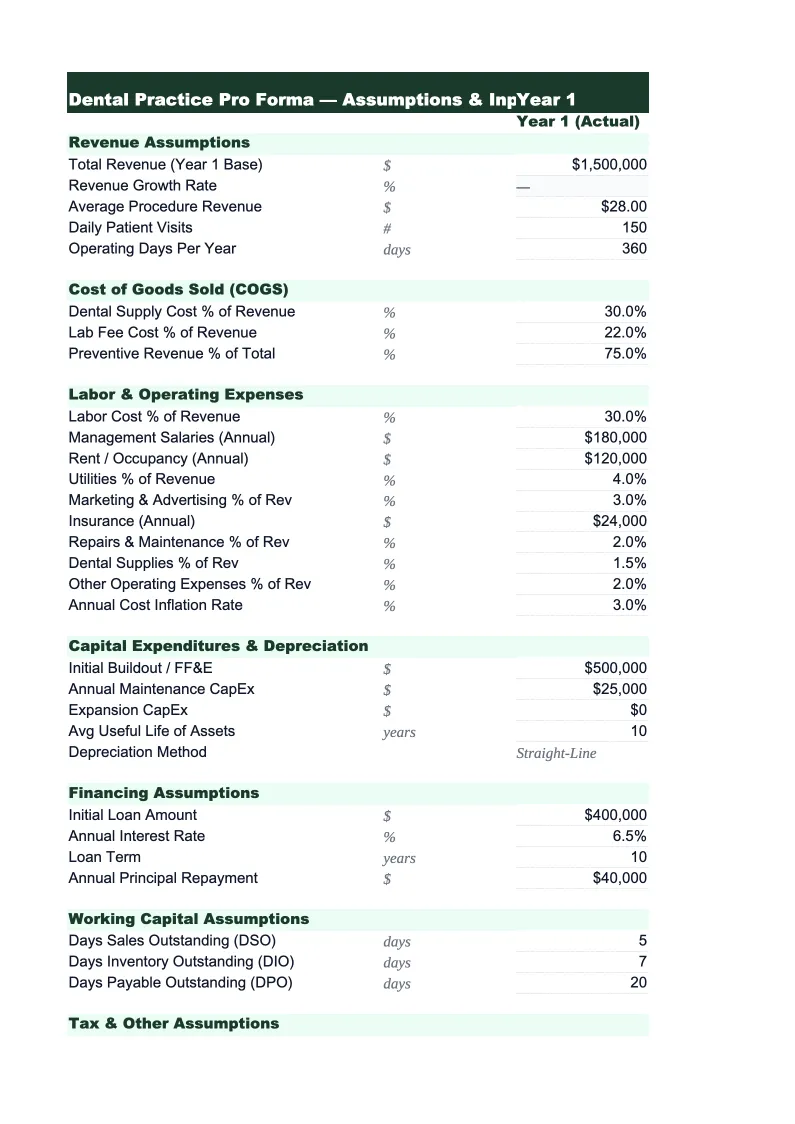
Assumptions
The control panel for the entire model.
Patient Volume Projections
A month-by-month forecast of patient visits for Years 1 through 3, broken out by appointment type: new patient exams, hygiene recall, restorative procedures, endodontics, oral surgery, implants, and cosmetic/elective services.
Revenue Projections
Projects monthly and annual production and collections by procedure category: preventive (exams and hygiene), restorative (fillings, crowns, and bridges), endodontics, oral surgery, implants and prosthetics, orthodontics and Invisalign, and whitening and elective services.
Expense Projections
A detailed 3-year expense forecast organized around the cost structure of a dental practice.
Pro Forma Income Statement
A 3-year projected profit and loss statement summarizing production, collections, and expenses into a clean annual view with monthly detail for Year 1.
Break-Even Analysis
Calculates the minimum monthly production needed to cover your fixed and variable overhead, and translates that into a daily production target and monthly patient volume requirement.
Startup Costs
A one-time summary of the capital required to open or acquire a dental practice.
Dental Practice Pro Forma Template Features
- Payer mix modeling for PPO, HMO, Medicaid, and fee-for-service with insurance write-off calculations
- Patient volume ramp-up by appointment type with active patient base tracking
- Dental overhead ratio benchmarks — supplies, lab fees, and staff cost as % of collections
- Break-even analysis with daily production targets and minimum monthly patient volume
- 3-year pro forma P&L formatted for SBA and dental practice lender review
- Startup cost summary for both de novo practices and acquisition financing
How to Use This Dental Practice Pro Forma Spreadsheet
Start with the Assumptions sheet. Enter your projected patient volume by appointment type, your average fee or production per procedure category, and your payer mix — what percentage of your patients will be PPO, fee-for-service, or Medicaid. If you're buying an existing practice, use the seller's production and collections history as your starting point and adjust for planned changes. If you're starting from scratch, research the demographics and insurance penetration in your target market to build realistic assumptions. Getting the payer mix right is especially important — a practice that's 80% PPO will collect significantly less per procedure than one that's 60% fee-for-service, and that difference flows through every projection in the model.
Once your assumptions are set, review the Patient Volume Projections and Revenue sheets to check whether the ramp-up schedule looks realistic. New dental practices typically add 20–40 new patients per month in Year 1 through a combination of online advertising, referrals, and community outreach. The Revenue sheet will show you how production and collections grow as your patient base builds. Use the Break-Even Analysis to check your daily production target — a solo general dentist typically needs $1,500–$2,500 in daily production to cover overhead, and this target should be achievable within 6–9 months of opening. If the break-even looks out of reach under your assumptions, adjust your fee schedule, payer mix, or overhead inputs before you commit to the space.
Know your break-even before you sign the lease or close the acquisition
Download the template, plug in your fee schedule and payer mix, and see whether the practice pencils out — with a pro forma your lender will recognize.
Why Every Dental Practice Needs a Pro Forma Before Launch or Acquisition
Opening or buying a dental practice is one of the largest financial decisions a dentist will make — and unlike most small business acquisitions, the numbers are relatively predictable if you model them correctly. A de novo startup typically requires $300,000 to $600,000 in startup capital before a single patient walks through the door. An acquisition typically trades at 60–80% of annual collections for a solo general practice. In both cases, banks and SBA lenders will not approve financing without a detailed 3-year pro forma, and the quality of that document often determines not just approval but also loan terms.
Dental practice finances have a structure unlike most small businesses. Revenue is driven by procedure mix and payer mix, not just volume. A practice seeing 40 new patients per month that's heavily weighted toward PPO insurance may collect the same as a practice seeing 25 new patients per month that's primarily fee-for-service — because PPO write-offs often reduce gross production by 25–40%. Understanding your net collection rate by payer type is the foundation of any accurate dental pro forma. On the expense side, three categories dominate: staff compensation (typically 25–30% of collections), dental supplies (5–7%), and lab fees (7–10%). Total overhead should target 59–65% of collections, leaving a 35–41% operating margin for the practice owner — which is strong compared to most small businesses but must be sustained through disciplined purchasing and payer contract management.
Dental Practice Industry at a Glance
Financial templates built for dental practices — from solo general dentists to multi-provider offices. Pre-loaded with CDT billing categories, insurance adjustment tracking, and the KPIs that matter to practice owners.
Revenue Drivers
- Patient exam and hygiene visits
- Restorative procedures (fillings, crowns, root canals)
- Implants and prosthetics
- Specialty services (whitening, Invisalign)
- Insurance reimbursements and fee-for-service collections
Key Cost Categories
- Staff salaries and benefits
- Dental supplies (chairside materials)
- Lab fees (outsourced crown and denture fabrication)
- Rent and facility
- Equipment and depreciation
- Marketing and patient acquisition
- Practice management software and billing systems
- Professional services (accounting, legal)
Typical Margins
Gross: 75-80% · Net: 30-40%
Seasonality
Summer peak driven by children's appointments before school year; year-end surge as patients use expiring insurance benefits; January restorative surge as annual maximums reset.
Key Performance Indicators
Dental Practice Pro Forma Template FAQ
More Dental Practice Templates
Dental Practice Balance Sheet Template for Excel
$29
Dental Practice Budget Template for Excel
$29
Dental Practice Business Plan Template for Excel
$39
Dental Practice Cash Flow Template for Excel
$29
Dental Practice Expense Tracker Template for Excel
$29
Dental Practice Financial Model Template for Excel
$29
Dental Practice Income Statement Template for Excel
$29
Dental Practice Invoice Template for Excel
$29
Dental Practice KPI Dashboard Template for Excel
$29
Dental Practice P&L Template for Excel
$29
Dental Practice Project Budget Template for Excel
$29
Dental Practice Sales Forecast Template for Excel
$29
Dental Practice Valuation Template for Excel
$29
Dental Practice Pro Forma Template
$29