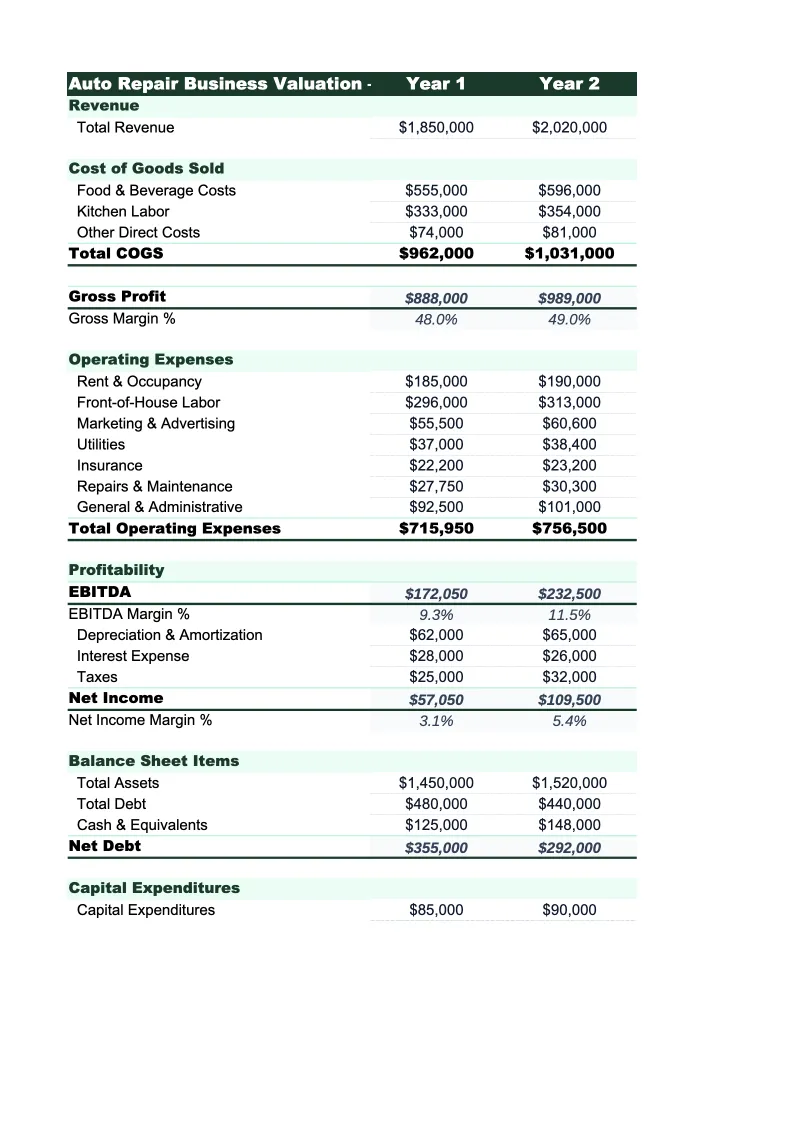
Auto Repair Valuation Template
Value your auto repair shop using seller's discretionary earnings multiples, an equipment-based asset approach, shop operations metrics, and revenue benchmarks — built around the factors buyers and brokers actually use when pricing independent and multi-bay shops.
What's Inside This Auto Repair Shop Valuation Template
This template includes 6 worksheets, each designed for a specific part of your auto repair financial workflow:
Business Inputs
The data entry foundation for the entire valuation model.
SDE Multiple Approach
Seller's Discretionary Earnings is the standard income-based valuation method for independently owned auto repair shops, and this sheet walks through the full normalization from net income to a defensible SDE figure.
Asset-Based Approach
A floor-value calculation based on the tangible assets a buyer would be acquiring, which carries more weight in auto repair valuations than in most other small service businesses because the equipment is both expensive and essential to operations.
Shop Operations Profile
Auto repair shop valuations depend on operational metrics that don't appear directly on the income statement but that buyers scrutinize carefully during due diligence, because they determine whether the shop's revenue is transferable or tied to the current owner's personal relationships and technical reputation.
Revenue Multiple Approach
A gross revenue screening method that establishes a broad value range as a cross-check against the SDE multiple approach.
Valuation Summary
A single-page output consolidating the SDE multiple, asset-based floor, and revenue multiple approaches into one view across conservative, base, and optimistic scenarios.
Auto Repair Shop Valuation Template Features
- SDE normalization with full owner compensation add-back and a multiple selection matrix scoring technician stability, equipment condition, specialization transferability, fleet account revenue, and lease terms
- Asset-based floor value covering vehicle lifts, alignment systems, diagnostic equipment, specialty tooling, and parts inventory with goodwill layered on top
- Shop Operations Profile sheet capturing car count, ARO, effective labor rate, technician tenure and classification, and fleet account concentration — the metrics buyers request in due diligence
- Owner dependency assessment flagging whether daily operations require the current owner's technical labor or customer relationships to sustain revenue
- Revenue multiple cross-check benchmarked to independent auto repair shop transactions with labor-to-parts ratio and fleet account adjustments
- Three-scenario Valuation Summary with SDE sensitivity table and deal structure comparison covering cash, seller financing, and earnout arrangements
How to Use This Auto Repair Business Valuation Spreadsheet
Start with the Business Inputs sheet. Pull your trailing twelve-month revenue by category from your shop management system — most systems (Mitchell 1, Shop-Ware, Tekmetric, ROWriter) can export a revenue breakdown by service category, and you want labor revenue separated from parts revenue rather than combined. Gather your full expense structure from your profit and loss statement or your accountant's records. Owner compensation needs to be fully documented: your salary or draws, any personal expenses run through the business (a vehicle, fuel, health insurance, personal cell phone), and any family members on payroll whose compensation would not continue under new ownership. For the asset section, pull any recent equipment appraisals if you have them, or estimate current resale value based on age and condition rather than original purchase price — a ten-year-old two-post lift that cost $12,000 new might be worth $4,000–$7,000 today depending on its condition and brand.
Work through the Shop Operations Profile sheet carefully before applying the SDE multiple. The technician section matters most: enter each technician's tenure, ASE certifications, and classification level, and be honest about whether the shop could retain those technicians through an ownership transition. A buyer is acquiring the workforce as much as the equipment, and a shop where two or three skilled technicians would likely leave with or shortly after the current owner is worth materially less than one with stable, tenure-compensated staff. The fleet account section documents any commercial accounts — enter each account's monthly revenue, whether it's under a formal agreement or a handshake relationship, and who manages the relationship. Fleet accounts on formal contracts that are clearly transferable are a genuine value driver; informal arrangements based on personal relationships with the current owner are a risk factor buyers will discount.
Know what your auto repair shop is worth before you sell
Enter your revenue, SDE, equipment values, and shop operations profile — and get a defensible valuation range with the SDE approach, asset floor, and the workforce and fleet account analysis that buyers will use to make their offer.
How Auto Repair Shops Are Valued When They Sell
Auto repair shop valuations are shaped by three realities that distinguish them from most other small businesses. First, the workforce is the primary asset — more than the equipment, the customer list, or even the lease. A shop's ability to perform the work that generates revenue depends entirely on whether the technicians stay after a sale, and buyers know it. A shop where the current owner is personally performing a significant portion of the billable labor is worth less than one where the technical work is fully distributed among a retained team, because a buyer must hire replacement labor immediately at close. Second, the equipment is substantial, expensive to replace, and essential — a buyer cannot operate an auto repair shop without functional vehicle lifts, working diagnostic tools, and alignment equipment, and the condition of that equipment is therefore a direct input to both the asset floor value and the SDE multiple. Third, the revenue mix between labor and parts matters: labor revenue reflects the shop's technical capacity and workforce, while parts revenue largely follows as a byproduct — a shop with strong labor revenue and appropriate parts margins is a healthier operation than one showing high parts revenue relative to labor, which can indicate a less skilled service mix.
The factors that push an auto repair shop valuation toward the upper end of the 2.0–3.5x SDE range are specific and well-understood by experienced buyers and business brokers. A stable, certified technician team that is compensated at market rates and has multi-year tenure is the single most important value driver — every year of average technician tenure reduces the buyer's staffing risk and increases the multiple they're willing to accept. Commercial fleet accounts under written agreements that are clearly assignable to a new owner represent recurring, predictable revenue that a buyer can underwrite conservatively in their model; shops where 20–30% of revenue comes from two to five solid fleet relationships often achieve a premium to the SDE range for comparable retail-only shops. A long-term lease at a favorable rate in a visible, high-traffic location reduces the buyer's operating cost risk; a lease expiring in less than two years without a signed renewal option is a negotiating liability that compresses the multiple. A clean, well-maintained equipment profile — especially newer or recently serviced lifts and a current Hunter or John Bean alignment system — removes a major post-acquisition capital expense concern that buyers factor into their pricing.
Auto Repair Industry at a Glance
Financial templates built for auto repair shops — from single-bay independents to multi-location service centers. Pre-loaded with labor, parts, and overhead categories specific to the automotive service industry.
Revenue Drivers
- Labor (repair services)
- Parts sales
- Oil changes & maintenance
- Diagnostics & inspections
- Tire sales
- Shop supplies fees
Key Cost Categories
- Parts & materials (COGS)
- Technician labor
- Rent & occupancy
- Equipment & tools
- Utilities
- Insurance
- Marketing & advertising
- Shop supplies
Typical Margins
Gross: 50-60% · Net: 5-15%
Seasonality
Busiest in summer (June–August) and spring (March–May) for maintenance and travel prep; January–February are consistently the slowest months.
Key Performance Indicators
Auto Repair Shop Valuation FAQ
More Auto Repair Templates
Auto Repair Shop Balance Sheet Template for Excel
$29
Auto Repair Shop Budget Template for Excel
$29
Auto Repair Shop Business Plan Template for Excel
$39
Auto Repair Shop Cash Flow Template for Excel
$29
Auto Repair Expense Tracker Template for Excel
$29
Auto Repair Financial Model Template for Excel
$29
Auto Repair Income Statement Template for Excel
$29
Auto Repair Invoice Template for Excel
$29
Auto Repair KPI Dashboard Template for Excel
$29
Auto Repair P&L Template for Excel
$29
Auto Repair Shop Pro Forma Template for Excel
$29
Auto Repair Shop Project Budget Template for Excel
$29
Auto Repair Sales Forecast Template for Excel
$29
More Valuation Templates
Auto Repair Valuation Template
$29