Stackrows
Church Valuation Template
A
B
C
D
E
F
G
1
Category
Budget
Actual
2
3
4
5
6
7
8
Church Inputs
Financial Health Scorecard
Property & Asset Assessment
Giving Sustainability Analysis
Merger & Transition Summary

Church Valuation Template

Assess a congregation's financial health, property value, and long-term sustainability using giving trend analysis, reserve scoring, property assessment, and a structured framework for mergers, closures, and denominational reviews.

$29Save 4+ hours vs. building a church financial assessment from scratch
Instant download after purchase
Works in Excel & Google Sheets
30-day money-back guarantee
.xlsx215 KB5 sheetsUpdated 2026-03-23

What's Inside This Church Valuation Template

This template includes 5 worksheets, each designed for a specific part of your church financial workflow:

1

Church Inputs

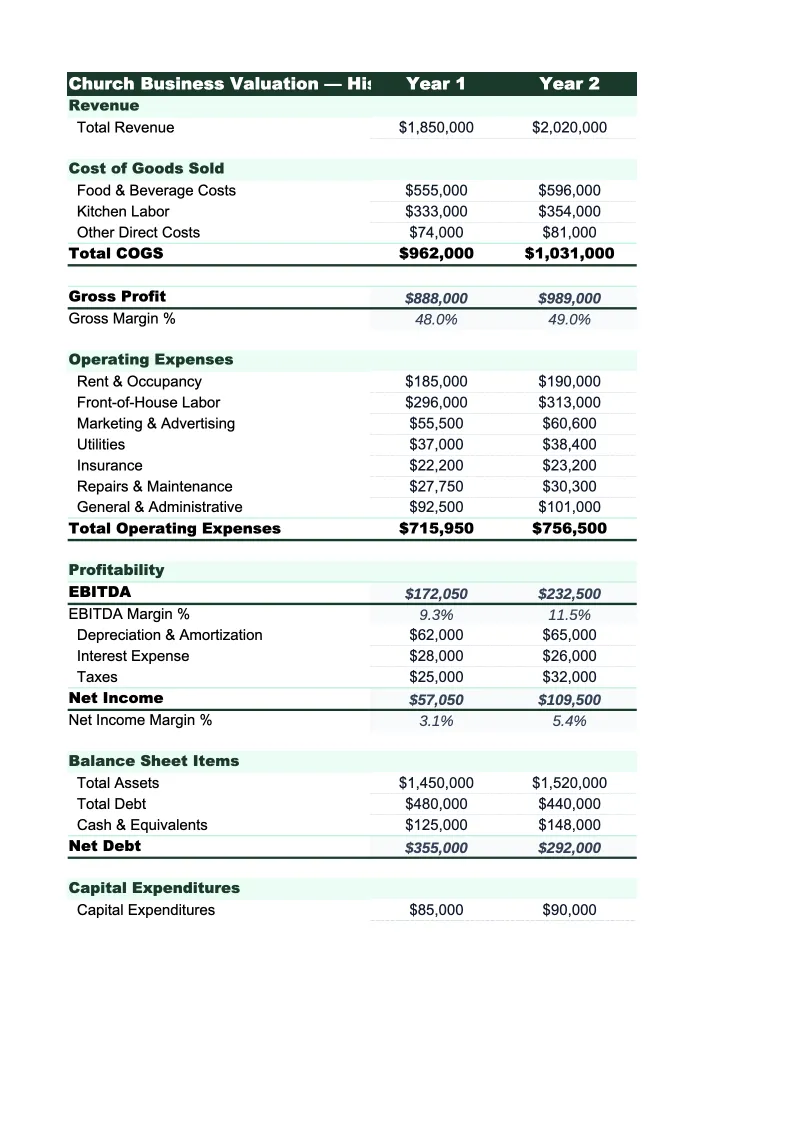
The data entry foundation for the entire assessment. Enter trailing twelve-month revenue broken out by source: regular tithes and offerings (weekly giving, online giving, and text-to-give), special campaign and seasonal offerings (Christmas, Easter, building fund drives), facility and parking rental income, school or childcare tuition if applicable, cemetery and memorial service fees, investment and interest income, and any denominational support or grants received. The expense section captures personnel and housing allowances broken out by pastoral staff, support staff, and part-time ministry roles; facilities costs including mortgage or rent, utilities, insurance, and maintenance; program and ministry expenses by department; missions and benevolence giving; administration including software, accounting, and office; and debt service on any outstanding building or equipment loans. Balance sheet inputs include unrestricted operating funds, designated or restricted funds by purpose (building fund, missions fund, memorial fund), endowment or permanently restricted assets, real property at book value, and total liabilities. Operational metrics include average weekly attendance over the trailing twelve months, total giving units (households that gave at least once), number of recurring givers set up on automatic payment, and headcount of full-time and part-time staff. These inputs drive all downstream analysis automatically.

2

Financial Health Scorecard

A structured assessment of the congregation's financial condition across six dimensions that denominational leaders, lenders, merger partners, and church boards use to evaluate organizational health and sustainability. The first dimension is the operating reserve ratio: unrestricted liquid funds divided by average monthly operating expenses — the benchmark for a financially healthy congregation is 3–6 months, with fewer than 2 months flagged as financially vulnerable. The second dimension is personnel cost as a percentage of total budget: most church financial consultants recommend keeping personnel costs below 50–55% of total expenses, as costs above 60% leave insufficient margin for facilities maintenance, ministry programming, and reserves. The third dimension is facilities cost as a percentage of total budget: total occupancy costs (mortgage or rent, utilities, insurance, maintenance) above 35% of the budget indicate potential over-investment in facility relative to the congregation's income base. The fourth dimension is giving per attender, the most comparable metric across congregations of different sizes: it is calculated as total annual contributions divided by average weekly attendance, and the national median for Protestant churches is approximately $1,000–$1,500 per attender annually, with significant variation by denomination and region. The fifth dimension is debt service coverage: annual operating surplus (or deficit) plus depreciation divided by annual debt service payments — a ratio above 1.25 indicates the congregation can comfortably service its debt obligations. The sixth dimension is giving trend: whether average weekly giving is growing, flat, or declining over the trailing three years, expressed as a compound annual growth rate. Each dimension is scored 1–5 and the composite score drives the sustainability rating used in the merger and transition summary.

3

Property & Asset Assessment

A systematic inventory and assessment of the congregation's real and personal property assets — typically the largest component of a church's balance sheet and the primary asset in any merger, closure, or property transaction. The real property section includes a row for each parcel owned by the church: the sanctuary building, educational or fellowship buildings, the parsonage or manse, parking lots, and cemetery land if applicable. For each parcel, enter the current book value (original cost less accumulated depreciation per the church's financial records), the most recent assessed value from county property tax records, and an estimated current market value based on comparable sales if available. The template calculates the unrealized appreciation or depreciation between book value and estimated market value — for many congregations, real property acquired decades ago at much lower cost represents a significant unrecorded asset that does not appear on the balance sheet. The personal property section captures major equipment and furnishings by category: audio-visual and sound equipment, musical instruments, kitchen and commercial food service equipment, transportation vehicles, and office equipment. Each item is entered at original cost with the estimated current replacement cost and estimated current resale value. Designated and restricted fund balances are listed separately from real property to show clearly what liquid assets are available versus encumbered by donor restrictions or board designations. The total asset summary shows book value assets, estimated fair market value of real property, designated fund balances, and endowment or permanently restricted assets as distinct categories that behave differently in any transaction or transition scenario.

4

Giving Sustainability Analysis

A forward-looking assessment of whether the congregation's current giving base can sustain its existing financial commitments, and what the giving base looks like relative to attendance and demographic trends. Enter up to three years of annual giving totals broken out by giving category: recurring automated givers (the most predictable giving segment), online one-time givers, check and cash givers, and estate or legacy gifts received. The trend analysis calculates compound annual growth rate for total giving, for the number of giving units, and for average gift per giving unit — these three metrics together reveal whether giving growth or decline is driven by acquiring new givers, by changes in per-household generosity, or by attrition of existing givers. A giving concentration analysis similar to major donor concentration in fundraising nonprofits is applied to the church context: enter the percentage of total giving contributed by the top 10, 25, and 50 giving units to assess dependency risk. Congregations where the top 10 families represent more than 40% of total giving face meaningful vulnerability to relocation, death, or giving changes within that core group. The sustainability projection models three scenarios — flat giving, 3% annual decline, and 5% annual decline — against the current expense structure to show how many years the church can sustain operations in each scenario before reserves are depleted. This analysis is particularly useful for boards and denominational leaders evaluating whether a financially challenged congregation has a realistic path to sustainability or is in a slow trajectory toward closure.

5

Merger & Transition Summary

A single-page output consolidating the financial health score, property assessment, giving sustainability analysis, and key operational metrics into a structured framework for merger conversations, denominational assessments, pastoral transitions, or property decisions. Unlike for-profit business acquisitions, church mergers and consolidations are driven by mission continuity, community need, and organizational sustainability rather than financial engineering — but the financial analysis is critical because it determines whether a consolidation creates a stronger combined congregation or simply burdens the acquiring church with a financially distressed partner's liabilities and a diminishing giving base. The summary presents four components of organizational value in the church context: the financial position (unrestricted liquid assets, total net assets, and debt obligations that transfer in any merger), the property position (fair market value of real assets, any title encumbrances, deferred maintenance obligations, and denominational property claims if applicable), the ministry and community position (average weekly attendance, ministry programming depth, community presence, and the demographics of the giving base), and the transition risk assessment (giving dependency concentration, staff transition complexity, and projected giving stability in the 12–24 months following a merger or pastoral change). A denominational review section provides the financial ratios most commonly requested by denominational bodies during church assessments: personnel cost ratio, facilities cost ratio, operating reserve, and giving per attender relative to regional benchmarks. The output includes a property disposition scenario analysis showing net proceeds from a potential property sale after outstanding mortgage payoff, estimated transaction costs, and any denominational property recapture provisions that may apply — relevant for congregations considering closure or relocation.

Church Valuation Template Features

  • Financial health scorecard across six dimensions — operating reserve, personnel cost ratio, facilities cost ratio, giving per attender, debt service coverage, and giving trend — benchmarked to church financial consulting standards
  • Property and asset assessment comparing book value to estimated fair market value for sanctuary, parsonage, educational buildings, and major equipment with unrealized appreciation calculation
  • Giving sustainability analysis tracking giving unit count, per-household giving trends, and giving concentration across top 10, 25, and 50 giving households
  • Three-scenario giving sustainability projection modeling flat, 3% decline, and 5% decline trajectories against current expense structure to show financial runway
  • Merger and transition summary separating financial position, property position, ministry value, and transition risk as distinct components for consolidation conversations
  • Property disposition scenario calculating net proceeds from potential property sale after mortgage payoff, transaction costs, and denominational recapture provisions

How to Use This Church Valuation Spreadsheet

Start with the Church Inputs sheet. Pull trailing twelve-month revenue data from your church management software or accounting system — most churches track giving, facility income, and special offerings in separate accounts, and keeping them separated here matters because each source carries a different predictability profile. Enter balance sheet figures including unrestricted operating funds, all designated fund balances by purpose, endowment assets if any, and outstanding mortgage or loan balances. The real property section in the Property Assessment sheet requires current book value from your depreciation schedule and an estimated current market value — your county assessor's website shows the assessed value, which is typically 80–90% of market value in most jurisdictions and gives you a reasonable starting estimate. Operational metrics including average weekly attendance and giving unit count are essential inputs; pull those from your church management system or attendance records.

Complete the Financial Health Scorecard and Giving Sustainability Analysis before your next board meeting, strategic planning session, or any conversation with denominational leadership. The scorecard will surface the ratios — personnel cost percentage, facilities cost percentage, and operating reserve — that church financial consultants and denominational bodies use to assess congregation health. Pay particular attention to the giving concentration analysis: many congregations are surprised to find that 30–40% of their giving comes from 5–10 households, which creates meaningful vulnerability to deaths, relocations, and life-stage giving changes in that core group. The sustainability projection scenarios are sobering for congregations experiencing gradual giving decline — the model shows exactly how many years of financial runway remain at the current trajectory, which forces a realistic conversation about whether the path is sustainable.

Use the Merger and Transition Summary before any formal conversation with a merger partner, a denominational leader conducting an assessment, or a lender refinancing a building loan. The summary brings together all five sheets into a single-page picture that both parties can work from. For merger conversations specifically, the property disposition scenario is critical: many church consolidations involve selling one congregation's property and using the proceeds to fund the combined ministry, and the net proceeds calculation — after mortgage payoff, transaction costs, and any denominational property recapture — determines the actual financial benefit the surviving congregation receives. Understanding that number before entering negotiations gives church boards the information they need to structure a merger that genuinely strengthens the combined ministry.

Know your congregation's financial health before the next board meeting

Enter your giving data, expense structure, property values, and fund balances — and get a complete picture of operating reserve depth, giving sustainability, and what your church is actually worth.

How Churches Are Valued for Mergers and Sustainability Planning

Valuing a church is not the same as valuing a for-profit business, but churches are financially assessed more often than most congregations realize. Denominational bodies conduct financial reviews when churches request loans for building projects, when they fall behind on denominational assessments, or when they are candidates for merger or closure. Lenders evaluate financial health when refinancing a mortgage or financing a building expansion. Boards conduct internal assessments when a long-tenured pastor retires and the congregation needs to evaluate whether current commitments are sustainable under new leadership. Real estate decisions — whether to sell a building and relocate, lease unused space, or pursue a renovation — require a clear picture of what the property is worth and what the congregation's balance sheet actually looks like. In all of these contexts, the same core metrics drive the assessment: operating reserve, giving per attender, personnel and facilities cost ratios, debt service coverage, and the concentration and trajectory of the giving base.

The financial characteristics that define a healthy, sustainable congregation are consistent across denominations and sizes, even though the absolute numbers vary widely. An operating reserve of 3–6 months of expenses is the most widely cited benchmark — congregations below 2 months are one bad year of giving away from a cash crisis, and bad years happen: attendance drops during pastoral transitions, major donors relocate, facilities require unexpected capital expenditures. Personnel costs below 55% of total budget leave enough margin for facilities maintenance, ministry programming, and reserve accumulation; congregations that push personnel above 60% consistently find themselves deferring maintenance and cutting ministry to cover payroll. Giving per attender is the most useful comparative metric because it normalizes for congregation size: a church of 150 attenders giving $180,000 annually ($1,200 per attender) is in a different financial position than one giving $120,000 ($800 per attender), even though the giving amounts are not dramatically different. Understanding where your congregation sits relative to these benchmarks — and whether the trajectory is improving or declining — is the starting point for any sustainability conversation.

Church mergers and consolidations have increased significantly over the past two decades as smaller congregations face the combined pressure of declining attendance, aging facilities, and shifting demographics. The practical financial framework for evaluating a merger candidate covers four questions: what unrestricted liquid assets and real property transfer to the surviving congregation, what are the debt obligations and deferred maintenance liabilities that come with them, how stable and transferable is the giving base during a two-year transition period when attendance disruption typically peaks, and what are the denominational property and endowment constraints that govern what can actually be done with the assets. A congregation with a well-maintained $2 million building, $150,000 in unrestricted reserves, and a $400,000 mortgage is a very different merger partner than one with a deteriorating building requiring $500,000 in deferred maintenance and a congregation whose giving has declined 5% annually for three years. This template is built to answer those specific questions before a merger conversation begins, so the decision is based on actual financial data rather than optimistic assumptions about what the combined congregation will look like.

Church Industry at a Glance

Financial templates built for churches and religious organizations — facility rentals, ceremony fees, staff payroll, and ministry budgets.

Revenue Drivers

  • Tithes and weekly offerings
  • Facility rental income
  • Special offerings (Christmas, Easter)
  • School and childcare tuition
  • Cemetery and memorial service fees

Key Cost Categories

  • Personnel and housing allowance
  • Facilities and occupancy
  • Worship and ministry programs
  • Missions and benevolence
  • Administration and software
  • Debt service

Typical Margins

Gross: N/A · Net: 0-5% operating surplus

Seasonality

Giving peaks at Christmas and Easter; summer typically sees 10-20% attendance and giving decline. Year-end giving surge in December is common for tax purposes.

Key Performance Indicators

Giving per attenderPersonnel cost as % of budgetFacilities cost as % of budgetMonths of operating reserveFacility utilization rate

Church Valuation Template FAQ

Church Valuation Template

$29