Accounting Firm Balance Sheet Template
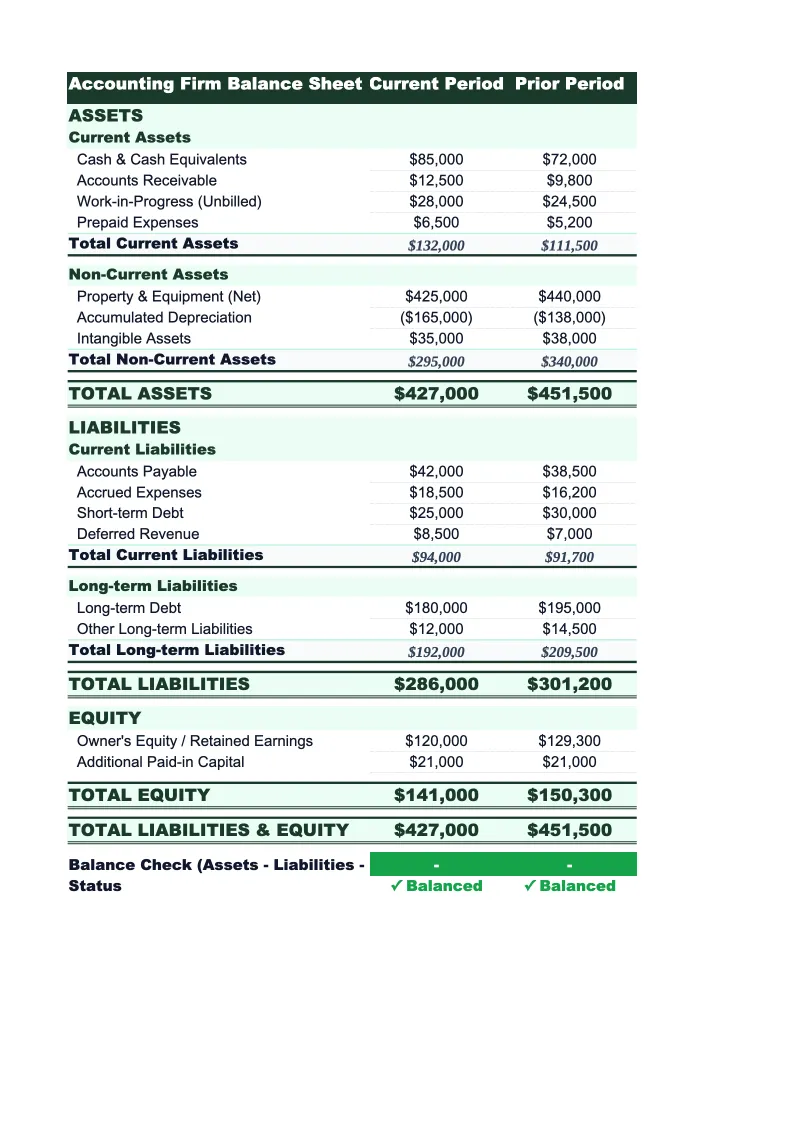
Track your accounting firm's financial position with a balance sheet built for CPA practices — work-in-progress, client receivables, deferred tax season revenue, and partner equity all in one place.
What's Inside This Accounting Firm Balance Sheet Template
This template includes 4 worksheets, each designed for a specific part of your accounting firm financial workflow:
Balance Sheet
The core worksheet showing your accounting firm's financial position at a specific date.
Period Comparison
A side-by-side view of your balance sheet across two reporting dates — typically the current quarter-end versus the prior quarter, or this year versus last year at the same point.
Working Capital
A focused view of short-term liquidity — critical for accounting firms heading into or coming out of busy season.
Receivables Aging
A client-by-client breakdown of outstanding invoices organized by how long they've been unpaid: current (0–30 days), 31–60 days, 61–90 days, and over 90 days.
Accounting Firm Balance Sheet Template Features
- Pre-built WIP line item for unbilled tax preparation and audit engagements in progress
- Deferred revenue category for client retainers and prepaid tax season fees
- Partner capital accounts structured for single-owner or multi-partner firms
- Accrued salaries and bonuses tracked separately from accounts payable
- Period-over-period comparison with dollar and percentage change for every line
- Receivables aging by client with 0–30, 31–60, 61–90, and 90+ day buckets
How to Use This Accounting Firm Balance Sheet Spreadsheet
Download the .xlsx file and open it in Excel or Google Sheets — no macros or plugins required. Start with the Balance Sheet tab and review the pre-loaded categories. Most CPA firms and bookkeeping practices will find the structure fits with minor adjustments: rename partner capital accounts to match your firm's ownership setup, add or remove software license lines depending on whether you capitalize or expense them, and check whether the deferred revenue line needs a second row if you carry both tax season prepayments and monthly retainers. The initial setup takes about 20 minutes.
Once the structure is right, enter your current balances from your bank accounts, accounting software, or most recent bank statements. The most important inputs for an accounting firm are: cash on hand, total outstanding receivables (which you'll detail in the Receivables Aging tab), the dollar value of work-in-progress for ongoing engagements that haven't been billed yet, any deferred revenue from clients who've already paid for upcoming work, and accrued staff compensation if payroll hasn't been run at month-end. The balance sheet formula will confirm the sheet balances — assets should equal liabilities plus equity.
20 minutes from download to your firm's first balance sheet
Download the template, enter your balances, and see your accounting practice's full financial position — assets, liabilities, partner equity, and receivables aging all in one place.
Why Accounting Firms Need a Balance Sheet Template
Accounting firms have a balance sheet pattern that's easy to misread without the right categories in place. Revenue concentrates in the first four months of the year and again in September through October, but staff costs, software renewals, and lease payments are spread evenly across all 12 months. This means cash at the bank in May can look healthy — because tax season payments came in — while the balance sheet is quietly accumulating liabilities that will come due in January before the next busy season starts. Firms that only watch cash miss that cycle until it causes a problem.
The balance sheet line items that matter most for an accounting practice are different from a product company. On the asset side, work-in-progress is often the largest current asset during busy season — it represents hours invested in client engagements that haven't been billed yet. Accounts receivable is the second large asset, and how quickly it ages tells you more about client health than any income statement. On the liability side, deferred revenue from prepaid tax season engagements is often understated or missing entirely from balance sheets built on generic templates. If a client paid $5,000 in December for a tax return you'll complete in March, that $5,000 is a liability until the work is done.
Accounting Firm Industry at a Glance
Financial templates built for accounting firms and CPA practices — from solo practitioners to multi-partner firms. Pre-loaded with billable hour tracking, realization rate calculations, and service categories that reflect how accounting firms actually bill.
Revenue Drivers
- Tax preparation and planning
- Audit and assurance
- Bookkeeping and client accounting services (CAS)
- Advisory and fractional CFO services
- Payroll processing
Key Cost Categories
- Professional staff salaries and benefits
- Administrative staff
- Occupancy and rent
- Technology and software (tax, practice management)
- Malpractice (E&O) insurance
- Marketing and business development
- CPE and professional development
- Subcontractors and offshore staff
Typical Margins
Gross: 50-65% · Net: 20-35%
Seasonality
Heavy busy season January through April 15; secondary crunch in September through October 15 for extensions. Slowest months are July and August.
Key Performance Indicators
Accounting Firm Balance Sheet Template FAQ
More Accounting Firm Templates
Accounting Firm Budget Template for Excel
$29
Accounting Firm Business Plan Template for Excel
$39
Accounting Firm Cash Flow Template for Excel
$29
Accounting Firm Expense Tracker Template for Excel
$29
Accounting Firm Financial Model Template for Excel
$29
Accounting Firm Income Statement Template for Excel
$29
Accounting Firm Invoice Template for Excel
$29
Accounting Firm KPI Dashboard Template for Excel
$29
Accounting Firm P&L Template for Excel
$29
Accounting Firm Pro Forma Template for Excel
$29
Accounting Firm Project Budget Template for Excel
$29
Accounting Firm Sales Forecast Template for Excel
$29
Accounting Firm Valuation Template for Excel
$29
More Balance Sheet Templates
Accounting Firm Balance Sheet Template
$29