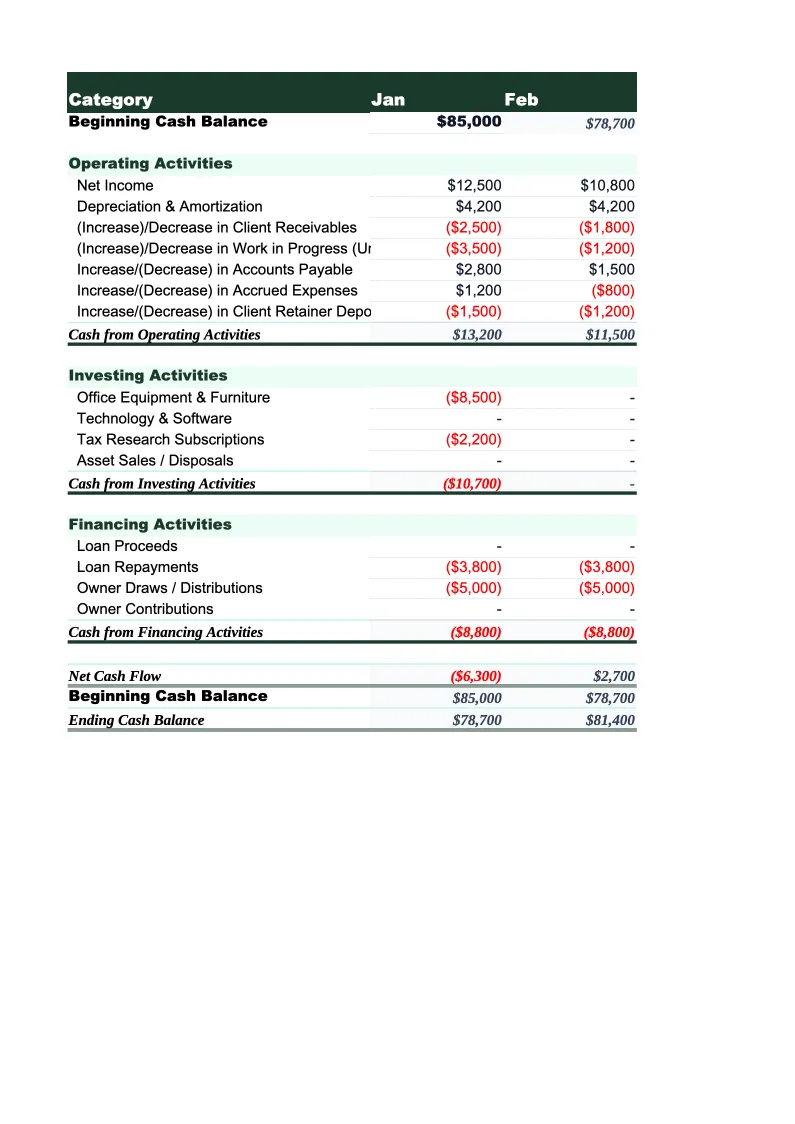
Accounting Firm Cash Flow Template
Track your accounting firm's cash flow from engagement billing through collection — with sheets for WIP, retainer revenue, AR aging, and a seasonal projection that accounts for the January–April tax season surge.
What's Inside This Accounting Firm Cash Flow Template
This template includes 5 worksheets, each designed for a specific part of your accounting firm financial workflow:
Monthly Cash Flow
The core statement tracking all cash in and out for the month, organized into operating, investing, and financing activities.
Accounts Receivable Aging
A receivables tracker that categorizes every outstanding invoice by how long it has been unpaid — current, 30 days, 60 days, 90 days, and 90+ days overdue.
WIP & Billing Pipeline
Work in progress tracking for tax engagements, audit projects, and other time-based work that has been completed but not yet billed.
Seasonal Cash Flow Projection
A 12-month forward-looking model built specifically around the accounting industry's extreme seasonality.
Dashboard
A single-screen summary of your firm's key cash flow metrics: cash on hand, monthly collections by service line, receivables aging distribution, WIP balance, collection rate, and days sales outstanding (DSO).
Accounting Firm Cash Flow Template Features
- Revenue tracking by service line: tax, audit, bookkeeping/CAS, advisory, payroll
- Accounts receivable aging with automatic 30/60/90/90+ day buckets
- WIP tracker separating project-based work from recurring retainer revenue
- Seasonal projection model pre-built for January–April and September–October crunch periods
- Collection rate and days sales outstanding (DSO) auto-calculated from actuals
- Subcontractor and offshore staffing costs tracked separately from W-2 staff
How to Use This Accounting Firm Cash Flow Spreadsheet
Getting started takes about 15 minutes. Download the .xlsx file and open it in Excel or Google Sheets. Start with the Accounts Receivable Aging sheet — enter your current outstanding invoices with client name, service type, invoice date, and amount. The sheet buckets each one into the correct aging column automatically. Then open the Monthly Cash Flow sheet and enter last month's actual collections and expenses as your starting baseline. This grounds the entire model in real numbers rather than guesses.
Once your baseline data is in, open the WIP & Billing Pipeline sheet and log current unbilled work by staff member and engagement. Separate your CAS clients onto the retainer section — their monthly fees are predictable and should be modeled differently from project-based tax and audit work. Then move to the Seasonal Cash Flow Projection sheet and review the pre-set seasonal multipliers. Adjust them to match your practice's revenue pattern: if your April is three times your August, set that ratio and the projection will scale accordingly for each month.
15 minutes from download to your first cash flow statement
Download the template, enter your current receivables and WIP, and see exactly where your firm's cash stands — and what the next 90 days look like.
Why Every Accounting Firm Needs a Cash Flow Template
Accounting firm cash flow is shaped by two forces that don't exist in most businesses: extreme seasonality and a billing cycle built around completed work. During tax season — roughly January through April 15 — a typical CPA firm generates 40–60% of its annual revenue in about 15 weeks. Staff works nights and weekends, client volume spikes, and cash flows in fast. Then May arrives, and billings drop by half. Firms that don't model this cycle explicitly often find themselves overstaffed in the summer, short on cash in August, and scrambling to make payroll decisions they should have seen coming in February.
The metrics that matter most in accounting firm cash flow are utilization rate, realization rate, and collection rate — and most firms track all three inconsistently. Utilization rate measures how much of your staff's total hours are actually billed to clients; healthy CPA firms target 60–70% for professional staff. Realization rate measures the percentage of billable time that converts to an invoice — write-offs before billing are invisible revenue losses that no collection process can recover. Collection rate is what you actually collect from what you invoice. If any of these three metrics is slipping, you'll see the effect in cash first, and this template helps you identify which one is the problem before you've lost the revenue.
Accounting Firm Industry at a Glance
Financial templates built for accounting firms and CPA practices — from solo practitioners to multi-partner firms. Pre-loaded with billable hour tracking, realization rate calculations, and service categories that reflect how accounting firms actually bill.
Revenue Drivers
- Tax preparation and planning
- Audit and assurance
- Bookkeeping and client accounting services (CAS)
- Advisory and fractional CFO services
- Payroll processing
Key Cost Categories
- Professional staff salaries and benefits
- Administrative staff
- Occupancy and rent
- Technology and software (tax, practice management)
- Malpractice (E&O) insurance
- Marketing and business development
- CPE and professional development
- Subcontractors and offshore staff
Typical Margins
Gross: 50-65% · Net: 20-35%
Seasonality
Heavy busy season January through April 15; secondary crunch in September through October 15 for extensions. Slowest months are July and August.
Key Performance Indicators
Accounting Firm Cash Flow Template FAQ
More Accounting Firm Templates
Accounting Firm Balance Sheet Template for Excel
$29
Accounting Firm Budget Template for Excel
$29
Accounting Firm Business Plan Template for Excel
$39
Accounting Firm Expense Tracker Template for Excel
$29
Accounting Firm Financial Model Template for Excel
$29
Accounting Firm Income Statement Template for Excel
$29
Accounting Firm Invoice Template for Excel
$29
Accounting Firm KPI Dashboard Template for Excel
$29
Accounting Firm P&L Template for Excel
$29
Accounting Firm Pro Forma Template for Excel
$29
Accounting Firm Project Budget Template for Excel
$29
Accounting Firm Sales Forecast Template for Excel
$29
Accounting Firm Valuation Template for Excel
$29
Accounting Firm Cash Flow Template
$29