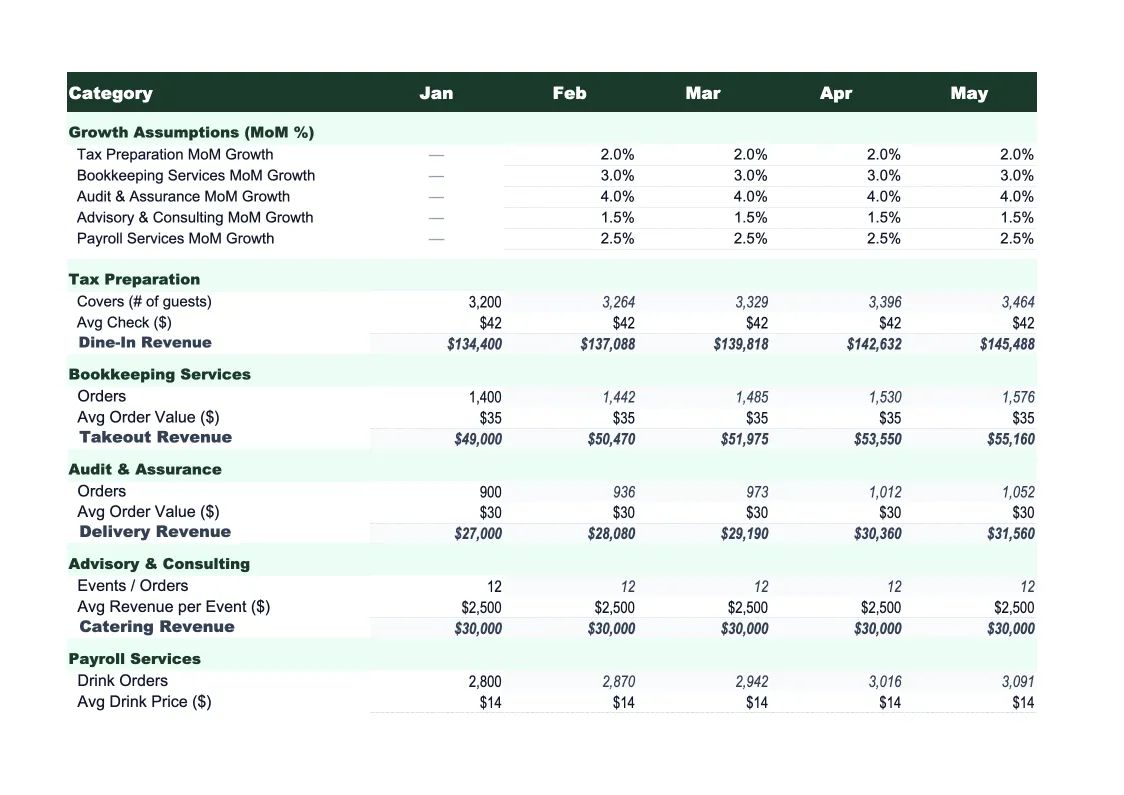
Accounting Firm Sales Forecast Template
Forecast accounting firm revenue by service line — tax, audit, bookkeeping, and advisory — with built-in busy season modeling, client pipeline tracking, and billable utilization analysis.
What's Inside This Accounting Firm Sales Forecast Template
This template includes 8 worksheets, each designed for a specific part of your accounting firm financial workflow:
Assumptions
The central input sheet that drives the entire model.
Client Revenue Tracker
A client-by-client breakdown of your existing revenue base.
Revenue Forecast
The monthly revenue build that breaks projections into four service lines: tax preparation and planning, audit and assurance, bookkeeping and client accounting services (CAS), and advisory or fractional CFO services.
Capacity & Utilization
Headcount and capacity analysis that validates whether your revenue forecast is achievable.
Pipeline Tracker
A deal-level view of all active prospects and proposals outside your current client base.
Actuals vs Forecast
Month-by-month comparison of your actual billings against the forecast, broken out by service line.
Scenario Planner
Three parallel revenue scenarios — base case, upside, and downside — with independent assumption sets for each.
Dashboard
Visual summary of the firm's revenue forecast with pre-built charts: monthly revenue by service line, busy season versus off-season revenue split, pipeline coverage ratio, and year-over-year growth if prior-year actuals are available.
Accounting Firm Sales Forecast Template Features
- Service line revenue model: tax, audit, bookkeeping/CAS, and advisory tracked separately
- Busy season volume factors built into the monthly forecast automatically
- Client retention-weighted revenue base with at-risk client flagging
- Capacity and utilization analysis with realization rate adjustment
- Pipeline tracker with weighted revenue by close probability
- Three-scenario planner: base, upside, and downside with independent assumptions
How to Use This Accounting Firm Sales Forecast Spreadsheet
Start with the Assumptions sheet. Download the file and open it in Excel or upload it to Google Sheets. Enter your staff headcount by level, standard billing rates, target utilization, and realization rate. If you're a solo practitioner, this takes ten minutes — enter your own rate, your weekly billable capacity, and split your time between service lines. If you run a multi-staff firm, enter each role level separately and set realistic utilization targets for each, keeping in mind that managers and partners carry more non-billable time than staff. Set your seasonal volume factors while you're here — typically 1.3 to 1.5x for January through April, 0.7x for July and August, and 1.2x for September through October.
Next, populate the Client Revenue Tracker with your entire existing client list. This is the most time-consuming step but also the most valuable — a realistic revenue floor is what separates a useful forecast from a wishful-thinking exercise. Tag each client by service line, enter their annual or monthly fee, and flag any renewal risk. Then move to the Pipeline Tracker and log every active prospect with an honest close probability. The combination of your existing client base and weighted new business pipeline gives you the inputs the Revenue Forecast sheet needs to project the next 12 months by service line.
15 minutes from download to your first accounting firm forecast
Download the template, enter your service line rates and client base, and get a complete 12-month revenue forecast with utilization analysis and scenario planning ready to use.
Why Accounting Firms Need a Purpose-Built Sales Forecast
Accounting firm revenue is structurally more complex than most professional services because it mixes three very different revenue patterns in a single practice. CAS and bookkeeping retainers behave like subscription revenue — predictable month over month, growing slowly as you add clients, and occasionally churning when a client outgrows you or cuts costs. Tax preparation revenue behaves like an annual spike — most of the year's billings compress into a ten-week window, and how much you earn depends on capacity as much as it does on client count. Advisory and fractional CFO work behaves like consulting — relationship-driven, variable in scope, and difficult to pipeline because it depends on what clients are going through rather than a calendar date.
Most accounting firm forecasts fail because they use a single revenue line and apply a flat growth assumption. That works for tracking the past but not for planning the future, because the actions that grow each revenue stream are completely different. Growing CAS revenue means systematically converting tax-only clients to recurring engagements and pricing those engagements at a monthly retainer rather than hourly. Growing tax revenue means adding clients before October and ensuring capacity to serve them in busy season. Growing advisory revenue means developing specific expertise and proactively identifying financial challenges your existing clients are facing before they ask. A forecast that separates these streams lets you see which part of the business is actually growing and what you need to do about the parts that aren't.
Accounting Firm Industry at a Glance
Financial templates built for accounting firms and CPA practices — from solo practitioners to multi-partner firms. Pre-loaded with billable hour tracking, realization rate calculations, and service categories that reflect how accounting firms actually bill.
Revenue Drivers
- Tax preparation and planning
- Audit and assurance
- Bookkeeping and client accounting services (CAS)
- Advisory and fractional CFO services
- Payroll processing
Key Cost Categories
- Professional staff salaries and benefits
- Administrative staff
- Occupancy and rent
- Technology and software (tax, practice management)
- Malpractice (E&O) insurance
- Marketing and business development
- CPE and professional development
- Subcontractors and offshore staff
Typical Margins
Gross: 50-65% · Net: 20-35%
Seasonality
Heavy busy season January through April 15; secondary crunch in September through October 15 for extensions. Slowest months are July and August.
Key Performance Indicators
Accounting Firm Sales Forecast Template FAQ
More Accounting Firm Templates
Accounting Firm Balance Sheet Template for Excel
$29
Accounting Firm Budget Template for Excel
$29
Accounting Firm Business Plan Template for Excel
$39
Accounting Firm Cash Flow Template for Excel
$29
Accounting Firm Expense Tracker Template for Excel
$29
Accounting Firm Financial Model Template for Excel
$29
Accounting Firm Income Statement Template for Excel
$29
Accounting Firm Invoice Template for Excel
$29
Accounting Firm KPI Dashboard Template for Excel
$29
Accounting Firm P&L Template for Excel
$29
Accounting Firm Pro Forma Template for Excel
$29
Accounting Firm Project Budget Template for Excel
$29
Accounting Firm Valuation Template for Excel
$29
More Sales Forecast Templates
Accounting Firm Sales Forecast Template
$29