Daycare Business Plan Template
Build a realistic daycare business plan with enrollment capacity model, staff-to-child ratios, and a 3-year financial projection accounting for seasonal enrollment and regulatory compliance costs.
What's Inside This Daycare Business Plan Template
This template includes 5 worksheets, each designed for a specific part of your daycare financial workflow:
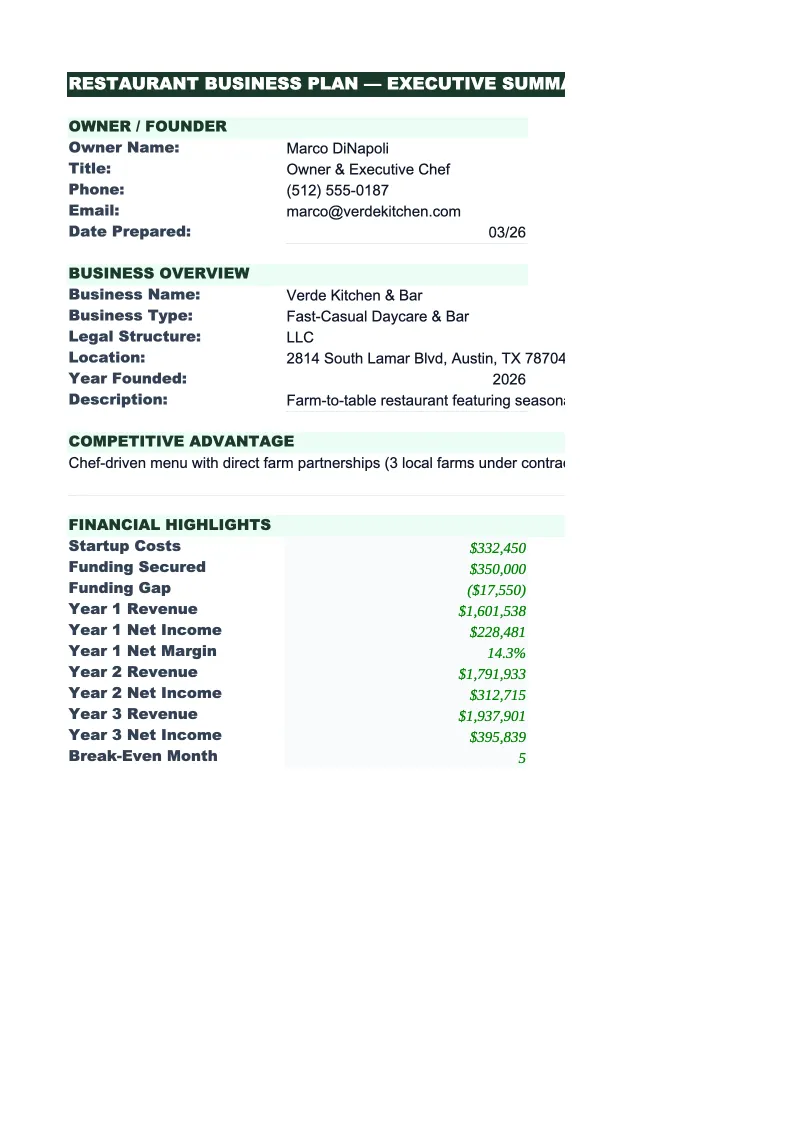
Executive Summary
A high-level overview of your daycare center, including mission and philosophy, age groups served (infants, toddlers, preschool, school-age), target families (working parents, dual-income households, professionals), and competitive positioning (quality of staff, curriculum, location, pricing).
Startup Costs & Funding
Details all capital required to establish a licensed daycare facility, typically $80,000–$250,000.
Revenue Forecast
A 12-month detailed revenue projection for year one, then annual summaries for years two and three.
Projected P&L
Annual profit and loss statement showing enrollment revenue, cost of goods sold (meals and snacks, typically 4–6% of revenue), staff labor costs (typically 50–65% of revenue—the largest expense in daycare), facility occupancy (rent, utilities, insurance, license maintenance, typically 12–18% of revenue), and operating expenses (supplies, diapers, toys, marketing, professional development, liability insurance).
Dashboard
A visual management tool showing: total startup investment and funding required, monthly and annual revenue by year, enrollment count and % of capacity, tuition revenue by age group, break-even enrollment level (how many children at what average tuition you need to cover fixed costs), labor cost % of revenue, occupancy cost % of revenue, net profit margin %, and 36-month cumulative cash flow.
Daycare Business Plan Template Features
- Enrollment capacity model with revenue by age group (infants, toddlers, preschool, school-age)
- Staff-to-child ratio compliance built into staffing cost calculations
- Tuition revenue model accounting for different rates by age group and part-time vs. full-time enrollment
- Startup costs tracker for facility buildout, equipment, licensing, and working capital
- Meal and supply costs tracked as % of revenue (food increases with enrollment)
- Break-even analysis showing required enrollment percentage and average tuition to cover costs
How to Use This Daycare Business Plan Spreadsheet
Start with the Executive Summary and define your daycare concept: which age groups will you serve (infants are higher tuition but require smaller class sizes and more staff; preschool is lower tuition but can accommodate larger groups), what's your licensed capacity, and what tuition rates are competitive in your market. Then gather facility and buildout costs: commercial real estate suitable for daycare (zoned appropriately, space for classrooms, bathrooms, kitchen, outdoor play), renovations to meet licensing requirements (kitchen equipment, bathrooms scaled for children, safety modifications), and playground equipment. Get quotes from contractors for buildout and from equipment suppliers; allocate budget for licensing and background check fees. Most daycare operators need $100,000–$200,000 for a 30–50 child facility.
Move to the Revenue Forecast sheet and model your enrollment ramp realistically. Most daycare centers start at 25–40% capacity in month one (limited by staff hiring, facility preparation, and brand awareness) and ramp to 60–80% capacity within 6–9 months. Year-one projections are often below break-even due to low enrollment; break-even typically occurs in month 8–12. Input your tuition rates by age group (infants command 20–30% premium to preschool pricing), and model the age mix realistically (not all children will be infants—that requires more staff and capital). The enrollment assumptions drive the staffing forecast: infant rooms need a 1:4 ratio, toddlers 1:6, preschool 1:10, school-age 1:15+. The template calculates required staff based on enrollment and ratios.
From facility concept to lender-ready projections in an afternoon
Enter your capacity, age mix, tuition rates, and staffing assumptions—the model builds your 3-year financial outlook, break-even enrollment %, and startup capital requirement automatically.
Why Daycare Centers Need a Detailed Business Plan
Daycare economics are driven by three variables: licensed capacity, enrollment %, and tuition rate. A 40-child daycare at 60% enrollment ($1,000 average tuition) generates $24,000/month; at 80% enrollment, $32,000/month. But profitability is constrained by mandatory staff-to-child ratios, which vary by age group and state. Infant rooms require 1 teacher per 4 children; toddler rooms 1:6; preschool 1:10. To operate profitably, you need to maintain a healthy mix of higher-tuition infants with lower-ratio classes and lower-tuition, higher-ratio preschoolers and school-age children. Many centers focus on preschool and school-age because the ratio is better, even though tuition is lower.
The biggest financial risk in daycare is the lag between startup costs and revenue generation. You must invest in facility buildout, equipment, licensing, and staff training before enrolling a single child. Most operators need 6–12 months of working capital because enrollment ramps slowly—you can't take in 40 children on day one, you can only take in the 4–6 children whose parents you've found, onboarded, and trained. Many daycare operators are under-capitalized and run out of cash during the ramp-up phase. Plan for at least three to four months of full operating expenses in working capital, even if your growth projections are optimistic.
Daycare Industry at a Glance
Financial templates built for daycare centers and childcare providers — pre-loaded with tuition billing categories, subsidy tracking, and the KPIs that determine whether a center is actually making money.
Revenue Drivers
- Weekly/monthly tuition by age group
- Government subsidies and voucher programs
- Before/after school care
- Drop-in and part-time care
- Enrichment classes and summer programs
Key Cost Categories
- Payroll and benefits (50-70% of revenue)
- Rent and occupancy
- Food and meals program
- Supplies and curriculum materials
- Insurance and licensing
- Utilities
- Marketing and enrollment
Typical Margins
Gross: 30-50% · Net: 10-16%
Seasonality
Peak enrollment in August-September (school year start) and January-February. Summer dip for school-age programs. Revenue is more stable than attendance because most centers bill flat tuition regardless of days attended.
Key Performance Indicators
Daycare Business Plan Template FAQ
More Daycare Templates
Daycare Balance Sheet Template for Excel
$29
Daycare Budget Template for Excel
$29
Daycare Cash Flow Template for Excel
$29
Daycare Expense Tracker Template for Excel
$29
Daycare Financial Model Template for Excel
$29
Daycare Income Statement Template for Excel
$29
Daycare Invoice Template for Excel
$29
Daycare KPI Dashboard Template for Excel
$29
Daycare P&L Template for Excel
$29
Daycare Pro Forma Template for Excel
$29
Daycare Project Budget Template for Excel
$29
Daycare Sales Forecast Template for Excel
$29
Daycare Business Valuation Template for Excel
$29
More Business Plan Templates
Daycare Business Plan Template
$39